Traditional Foods Featuring Regional Flavors
with Glutinous Rice Cakes in Broth
[Asia Economy Reporter Jeon Jinyoung] If you are a fan of the Shin-chan animation, you might have seen the rice cake soup that the Shin-chan family only eats. They were eating rice cake soup with rice cakes stretching like cheese.
Did you know that Japan also eats rice cake soup on New Year's Day, just like Korea? Just like in Korea, the shape of the rice cakes and the way the broth is made vary by region.
In Korea, people eat rice cake soup on New Year's Day, while in Japan, they eat "Ozoni" on New Year's Day. Since Japan does not celebrate the Lunar New Year like Korea, they usually eat it on the first day of the new year. Ozoni is made with clear broth, meat, vegetables, and glutinous rice cakes.
Those who have tried the Japanese glutinous rice cake "Kirimochi" know that it has a stretchy texture like tteokbokki rather than the chewy texture of Korean rice cakes. This is why the rice cake soup Shin-chan was eating stretched like cheese.
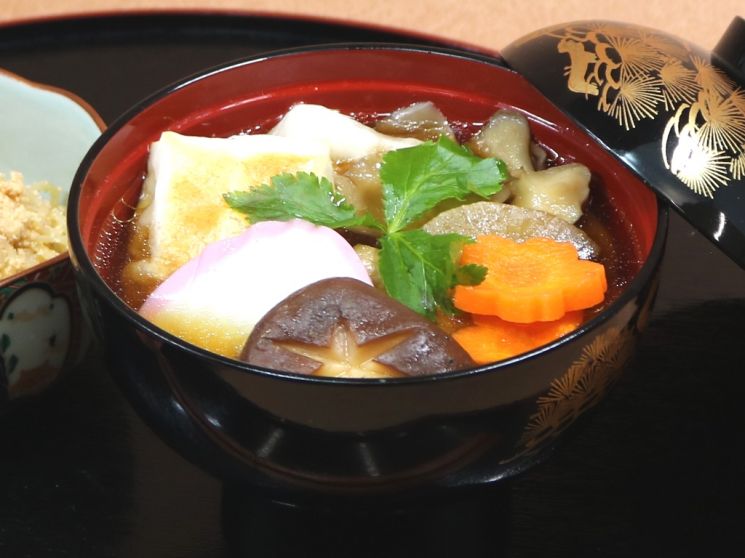
Japan's Rice Cake Soup 'Ozoni'
So, when did people start eating Ozoni? Its origin dates back to the Heian period in Japan. Like Korea, Japan was an agricultural society, so rice cakes were special foods eaten on special occasions since ancient times.
In Japan, it is said that on New Year's Day, the Toshigami (Year God) descends from the mountains and visits every home. To honor the deity, people offered rice cakes, taro, carrots, radishes, and other vegetables along with spring water drawn from wells or rivers, then cooked them over the first fire of the new year. This is said to be the origin of Ozoni.
Of course, since rice was a precious food only available to samurai, commoners used taro instead of rice cakes.
Just as the shape and ingredients of rice cakes vary by region in Korea, the same applies to Japan. In the Kanto region, square-shaped glutinous rice cakes are used, while in the Kansai region, round rice cakes are used.
The reason for the different shapes in the Kanto region is that during the Edo period, the population was concentrated there. Cutting rice cakes into squares was faster and allowed for mass production compared to shaping them round by hand, so the square rice cake method became established.
Besides this, there are various regional types of Ozoni, such as rice cakes filled with red bean paste or grilled rice cakes added to the broth.
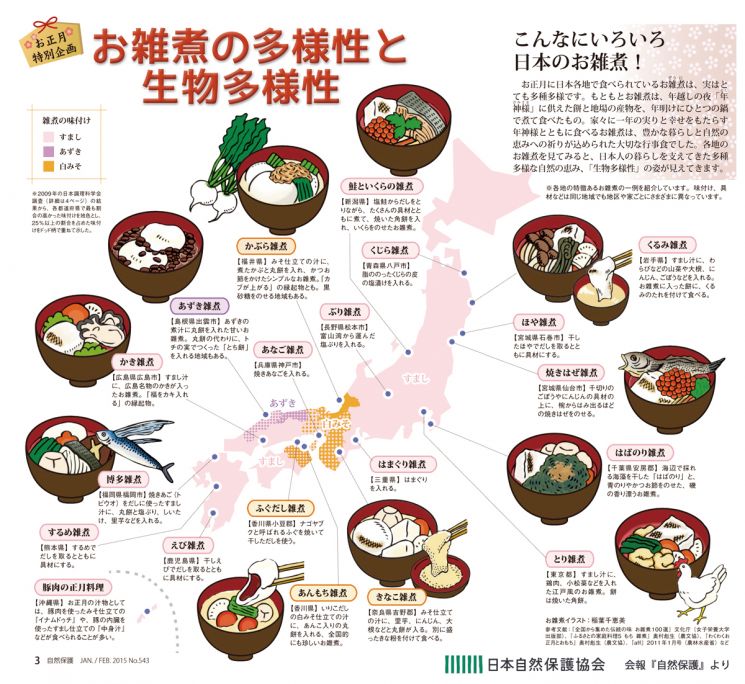
The broth also differs. Usually, a clear broth made by boiling dried bonito flakes (katsuobushi) or chicken is used, but each region has its own characteristics. In the Kansai region, a cloudy broth with miso is used, and in Tottori and Shimane prefectures, a sweet broth made with red beans is common.
Also, in Aomori and Hyogo prefectures, where whaling bases existed, whale meat is added to make whale rice cake soup; in Niigata prefecture, salmon rice cake soup is traditional; and in Hiroshima, famous for oysters, oyster rice cake soup is traditionally eaten.
When I actually talked with Japanese friends about Ozoni, they recalled different memories such as "I woke up to the sweet smell of red bean Ozoni on New Year's," and "It's hard to imagine Ozoni without clear broth."
I thought it was interesting because it seemed similar to the debate over whether kongguksu (cold soybean noodle soup) should have sugar or salt. Although Korea and Japan seem very different, they also share many similarities like this.
Everyone, enjoy your rice cake soup and have a happy Lunar New Year.
© The Asia Business Daily(www.asiae.co.kr). All rights reserved.