Seasonal Daehan... Morning -6~3°C, Afternoon -4~7°C with Little Difference
Snow in Central Region on Seol... Heavy Snow on West Coast on Last Day
[Asia Economy Reporter Han Ye-ju] From the evening commute on the 19th, snow or rain will fall in the Seoul metropolitan area and the inland and mountainous areas of Gangwon Province.
Starting around 3 PM that day, snow began to fall in the northern part of Gyeonggi Province and the inland northern part of Gangwon Province. Snow and rain will expand to cover the entire Seoul metropolitan area and the inland and mountainous areas of Gangwon Province by evening. Overnight, snow or rain will fall in the central region excluding the east coast of Gangwon, the inland areas of Jeonbuk, the northern inland areas of Gyeongbuk, and the northeastern mountainous areas of Gyeongbuk.
Additionally, in the early morning of the 20th, snow will lightly fall in the eastern inland areas of Jeonnam, the southwestern inland areas of Gyeongbuk, and the northwestern inland areas of Gyeongnam. Between morning and afternoon, light snow will fall on the southern West Coast of Chungnam, the West Coast of Jeonbuk, the southern inland areas of Jeonbuk, and the western part of Jeonnam. Snow is also expected to fall on the mountainous areas of Jeju from early morning to noon on the 20th.
Since this is a weak low-pressure trough, the snowfall amount will not be heavy. The expected snowfall amounts are 1 to 5 cm in the northeastern part of Gyeonggi, inland Gangwon, and Gangwon mountainous areas; 1 to 3 cm in the southeastern part of Gyeonggi, northern Chungbuk, Ulleungdo, and Dokdo; around 1 cm in the southwestern part of Gyeonggi, northern Chungnam, and Jeju mountainous areas; and less than 1 cm in Seoul, Incheon, northwestern Gyeonggi, southern Chungcheong, northern inland Gyeongbuk, northeastern mountainous Gyeongbuk, and inland Jeonbuk.
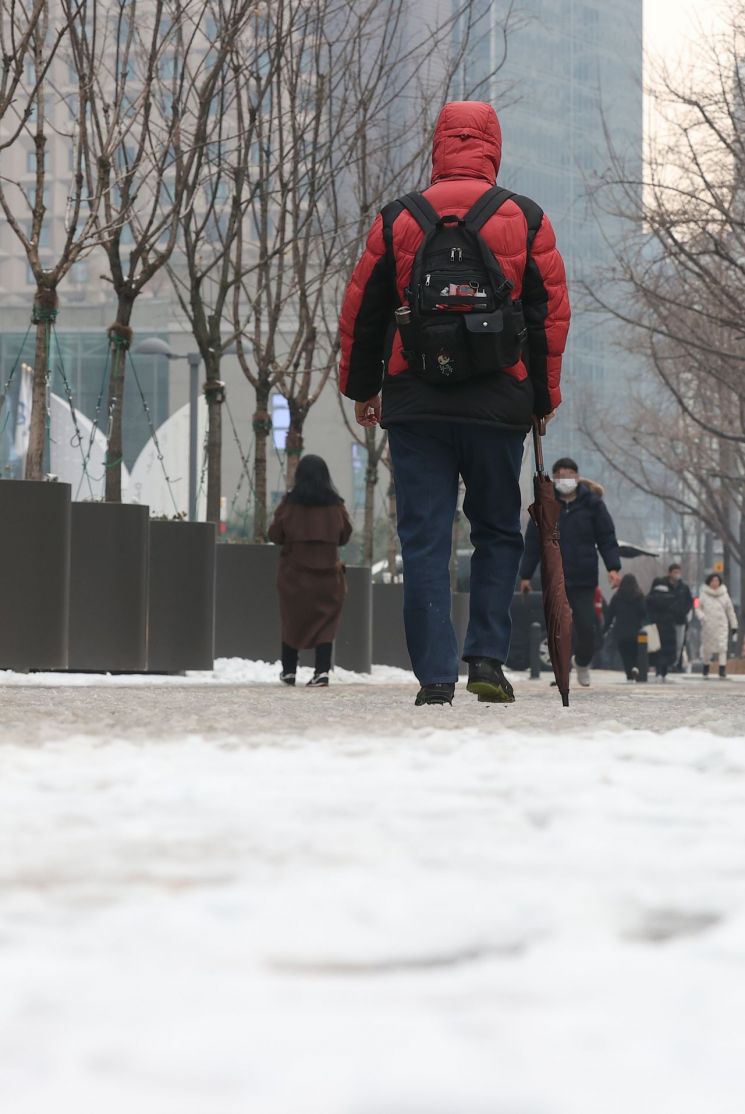
On the 20th, which is Daehan (Great Cold) according to the solar terms, cold air will flow in from the northwest starting from noon, causing temperatures to drop sharply. The morning low temperatures on the 20th will range between -6°C and 3°C, which is higher than on the 19th (between -12°C and 1°C) and the average (between -11°C and 0°C). However, the daytime high temperatures will range from -4°C to 7°C, which is lower than on the 19th (between 0°C and 9°C) and the average (between 1°C and 8°C).
The expected minimum and maximum temperatures in major cities are as follows: Seoul -3°C and -1°C, Incheon -3°C and -3°C, Daejeon -1°C and 1°C, Gwangju 0°C and 3°C, Daegu -1°C and 4°C, Ulsan 1°C and 5°C, and Busan 3°C and 7°C.
Strong winds with gusts exceeding 90 km/h (25 m/s) are expected in the mountainous areas of Gangwon and Jeju from the night of the 19th through the 20th. On the 20th, most regions will experience strong winds with gusts around 55 km/h.
During the Lunar New Year holiday, snow will fall in the central region, and heavy snow is expected on the West Coast on the last day of the holiday. On the 21st, morning temperatures in the central inland areas will drop below -10°C, with the mountainous areas of Gangwon falling below -15°C in the morning.
On Lunar New Year's Day, the 22nd, a low-pressure trough will pass over the northern part of Korea and the southern sea near Jeju, bringing snow to the central region and rain to Jeju. The southern region between these two areas will see snow in the northern part closer to the central region and rain in the southern part closer to Jeju. Both low-pressure troughs are weak, so precipitation amounts are expected to be low.
Temperatures will remain near the average for this time of year until Lunar New Year's Day, but starting from the 23rd, when the homecoming rush intensifies, the "strongest cold wave of this winter" is expected to begin. From the 23rd to the 24th, a continental high-pressure system will expand over the northwest of Korea, bringing cold winds and causing temperatures to plummet. The morning low temperature on the 24th will be more than 10°C lower than on the 23rd. On the 24th, the morning low in Seoul is expected to drop to -17°C, and most regions nationwide will experience the strongest cold of this winter so far.
Meanwhile, yellow dust is currently entering Korea. Accordingly, on the 20th, fine dust (PM10) levels will be "bad" in the morning in the Seoul metropolitan area, Chungcheong, and Honam regions, and in the afternoon in Yeongnam and Jeju.
© The Asia Business Daily(www.asiae.co.kr). All rights reserved.
![Clutching a Stolen Dior Bag, Saying "I Hate Being Poor but Real"... The Grotesque Con of a "Human Knockoff" [Slate]](https://cwcontent.asiae.co.kr/asiaresize/183/2026021902243444107_1771435474.jpg)















