9-Year and 8-Year Government Bond Yields
Surpass 10-Year Yield
Concerns Over Side Effects of Artificial Interest Rate Adjustments
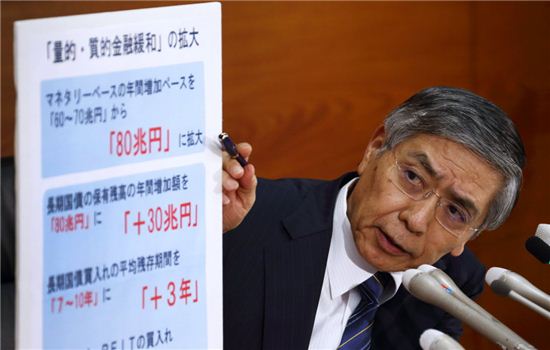 Haruhiko Kuroda, Governor of the Bank of Japan
[Asia Economy Reporter Lee Ji-eun] As the Bank of Japan (BOJ) attempts to control inflation by maintaining its yield curve control (YCC) policy rather than adjusting the benchmark interest rate, confusion is intensifying in the Japanese bond market. With the 9-year government bond yield surpassing the 10-year yield, concerns are emerging that distortions will deepen in the corporate bond market, which uses government bond yields as a benchmark. These concerns are leading to criticism that Japan's monetary policy has reached its limits.
On the 18th, the 10-year government bond yield in the Japanese bond market temporarily bypassed the BOJ's allowable fluctuation range of 0.5%, reaching 0.502% during intraday trading. However, as the market approached closing, the yield fell and closed in the 0.4% range. Meanwhile, yields on 8- and 9-year bonds, which are not directly managed by the BOJ, surged. The 9-year yield soared to 0.572% at one point during the previous day’s trading, and the 8-year yield exceeded the 0.6% mark, reaching 0.609%.
This created a market distortion where short-term yields exceeded the 10-year yield. As of 10:30 a.m. on the 19th, the 10-year yield stood at 0.425%, while the 9-year and 8-year yields were at 0.484% and 0.525%, respectively. This was largely a consequence of the BOJ’s decision the previous day to maintain its unlimited government bond purchases under the yield curve control (YCC) policy. Foreign investors rushed to redeem their holdings.
This distortion in the Japanese bond market has deepened since the BOJ raised the allowable fluctuation range for long-term yields last month. Instead of making a sudden decision such as raising the benchmark interest rate, the BOJ slightly increased the upper limit on long-term yields. However, hedge funds and other foreign investors interpreted this move as a signal of monetary tightening and have been selling government bonds in large volumes. They have sold not only 10-year bonds but also 2-year and 5-year bonds, causing yield distortions. The spread between 10-year and 2-year yields, which was 0.15 percentage points as of the 1st of last month, widened to 0.195 percentage points as of the 18th of this month.
Morgan Stanley MUFG Securities analyst Koichi Sugasaki expressed concern, stating, "The revision of monetary policy last month has led foreign investors to become confident that there will be changes in the BOJ’s policy."
Despite these developments, the BOJ indicated the day before that it intends to strengthen policies that artificially adjust interest rates. It announced plans to make the lending rate for the “Common Collateral Fund Supply Operation,” which lends funds to financial institutions, more flexible. Nihon Keizai explained that this policy is implemented to encourage banks to invest in government bonds by providing long-term funds to financial institutions at low interest rates, thereby promoting a decline in yields.
However, the market expects significant side effects to emerge in Japan’s bond market due to the BOJ’s artificial interest rate adjustment policy. Signs of this are already appearing in the corporate bond market. Repeated government bond purchases by the BOJ have caused the 10-year yield to lose its role as an indicator reflecting market expectations, leading to distortions in the general corporate bond market that uses government bond yields as a benchmark. Since companies issue corporate bonds based on the 10-year government bond yield as a reference rate, investors perceive bond yields as excessively low and are reluctant to purchase corporate bonds. In fact, as of last year, Japan’s corporate bond issuance fell below 12 trillion yen (approximately 115.74 trillion won), a 20% decrease compared to the previous year.
The artificial interest rate adjustment policy is also causing a decline in liquidity in the government bond market. Securities firms, which used to supply liquidity to the market, have reduced their trading activities, while the BOJ has been hoarding specific government bonds, resulting in an 80% decrease in average daily trading volume compared to 2015.
Nihon Keizai stated, "As the expectations of bond-issuing companies and investors do not align, many companies are canceling some corporate bond issuances," adding, "An accommodative monetary policy should be implemented to facilitate smooth funding for the private sector, but currently, it is rather hindering funding."
© The Asia Business Daily(www.asiae.co.kr). All rights reserved.
![Clutching a Stolen Dior Bag, Saying "I Hate Being Poor but Real"... The Grotesque Con of a "Human Knockoff" [Slate]](https://cwcontent.asiae.co.kr/asiaresize/183/2026021902243444107_1771435474.jpg)














