Interview with Kim Bugi, CEO of Standard Energy
"Negotiations for Large-Scale Supply Amid High Demand"
[Asia Economy Reporter Kim Cheolhyun] In January last year, Lotte Chemical invested 65 billion KRW in battery manufacturer Standard Energy, securing a 15% stake. What caught Lotte's attention before the investment was Standard Energy's world-first development of the 'Vanadium Ion Battery.' They saw this battery as the core of the next-generation Energy Storage System (ESS). Now, a year later, the results of this investment seem to be materializing. Standard Energy stated that this year will be the inaugural year for the commercial sale of vanadium ion batteries. We visited Standard Energy's headquarters in Daedeok Technovalley, Daejeon, to hear from CEO Kim Bugi.
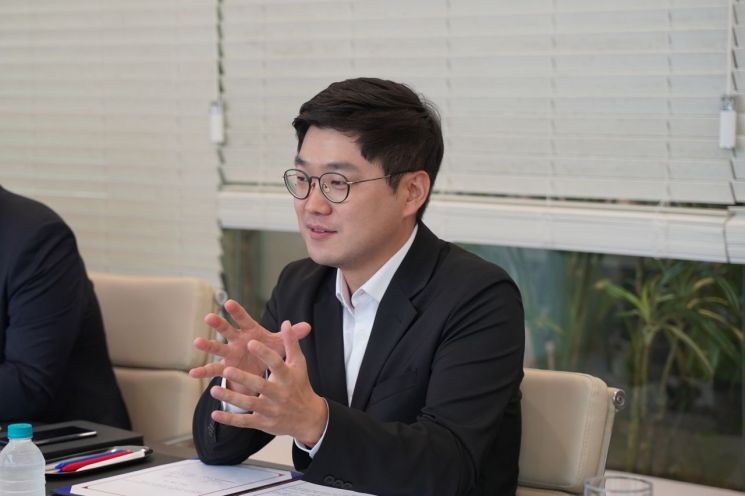
CEO Kim said, "We have established a system for mass production of vanadium ion batteries and are preparing for large-scale manufacturing," adding, "There is significant latent demand, including from large corporations, and we are concretely negotiating to supply batteries on a large scale." Standard Energy has three factories in Daedeok Technovalley, Daejeon, dedicated to producing vanadium ion batteries. It took 10 years to reach this point since the company was founded in August 2013 by researchers from KAIST and MIT in the United States. Battery technology requires a long physical maturation period.
During this time, Standard Energy did not give up on certain goals. CEO Kim said, "When we first made the vanadium ion battery, our goals were safety, efficiency, lifespan, and eco-friendliness," adding, "Although there were many difficulties, we have not compromised on any of these and have come this far." He believed that batteries must be safe, highly efficient, and that nearly all materials should be recyclable.
This is quite different from the current mainstream lithium-ion batteries in the market. Lithium-ion batteries have safety issues due to frequent fire incidents. They have a short lifespan and cause environmental pollution when discarded. Vanadium ion batteries use water-based electrolytes, fundamentally eliminating fire risks. They have a long lifespan and allow material recycling. CEO Kim explained, "We focused on creating environmentally friendly technology throughout the entire battery lifecycle?from production and use to disposal?not just on recyclability," adding, "We also invested heavily in achieving economic feasibility."
However, Standard Energy's goal is not to 'replace lithium-ion batteries.' CEO Kim predicted that vanadium ion batteries and lithium-ion batteries will have a complementary relationship in the market going forward. Electric vehicles require small and lightweight batteries, so lithium-ion batteries are mainly used. The ESS targeted by Standard Energy requires large capacity and safe storage.
Only safety certifications and procedures remain for vanadium ion batteries to enter the regulatory framework. Batteries for ESS use must obtain group standard certification from the Korea Battery Industry Association or KC certification from the National Institute of Technology and Standards and be installed according to the Korean Electrical Equipment Regulations. CEO Kim said, "If results come out within the year, we will be able to sign contracts for commercial sales." The technology has already been verified, with ESS incorporating this battery operating in Apgujeong-dong, Seoul. CEO Kim said, "We provide ultra-fast electric vehicle charging services so that anyone can experience Standard Energy's battery technology," adding, "We supply power that enables charging within 30 minutes in the heart of the city." Standard Energy is also considering business models linked to electric vehicle charging stations in the future.
Standard Energy started with battery materials but now looks toward power services. Electricity stored in ESS can be used efficiently when needed. CEO Kim emphasized, "In the future electric-based society, we want to contribute to national power grid operations," adding, "By storing electricity in large volumes and distributing it, we can realize energy equality that was previously impossible." If electricity stored in ESS can be used anytime where needed, an era will come when electricity is regarded like air, and people will no longer shiver from cold or collapse from heat due to electricity shortages.
© The Asia Business Daily(www.asiae.co.kr). All rights reserved.