Government Unveils 'Cargo Transport Market Normalization Plan'
Promotes Introduction of Standard Freight Rate System as a 'Guideline'
Reorganizes Freight Commission with One More Shipper Member
[Asia Economy Reporter Kim Min-young] The government plans to promote a non-mandatory standard freight rate system instead of the safety freight rate system, which was abolished at the end of last year due to sunset provisions.
The Korea Transport Institute held a public hearing on the "Measures to Normalize the Freight Transport Market" on the 18th at Post Tower in Jung-gu and presented a plan to reform the safety freight rate system containing these details.
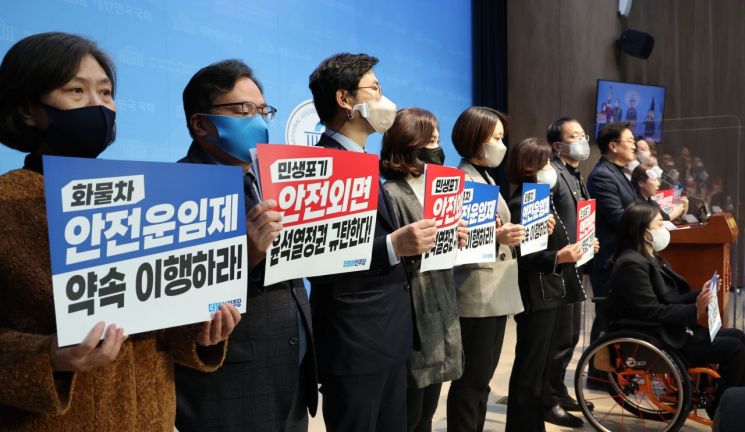
Earlier, after the Cargo Solidarity withdrew its general strike, the Ministry of Land, Infrastructure and Transport formed a "Logistics Industry Development Council" involving shippers, carriers, and truck owners from the 20th of last month to discuss the reform of the safety freight rate system.
The government decided to first abolish the name of the safety freight rate system and reorganize it into a standard freight rate system to promote it, citing the minimal traffic safety effect, which was the original purpose of introducing the safety freight rate system.
The safety freight rate system, which was sunset at the end of last year, guaranteed a minimum transportation fee to truck owners to prevent overwork and speeding, and imposed a fine of 5 million KRW on shippers (companies commissioning freight transport) who paid less than that. It was introduced as a three-year sunset system targeting cement and container cargo in 2020 as a national agenda under the Moon Jae-in administration.
The standard freight rate system, like the safety freight rate system, enforces freight rates between carriers and truck owners, but does not enforce freight rates between shippers and carriers, instead announcing them annually as guidelines. Accordingly, shippers can autonomously set freight rates and conclude transportation contracts without adhering to government-set rates.
The clause that imposed a 5 million KRW fine unconditionally on shippers violating freight regulations will be abolished. However, if shippers and truck owners contract directly, corrective orders will be issued, and failure to comply will result in penalties. The same applies to carriers.
Also, truck owners whose income exceeds a certain level under the standard freight rate system will be excluded from its application. The standard freight rate system will be applied to cement and container items, similar to the safety freight rate system. It will initially operate as a three-year sunset system until December 2025, after which the continuation of the system will be decided.
The composition of the Freight Rate Committee will also be changed. Previously, it consisted of 4 public interest members, 3 shipper representatives, 3 carrier representatives, and 3 truck owners, but there were complaints that the interests of carriers and truck owners were evenly matched, causing imbalance. Accordingly, the committee will be composed of 6 public interest members, 3 shippers, 3 carriers, and 2 truck owners going forward.
Additionally, to ensure objective cost calculation, data from the National Tax Service, vehicle management system, and fuel subsidy system will be actively utilized. To improve the income of truck owners vulnerable to fuel price fluctuations, a standard contract including freight rates and a fuel price linkage system will also be introduced.
To normalize the freight transport market, measures will be promoted to eliminate consignment specialist companies that only receive consignment fees without providing specific work from the market. This is to prevent the adverse effects of the consignment system.
The Ministry of Land, Infrastructure and Transport plans to thoroughly review the results of the council discussions and opinions presented at the public hearing to finalize measures to normalize the freight transport market.
© The Asia Business Daily(www.asiae.co.kr). All rights reserved.
![Clutching a Stolen Dior Bag, Saying "I Hate Being Poor but Real"... The Grotesque Con of a "Human Knockoff" [Slate]](https://cwcontent.asiae.co.kr/asiaresize/183/2026021902243444107_1771435474.jpg)















