FKCCI, Report on 'Global Trends in the Agricultural Machinery Industry and Korea's Challenges'
[Asia Economy Reporter Sunmi Park] In the global agricultural machinery industry market worth 200 trillion won, Korea's share is found to be less than 1%. There are calls to consider applying tax credits to companies investing in research and development (R&D) or facilities related to advanced agricultural machinery.
On the 19th, the Federation of Korean Industries (FKI) stated in its report titled "Global Trends in the Agricultural Machinery Industry and Korea's Challenges" that active policy support for the agricultural machinery industry evolving into advanced industries such as autonomous driving and robotics is necessary to create a breakthrough for Korean agriculture.
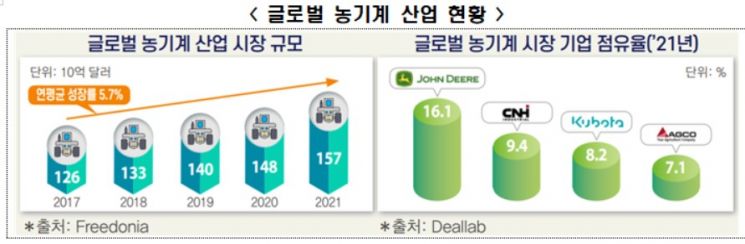
The global agricultural machinery industry market size is approximately $157 billion (about 200 trillion won). It is a promising industry group that grows steadily by more than 5% annually. Major companies include John Deere (USA), CNH (UK), Kubota (Japan), and AGCO (USA). These top four companies account for about 40% of the global market.
As the paradigm of agriculture shifts to "smart agriculture" utilizing advanced technologies, cutting-edge technologies such as artificial intelligence (AI) and big data are being applied even to traditional agricultural machinery like tractors and combines. John Deere, the world's number one agricultural machinery company that received much attention with its keynote speech at CES 2023, is already mass-producing level 2 manned autonomous tractors. It has also completed research and development for level 4 fully autonomous tractors that require no human intervention.
On the other hand, Korea's domestic agricultural machinery market size was only about 2.3 trillion won as of last year. The average annual growth rate over the past five years was just 1.7%. Major companies such as Daedong, LS Mtron, and TYM are not comparable to global companies in terms of sales scale. The Korea Institute of Planning and Evaluation for Technology in Food, Agriculture, Forestry and Fisheries evaluated that the technological level of Korean companies in the agricultural machinery sector lags about three years behind advanced countries.
In the report, FKI advised that it is necessary to strengthen industry-academia-research clusters encompassing agricultural machinery-related research institutions (Rural Development Administration, Korea Institute of Machinery and Materials, Korea Institute of Industrial Technology, etc.). It also emphasized the need for the prompt passage of the "Smart Agriculture Promotion Act," currently submitted to the National Assembly, to provide strong legal and institutional support. They also judged that applying tax credits to companies investing in R&D or facilities related to advanced agricultural machinery should be considered.
Furthermore, to overcome the limitations of the stagnant domestic market, policy efforts to comprehensively support the overseas expansion of Korean agricultural machinery companies are urgently needed.
Yoo Hwan-ik, head of the Industry Division at FKI, said, "If the agricultural machinery industry is strategically fostered amid the overall economic slowdown in Korean industries, including export slumps, it can achieve two goals: overcoming the food and agricultural crisis and securing new growth engines." He added, "It is also worth considering designing projects with the participation of domestic agricultural machinery companies in mind when promoting rural development ODA (Official Development Assistance) targeting developing countries."
© The Asia Business Daily(www.asiae.co.kr). All rights reserved.
![Clutching a Stolen Dior Bag, Saying "I Hate Being Poor but Real"... The Grotesque Con of a "Human Knockoff" [Slate]](https://cwcontent.asiae.co.kr/asiaresize/183/2026021902243444107_1771435474.jpg)















