The government is confident in a rapid economic recovery
but requires stable quarantine conditions such as a decrease in confirmed cases
and effective policies to improve domestic demand are also needed
[Asia Economy Beijing=Special Correspondent Kim Hyun-jung] China, which showed sluggish economic growth last year due to the impact of the COVID-19 pandemic, is confident of a rebound by asserting a "bottoming out" theory. However, experts evaluate that recovery to a normal trajectory requires the stabilization of COVID-19 infection numbers and realistic policy measures to restore domestic demand. In the mid to long term, there are increasing calls for measures to address structural changes such as population decline.
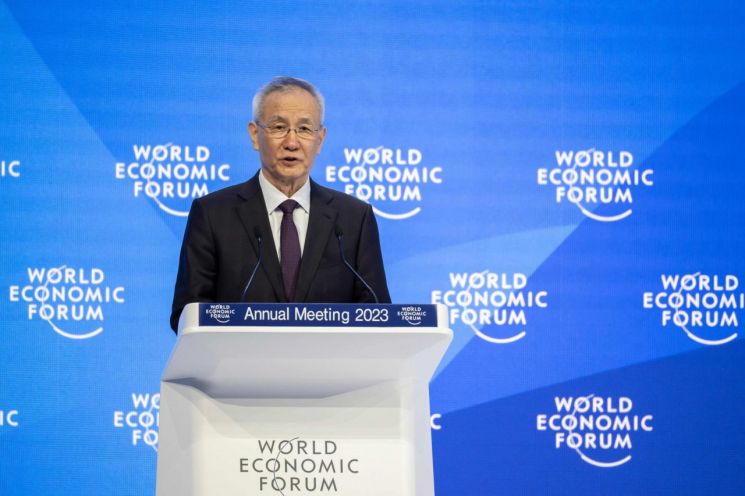
Chinese Vice Premier Liu He said in a special speech at the World Economic Forum Annual Meeting (WEF, Davos Forum) held in Davos, Switzerland on the 17th (local time), "I am confident that our economy will return to a normal growth trend this year," adding, "Imports, corporate investment, and consumption will increase noticeably." He also emphasized, "We will support the private sector, promote fair competition, and deepen broad reforms," and "We will promote comprehensive opening-up and improve the level and quality of openness."
Earlier, the National Bureau of Statistics of China announced that last year, China's Gross Domestic Product (GDP) was 121.0207 trillion yuan (approximately 2,223.51332 trillion won), marking a 3.0% increase compared to the previous year. Except for 2020 (2.2%), the first year of the COVID-19 outbreak, this is the lowest figure since 1976 (-1.6%), the last year of the Cultural Revolution. The government has publicly announced growth targets since 1994, and last year was the first time the actual growth rate fell more than 2 percentage points below the target. There were also shortfalls in 1998 and 2014, but those gaps were only about 0.2 to 0.1 percentage points, so they were considered de facto target achievements within China.
The foremost prerequisite to overcoming economic sluggishness is a reduction in confirmed COVID-19 cases. Although China has already abolished all COVID-19 prevention measures such as polymerase chain reaction (PCR) testing and quarantine, it is suffering from social chaos and medical system overload due to a surge in confirmed cases. Sultan Ahmed bin Sulayem, chairman of Nakheel, a Dubai state-owned real estate developer, told Bloomberg, "China's exit from zero-COVID is key to promoting international trade and enabling economic recovery."
Domestically, voices are emerging that to achieve China's "economic rebound," responses to the real estate slump and weak domestic demand are necessary. Vice Premier Liu He mentioned the government's need to intervene in the contraction of China's real estate market at the Davos Forum. He explained, "Risks in the real estate sector, if mishandled, can cause systemic risks, so timely intervention is essential," and reported that market supply and demand are improving through contract and property rights protection, liquidity improvement for real estate companies, and easing of control measures. Wang Tao, chief economist for China at UBS Securities, forecasted, "With economic reopening and real estate stabilization after COVID-19, China's GDP growth rate will recover to the 5% range this year compared to the previous year."
If COVID-19 was a three-year adverse factor, population decline and aging are identified as burdens on China's mid- to long-term growth. On the same day, the National Bureau of Statistics announced that as of the end of last year, China's population was 1.41175 billion, a decrease of 850,000 from the previous year. Deaths numbered 10.41 million, surpassing the 9.56 million births, resulting in a natural population growth rate of minus (-0.6%). The number of births fell to the lowest level in 72 years since 1950, while deaths exceeded the average (10 million). This is the first time in 61 years since 1961 that China's population has declined.
There are also indications that proactive investment in technological innovation must precede responses to population decline. In fact, China is laying the groundwork for rapid growth in related fields. According to the National Intellectual Property Administration (NIPA), the total number of patent invention applications filed in China last year reached 4.21 million, of which 3.28 million were from mainland China. Notably, high value-added patents related to strategic industries numbered 952,000, an 18.7% increase from the previous year. Zhang Ziwei, chief economist at Pinpoint Asset Management, pointed out, "China can no longer rely on the 'demographic dividend effect' (the effect of economic growth being promoted by a high proportion of the working-age population) as a structural driver of economic growth," adding, "Demographics will be a headwind going forward." He further added, "Economic growth must rely more on productivity improvement."
© The Asia Business Daily(www.asiae.co.kr). All rights reserved.
![Clutching a Stolen Dior Bag, Saying "I Hate Being Poor but Real"... The Grotesque Con of a "Human Knockoff" [Slate]](https://cwcontent.asiae.co.kr/asiaresize/183/2026021902243444107_1771435474.jpg)
















