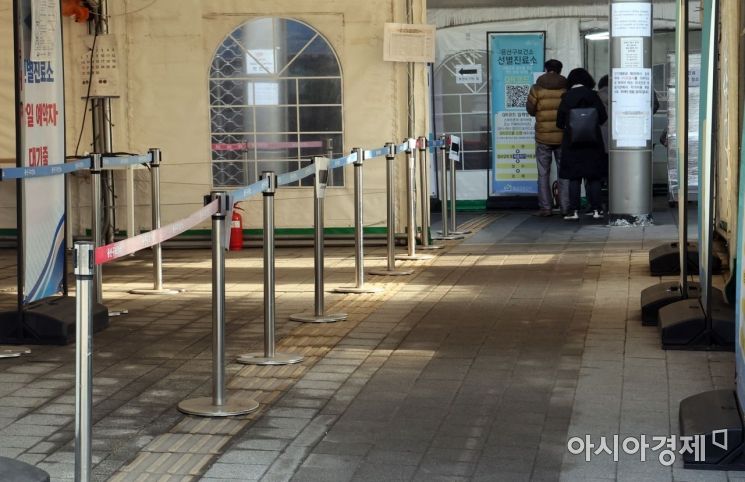
 On the 9th, the screening clinic at Yongsan-gu Public Health Center in Seoul appeared quiet due to a decrease in visitors for testing. Photo by Heo Younghan younghan@
[Asia Economy Reporter Byeon Seon-jin] The winter wave of COVID-19 has passed its peak and is continuously declining.
According to the Central Disease Control Headquarters (CDCH) on the 18th, the weekly new confirmed cases for the second week of January (8?14) were 300,563, a 27.5% decrease compared to the previous week. The effective reproduction number (Rt) was 0.85, remaining below '1' for two consecutive weeks. When this index is below 1, it indicates 'epidemic suppression.'
The average daily number of severe or critical patients hospitalized was 524, a 12.2% decrease from the previous week (597). The average daily deaths were 51, also down 10.5% from the previous week (57). Although confirmed cases have decreased for three consecutive weeks, health authorities emphasized the need for continued monitoring of trends in severe cases and deaths, and assessed the weekly COVID-19 risk level for the second week of January as ‘moderate’ nationwide, including the metropolitan area and non-metropolitan areas.
Regarding the weekly variant detection rates, BN.1 surged from 32.4% the previous week to 39.2%, overtaking BA.5 (28.3%) as the dominant strain. BA.2.75 accounted for 8.6%, BF.7 for 6.2%, and BQ.1 and BQ.1.1 for 7.4% and 4.7%, respectively. The XBB.1.5 variant, prevalent in the United States, was detected 14 additional times, bringing the cumulative total to 31 cases.
COVID-19 positivity among arrivals from China is on a declining trend. From January 8 to 14, the positivity rate among those entering Korea from China was 5.8% (484 confirmed cases out of 8,370 arrivals). Short-term foreign visitors tested at airports showed a positivity rate of 10.3%, while long-term foreign residents and Korean nationals tested at local health centers had rates of 5.8% and 3.8%, respectively. This overall positivity rate is significantly lower compared to 18.1% recorded in the previous week (January 2?7).
Im Suk-young, head of the CDCH Situation Management Division, noted, "There is insufficient data to accurately assess whether the epidemic is declining in China, making precise judgment difficult." She also pointed out concerns about a secondary spread from large cities to medium-sized cities and rural areas due to the expected large-scale population movement during the Lunar New Year holiday.
Health authorities believe the winter wave is subsiding but expressed concerns about potential spread due to increased travel during the Lunar New Year holiday. Im emphasized, "Please pay attention to hygiene management such as regular ventilation, hand washing, and disinfection. Especially, those aged 60 and over in high-risk groups are strongly urged to receive their winter vaccination either before traveling to their hometowns or before welcoming returning visitors."
© The Asia Business Daily(www.asiae.co.kr). All rights reserved.
![Clutching a Stolen Dior Bag, Saying "I Hate Being Poor but Real"... The Grotesque Con of a "Human Knockoff" [Slate]](https://cwcontent.asiae.co.kr/asiaresize/183/2026021902243444107_1771435474.jpg)















