[Asia Economy Yang Nak-gyu, Military Specialist Reporter] The remains, initially presumed to be those of a U.S. soldier and transported across the Pacific for identification, have been confirmed as those of South Korean Army Private Choi Bong-geun. The remains, found at Hwaseolmari Hill in Cheorwon-gun, Gangwon Province, wearing a Taeguk badge on the chest, were identified as those of Corporal Oh Moon-kyo.
On the 18th, the Ministry of National Defense's Remains Recovery and Identification Team (hereafter, the National Recovery Team) announced that among the 66 remains of Korean War casualties repatriated to Korea through the 'Korea-U.S. Remains Mutual Transfer Ceremony' in September 2021, one was confirmed to be Private Choi Bong-geun.
Private Choi’s remains were discovered around April 2001 during the excavation of U.S. soldier remains in the Sabuk-myeon area of Chuncheon-si, Gangwon Province, where a portion of the right shinbone was found. The U.S. military presumed the remains to be of their soldier and transferred them to the U.S. Hawaii Identification Center for identification. Subsequently, Korea and the U.S. jointly conducted identification based on Korean War battle records, excavation circumstances, genetic and forensic anthropological analyses, concluding that the remains belonged to a South Korean soldier. The 66 remains, including Private Choi’s, were repatriated to Korea in September 2021 through the 'Korea-U.S. Remains Mutual Transfer Ceremony' without confirmed identities.
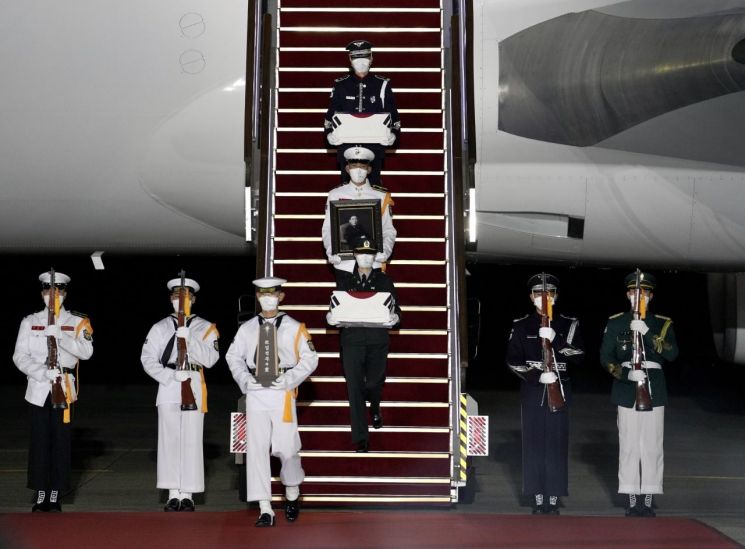
After repatriation, genetic analysis confirmed a father-daughter relationship with Ms. Wol-seon, the daughter of the deceased, from a sample collected in 2020. This is the first confirmed identity among the 66 repatriated remains.
Born in 1920 in Miryang, Gyeongnam, Private Choi enlisted after the outbreak of the Korean War, leaving behind one son and one daughter. He died heroically at age 31 on October 1 of that year, the day the South Korean Army broke through the 38th parallel. Ms. Wol-seon expressed gratitude to the military upon hearing the news of her father’s return, saying, "I am deeply moved to finally meet my father after waiting patiently for so long." A 'Heroic Return Ceremony' for Private Choi will be held at the family home in Miryang that day.
Identified as South Korean soldier through genetic and other analyses... 66 remains including Private Choi repatriated to Korea
Additionally, the remains recovered in 2019 at Hwaseolmari Hill, wearing a Taeguk badge on the chest, were confirmed to be those of Corporal Oh Moon-kyo. His remains were first discovered by specialized excavation personnel in an area presumed to be a personal foxhole from the Korean War, where parts of the skull and combat boots were found. Further excavation revealed most of the skeleton from skull to foot bones in a supine position.
On the left chest was a South Korean military rank insignia, and on the right, a badge engraved with the Taeguk symbol. The Taeguk badge was awarded to soldiers who participated in the Korean War under the 'Korean War Service Medal Decree' (Presidential Decree No. 390) enacted in 1950. The National Recovery Team explained that this is a 'rare artifact,' with only six such badges found to date, including two in the Demilitarized Zone.
The National Recovery Team’s mobile inquiry officer identified Corporal Oh’s registered domicile as Naju-si, Jeollanam-do, from military records, and located Mr. Oh Jong-suk, presumed to be his son, by reviewing the Naju district’s family registry. In April last year, they visited Mr. Jong-suk’s home to collect genetic samples, and detailed analysis confirmed their familial relationship. This brings the total number of identified casualties recovered from Hwaseolmari Hill to ten.
Born in 1930 in Gongsan-myeon, Naju, the deceased enlisted in April 1952, leaving behind his pregnant wife, and fought in the Hwaseolmari Hill battle as part of the 2nd Division. The 2nd Division repeatedly clashed with Chinese forces over Hwaseolmari Hill, a strategic point on the central front north of Cheorwon, ultimately defending the hill against enemy human wave attacks. Corporal Oh died heroically at age 22 on July 10, 1953, shortly before the armistice. His son, Jong-suk, said, "Meeting my father’s remains, even belatedly, is the reason I have lived until now." Since excavations began in April 2004, the total number of identified casualties has reached 204.
© The Asia Business Daily(www.asiae.co.kr). All rights reserved.
![Clutching a Stolen Dior Bag, Saying "I Hate Being Poor but Real"... The Grotesque Con of a "Human Knockoff" [Slate]](https://cwcontent.asiae.co.kr/asiaresize/183/2026021902243444107_1771435474.jpg)















