Amoji's Self-Developed Ammonia-Based Hydrogen Fuel Cell
Power Output Increased from 5kW to 300kW in 8 Months
Continuous Demonstration Success from Drones to Trucks
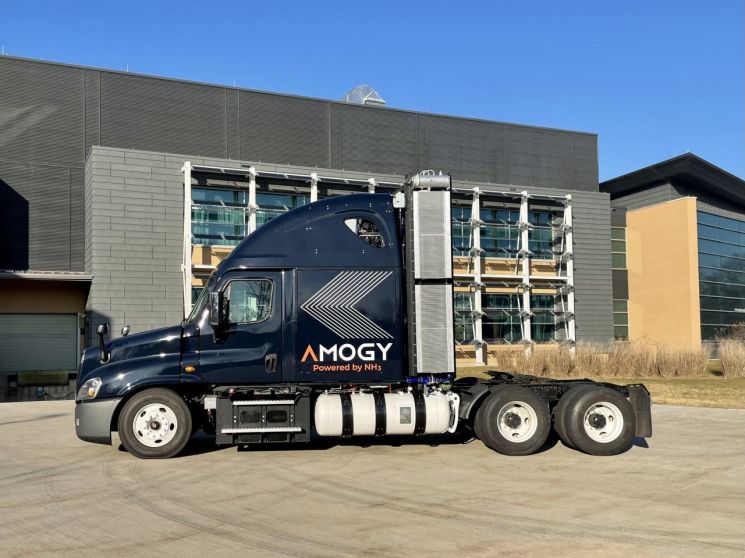 The ammonia-based hydrogen fuel cell system "Amoji," invested in by SK Innovation, is a truck that successfully completed the world's first driving test powered by ammonia earlier this month at Stony Brook University in New York State, USA. Photo by SK Innovation
[Asia Economy Reporter Donghoon Jeong] SK Innovation's $30 million (approximately 37.2 billion KRW) investment in the U.S. company Amogy has led to a successful trial of driving a large truck powered by ammonia without carbon emissions.
Amogy, a specialist in ammonia-based hydrogen fuel cell systems, announced on the 17th (local time) that it successfully conducted a driving test of a U.S. Class 8 truck, the Cascadia, equipped with its ammonia system at the Stony Brook University test track in New York. This is the first time a large vehicle has been driven using ammonia without carbon emissions. The driving test utilized 900 kWh of electric energy generated from liquefied ammonia fully charged into the truck for 8 minutes. Class 8 is the largest category of U.S. heavy-duty trucks with a gross weight of 33,000 pounds (approximately 15 tons), and Cascadia is a heavy-duty truck brand under Freightliner, a Daimler subsidiary.
With this test, Amogy has secured advanced technology for ammonia-based hydrogen fuel cell systems, progressing from a 5 kW drone in July 2021, a 100 kW tractor in May last year, to a 300 kW heavy-duty truck. At the end of this month, they plan to conduct a driving test of the Cascadia truck simulating real freight transport conditions at the Transportation Research Center (TRC), the largest automotive research institute in Ohio.
According to the U.S. Environmental Protection Agency (EPA), as of 2019, 29% of total U.S. greenhouse gas emissions came from the transportation sector, including vehicles, aircraft, and ships. Of this, 23% was generated by the operation of large vehicles such as trucks. Large vehicles that carry heavy loads over long distances are considered premature to replace fossil fuels with batteries due to energy density and long charging times.
However, by utilizing Amogy’s proprietary ammonia-based hydrogen fuel cell system, vehicles can be powered without carbon emissions simply by directly injecting ammonia into the vehicle. This is thanks to Amogy’s unique integrated technology that extracts hydrogen from ammonia, which consists of hydrogen and nitrogen, and immediately uses this hydrogen in the fuel cell.
Ammonia is a global raw material produced and transported at 200 million tons annually through existing transportation and storage infrastructure built worldwide over decades. It is regarded as a reliable alternative for hydrogen supply. The liquefaction point of ammonia (-33°C) is higher than that of hydrogen (-253°C), resulting in lower energy consumption and greater economic efficiency for liquefaction. Liquefied ammonia also has the advantage of higher energy density per volume compared to liquefied hydrogen. Global companies such as Amazon, Aramco, and AP Ventures have also been investing in Amogy consecutively.
Woosung Hoon, CEO of Amogy, said, "Ammonia has a significantly high energy density and a globally established infrastructure, making it the optimal fuel to realize rapid decarbonization in the freight transport industry, such as large trucks. Amogy expects to provide suitable decarbonization solutions for industries where reducing greenhouse gas emissions is challenging, such as the shipping industry, following drones, tractors, and trucks, in the near future."
© The Asia Business Daily(www.asiae.co.kr). All rights reserved.
![Clutching a Stolen Dior Bag, Saying "I Hate Being Poor but Real"... The Grotesque Con of a "Human Knockoff" [Slate]](https://cwcontent.asiae.co.kr/asiaresize/183/2026021902243444107_1771435474.jpg)















