Decision by Ministry of Economy and Finance to Reduce Beds from 1050 to 760
Specialist Medical Association Holds General Meeting and Votes 'Reject'
"Declaration of Abandoning Disaster Medical Care and Essential Severe Medical Care"
Alumni of Medical Center and Civil Society Unite in Condemnation
[Asia Economy Reporter Lee Gwan-ju] The Ministry of Economy and Finance's significant reduction of the scale of the National Medical Center's new construction and relocation project has sparked strong opposition both inside and outside the medical center. Despite the increased importance of public healthcare highlighted by the COVID-19 pandemic, the criticism centers on the fact that the response to infectious diseases, essential critical care, and medical services for vulnerable groups were downsized solely based on economic logic.
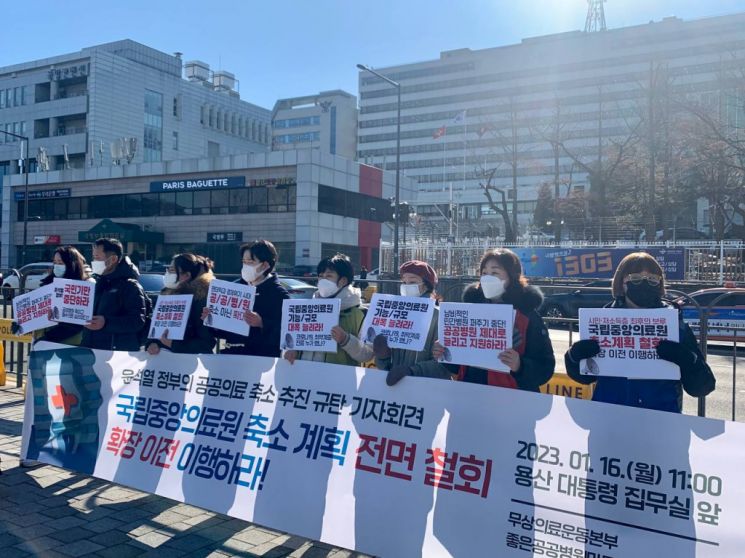 The Movement for Free Medical Care Headquarters and the Movement for Creating Good Public Hospitals Headquarters held a press conference on the 16th in front of the Presidential Office in Yongsan-gu, Seoul, demanding the withdrawal of the plan to downsize the National Medical Center.
 [Photo by the Health and Medical Workers' Union]
According to the medical community on the 18th, the National Medical Center, established in 1958, has been discussing relocation since 2003 due to aging facilities and cramped spaces. As the center's role was strengthened by being designated as the central infectious disease hospital during outbreaks such as MERS and COVID-19, the project to relocate the hospital to the former US Army Corps of Engineers site in Bangsan-dong, Jung-gu, Seoul, and to build the central infectious disease hospital together began in earnest.
The issue arose when the Ministry of Economy and Finance notified the National Medical Center earlier this month of the adjustment results for the total project cost of the new construction and relocation project. Initially, the Ministry of Health and Welfare and the National Medical Center requested a total of 1,050 beds, including 800 beds for the main hospital, 150 beds for the central infectious disease hospital, and 100 beds for the central trauma center. However, the Ministry of Economy and Finance deemed 760 beds appropriate?526 beds for the main hospital, 134 beds for the central infectious disease hospital, and 100 beds for the central trauma center?and reduced the project budget from 1.2341 trillion won to 1.1726 trillion won. In particular, the number of beds was cut by 27.6%.
As this fact became known, criticism poured in not only from civil society but also from within the National Medical Center. The Council of Specialists, composed of specialists affiliated with the National Medical Center, held an extraordinary general meeting on the 16th and resolved with 98% approval to reject the downsizing plan of the new construction and relocation project. It is considered extremely rare for medical staff from a public medical institution to gather in one place and express their opinions on a specific issue.
Furthermore, the council issued a public appeal stating, “To perform essential medical services and the medical safety net role during disasters and to provide high-level medical services as the national central hospital for essential medical care, a scale of more than 1,000 beds is necessary.” They emphasized that large-scale beds are required to provide essential medical care even during infectious disease outbreaks. In fact, leading overseas infectious disease hospitals such as Germany’s Charit? Hospital (3,001 beds), Hong Kong Infectious Disease Center (1,753 beds), and Singapore Tan Tock Seng Hospital (1,720 beds) operate large-scale bed capacities. The council appealed, “The scale notified by the Ministry of Economy and Finance makes it impossible to provide adequate medical care to medically vulnerable groups who desperately need help from public hospitals,” and asked, “We want to know if there is any plan for the development of the National Medical Center, the central institution of national public healthcare.”
The National Medical Center Alumni Association, composed of senior medical professionals who graduated from the center, also joined the criticism. The association issued a statement strongly condemning the downsizing plan of the new construction and relocation project, calling it “a destruction of the century-long foundation of public healthcare.” They directly criticized the reduction in the number of beds as “an abandonment of the government’s claimed function and role enhancement of the national public healthcare control tower and a blow to the morale and dignity of the National Medical Center family and alumni who have steadfastly fulfilled their duties despite harsh conditions.”
Civil society immediately raised their voices demanding the withdrawal of the downsizing plan and the expansion and relocation as originally planned. The Free Medical Movement Headquarters and the Good Public Hospital Movement Headquarters held a press conference on the 16th in front of the Presidential Office in Yongsan-gu, Seoul, pointing out that the downsizing of the National Medical Center’s new construction and relocation project is “a declaration of giving up on infectious disease and disaster medical care and essential medical services.” They noted, “The proportion of medical aid patients among those visiting the National Medical Center reached 25.9% in 2019. It is the last bastion of life and health for vulnerable groups such as low-income people, homeless individuals, migrants, and people infected with the human immunodeficiency virus (HIV).” They warned, “Reducing the expansion plan of the National Medical Center, a symbol of public healthcare, in the ongoing pandemic and economic crisis era will provoke strong opposition from the majority of the public.”
© The Asia Business Daily(www.asiae.co.kr). All rights reserved.
![Clutching a Stolen Dior Bag, Saying "I Hate Being Poor but Real"... The Grotesque Con of a "Human Knockoff" [Slate]](https://cwcontent.asiae.co.kr/asiaresize/183/2026021902243444107_1771435474.jpg)
















