Laser Fired to Induce Lightning Strike... Protection Radius Expanded
13 Billion Won to Block Once... "Used at Space Launch Pads and Airports"
[Asia Economy Reporter Hyunwoo Lee] With the successful experiment of the 'Laser Lightning Rod (LLR)' that fires high-power lasers into the sky to prevent lightning damage, a new lightning rod that will replace the traditional metal lightning rod used for about 270 years has been developed. It is especially expected to be widely used in the space, aviation, and telecommunications sectors, which have suffered severe losses from lightning damage.
According to the Washington Post on the 17th (local time), a European research team led by Dr. Aur?lien Houard of Ecole Polytechnique in France announced in the scientific journal Nature Photonics that they succeeded in a practical experiment of LLR. They also disclosed the details of the experiment conducted last summer on the Gentis peak of the Alps.
LLR refers to a technology that fires high-power lasers into the sky to create a conductor that can induce lightning. It can project lasers to higher altitudes than traditional metal lightning rods, thereby expanding the lightning protection area.
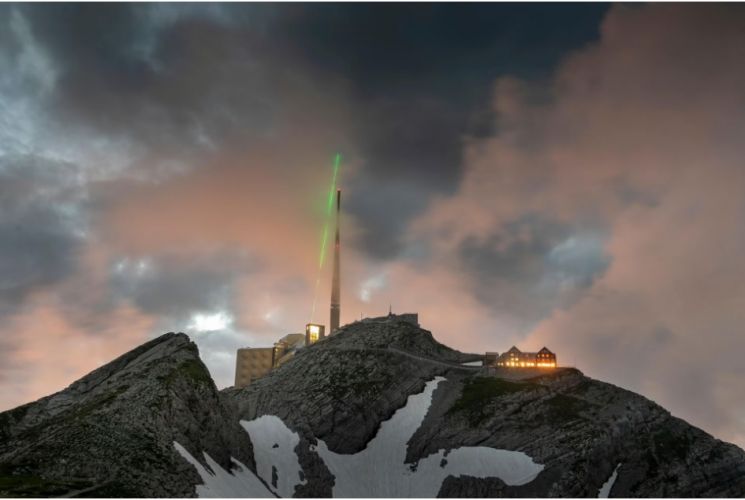 The scene of a live 'Laser Lightning Rod (LLR)' experiment conducted last July at the 'Swisscom' transmission tower on the S?ntis peak of the Swiss Alps. [Image source: German laser manufacturer Trumpf]
The research team led by Dr. Houard installed the LLR, which had only been tested in laboratory environments until now, around the 'Swisscom' transmission tower located at the summit of Gentis peak at an altitude of 2,500 meters, and tested its performance under actual lightning conditions. This transmission tower is struck by lightning about 100 times a year and is considered one of the structures most affected by lightning in Europe.
The laser lightning rod developed by the research team was manufactured with dimensions of 1.5 meters in width, 8 meters in height, and a weight of 3 tons, capable of firing 1,000 laser pulses per second. It is reported that on a day when lightning occurred in July last year, the team fired the laser for six hours and successfully blocked lightning four times.
Dr. Houard explained, "The goal was to verify whether there was a difference when operating the LLR and when not," adding, "We compared the data collected when the laser beam extended from the tip of the transmission tower and when it was simply struck by lightning."
Regarding this, Dr. Jean-Pierre Wolf, a professor of applied physics at the University of Geneva and the lead author of the paper, explained, "From the first lightning using the laser lightning rod, we confirmed that the lightning followed the laser beam from 60 meters before reaching the transmission tower, which means the lightning protection radius of the lightning rod increased from 120 meters to 180 meters."
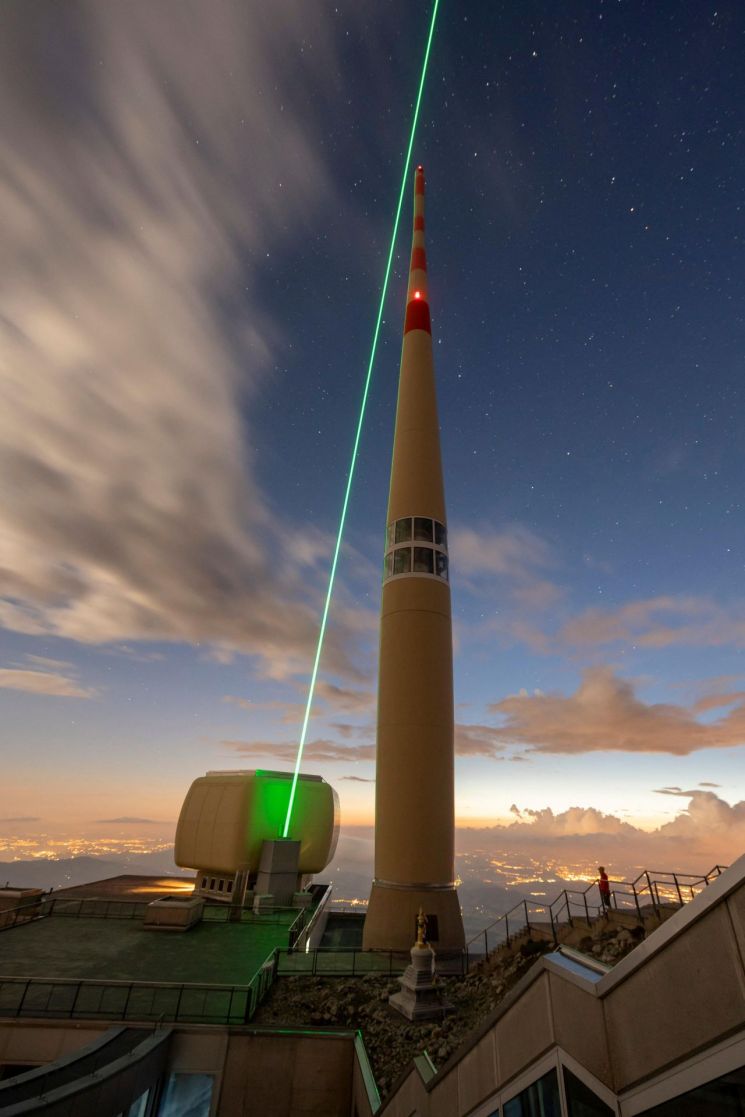 The laser firing device during the 'Laser Lightning Rod (LLR)' field test conducted last July at the Swisscom transmission tower on the S?ntis peak of the Swiss Alps. [Image source=Reuters·Yonhap News]
With the success of this laser lightning rod experiment, a new lightning rod that will replace the metal lightning rod invented by Benjamin Franklin in 1752 has been paved after 270 years. Although the metal lightning rod is efficient in preventing lightning damage, increasing the protection radius requires continuously raising the height of the lightning rod, which raises issues of installation costs and structural problems.
In particular, laser lightning rods are expected to replace traditional metal lightning rods in facilities where building height must be limited for safety reasons, such as airports, space launch sites, and nuclear power plants.
However, since the price is still very high, it is expected that more time will be needed for commercialization in general buildings. In an interview with the Washington Post, Dr. Houard said, "Laser lightning rods are quite expensive, costing about 1 million euros (approximately 1.3 billion KRW) at once for lightning protection," adding, "They should be used to protect airports with many airplanes or rocket launch pads."
© The Asia Business Daily(www.asiae.co.kr). All rights reserved.
![Clutching a Stolen Dior Bag, Saying "I Hate Being Poor but Real"... The Grotesque Con of a "Human Knockoff" [Slate]](https://cwcontent.asiae.co.kr/asiaresize/183/2026021902243444107_1771435474.jpg)

















