Regular Savings and Time Deposits Surge by 58.4 Trillion Won Compared to Previous Month
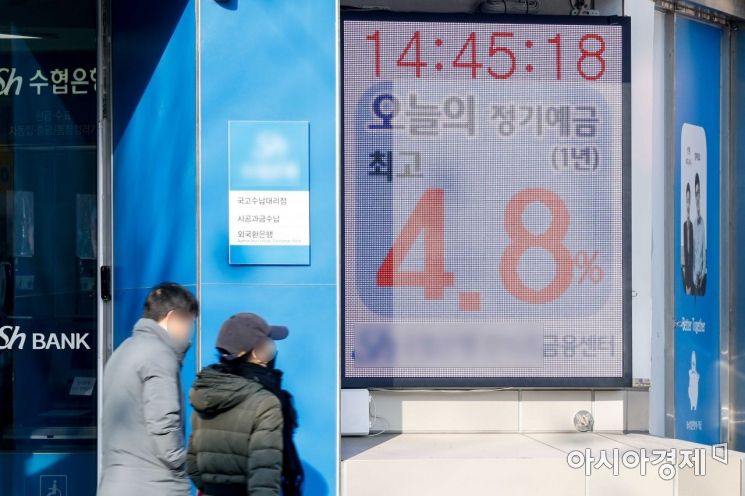
[Asia Economy Reporter Seo So-jeong] Amid the record increase in regular savings and time deposits in November due to the impact of the base interest rate hike, the money supply in November increased by 27.3 trillion KRW.
According to the 'Money and Liquidity' statistics released by the Bank of Korea on the 17th, the average broad money supply (M2) balance in November was 3,785.3 trillion KRW, up 27.3 trillion KRW from October. The M2 money supply growth rate more than doubled from 0.3% in June and July to 0.7% in August, then maintained the previous month's level in September, before rising to 0.4% in October and 0.7% in November.
The broad money supply indicator M2 includes cash, demand deposits, and checking deposits (all M1), as well as money market funds (MMF), time deposits under two years, installment savings, beneficiary certificates, certificates of deposit (CD), repurchase agreements (RP), financial bonds under two years, and money trusts under two years?short-term financial products that can be quickly converted into cash.
In particular, the M2 growth trend continues as investors flock to regular savings and time deposits due to the interest rate hike. The Bank of Korea explained, "While regular savings and time deposits increased sharply due to rising interest rates and preference for safe assets, demand deposits and checking deposits decreased significantly."
However, the year-on-year growth rate has been declining since December last year (13.2%), with rates of 9.4% in April, 9.3% in May, 8.8% in June, 8.0% in July, 7.2% in August, 6.6% in September, 5.9% in October, and 5.4% in November.
Looking at M2 by financial product, regular savings and time deposits surged by 58.4 trillion KRW compared to the previous month, marking the largest increase since statistics compilation began in December 2001. Conversely, checking deposits and demand deposits decreased by 19.1 trillion KRW and 13.8 trillion KRW respectively, recording the largest decline on record.
By economic agent, households and non-profit organizations (14.1 trillion KRW), other financial institutions (7.9 trillion KRW, influenced by local government grants inflow), and corporations (3.8 trillion KRW) increased mainly in regular savings and time deposits.
Meanwhile, the short-term money supply indicator M1 (narrow money) decreased by 34.4 trillion KRW (2.7%) from the previous month as both cash currency and settlement deposits declined. On a month-to-month basis, it has fallen for five consecutive months: -1.0% in July, -1.5% in August, -1.7% in September, -1.9% in October, and -2.7% in November. Year-on-year, it decreased by 6.8%, continuing the downward trend.
© The Asia Business Daily(www.asiae.co.kr). All rights reserved.
![Clutching a Stolen Dior Bag, Saying "I Hate Being Poor but Real"... The Grotesque Con of a "Human Knockoff" [Slate]](https://cwcontent.asiae.co.kr/asiaresize/183/2026021902243444107_1771435474.jpg)















