Second in Sales and Winner of 'Car of the Year'
Growing Indian Market...Whole-Government Policy
Responding This Year with Locally Produced Ioniq 5
Six Electric Vehicles to Launch by 2028
Calls for Diverse Strategies Including Electric Two-Wheelers
[Asia Economy Reporter Oh Gyumin] Hyundai Motor Group is achieving remarkable results in the Indian market, which has emerged as the world's third-largest automobile market. The group plans to accelerate electric vehicle development to secure a leading position in the market. However, experts point out that various strategies, such as developing two-wheelers, are necessary to survive competition with other companies.
Hyundai and Kia are performing well in sales. The Society of Indian Automobile Manufacturers (SIAM) reported that last year Hyundai and Kia sold 807,067 units, ranking second in sales after Japan's Maruti Suzuki (1,576,025 units). Indian companies Tata Motors (526,821 units) and Mahindra & Mahindra (332,872 units) followed behind.
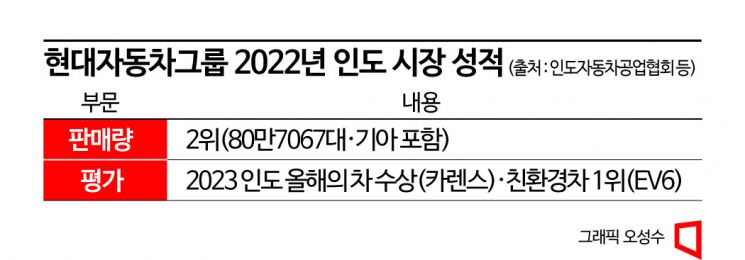
The local evaluation of the vehicles they introduced is also positive. The Kia Carens was named the ‘2023 Indian Car of the Year.’ The Carens is a 7-seater mid-size multi-purpose vehicle (MPV) launched in January last year targeting the Indian market. The EV6 ranked first in the eco-friendly vehicle category. This automobile award is selected annually by 18 professional journalists who evaluate new cars released each year based on price, driving performance, and other factors.
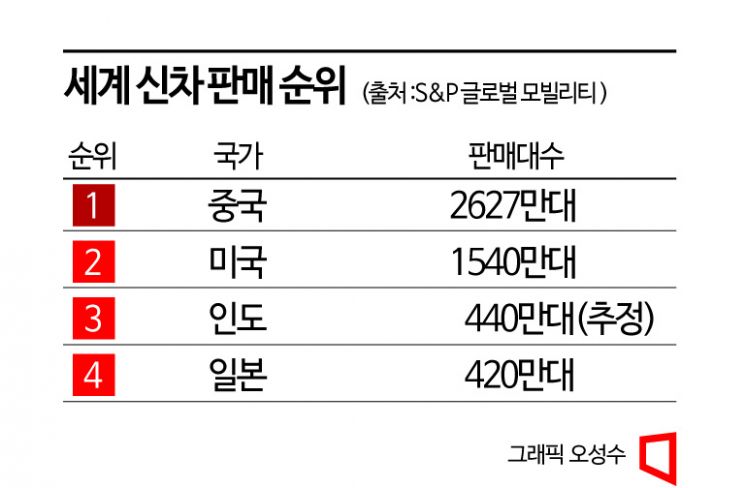
The Indian automobile market is showing steep growth. According to S&P Global Mobility data, new car sales in India last year were at least 4.4 million units. India surpassed Japan, which sold about 4.2 million units, to claim third place for the first time. China recorded the highest global new car sales with 26.27 million units, followed by the United States with 15.4 million units. The forecasted growth rate for new car sales in India this year is over 10% compared to last year, more than twice the global market growth forecast of 4.8%.
Particularly, attention should be paid to the electric vehicle market. The Indian government plans to increase the share of electric vehicle sales to 30% of total automobile sales by 2030. Policies to expand charging infrastructure and support funding for electric vehicle production are also being promoted. Population and income growth, expected to make India the world's largest by this year, further brighten the outlook.
Hyundai and Kia are responding swiftly. This year, they are putting the locally produced Ioniq 5 at the forefront. The chassis and modules are brought from the Indonesian factory and finally assembled locally in India for sale. They also plan to increase sales of the EV6, which sold 430 units last year. In the fourth quarter of 2024, they will introduce an electric version of the existing internal combustion engine small sport utility vehicle (SUV), the Creta. It will be unveiled at the Auto Expo held in New Delhi, India, in 2025. The sales target is up to 25,000 units. By 2028, they plan to invest 40 billion rupees (approximately 620 billion KRW) to launch a total of six electric vehicle models.
The global automobile industry is also planning electric vehicle launches in the second half of 2024. Renault is considering launching the Kwid hatchback electric vehicle after establishing a local factory. Chinese electric vehicle manufacturer BYD aims to capture 40% of the Indian electric vehicle market by 2030 with the launch of the ‘Seal Luxury Sedan.’
However, experts emphasize the need for diverse strategies to survive competition among companies. A representative example is the need for measures regarding electric two-wheelers (motorcycles). India and Southeast Asia have narrow roads and densely populated metropolitan areas, leading to high demand for two-wheelers. Last year, the number of registered electric two-wheelers in India was 615,365 units, while electric cars numbered 380,000 units. The U.S. consulting firm Bain & Company predicts that by 2030, annual sales of electric two-wheelers in India will reach about 13 million units, accounting for 40-45% of the total automobile market. In other words, the Indian automobile market is expected to transition from internal combustion engines to electric two-wheelers and then to electric cars. Investment in electric two-wheelers is necessary to enhance brand image before electric cars become mainstream.
Professor Kim Pilsoo of the Department of Automotive Studies at Daelim University said, “(In India) the era of owning a personal car has not yet arrived, and the government is prioritizing replacing internal combustion engine two-wheelers with electric two-wheelers,” adding, “Not only established automakers but also startups need to invest in electric two-wheelers to secure market leadership.”
© The Asia Business Daily(www.asiae.co.kr). All rights reserved.
![Clutching a Stolen Dior Bag, Saying "I Hate Being Poor but Real"... The Grotesque Con of a "Human Knockoff" [Slate]](https://cwcontent.asiae.co.kr/asiaresize/183/2026021902243444107_1771435474.jpg)
















