[Asia Economy Reporter Kim Hye-min] As Seoul's real estate regulations are largely lifted, there are expectations that the local housing sales market will be hit hard, and the local subscription market is also showing a strong trend of selective subscriptions. The enthusiasm for subscriptions varies clearly by region depending on the sale price and supply volume. One complex in Changwon, which benefited from the sale price, recorded double-digit subscription competition rates, while Daegu, already in an oversupply state, continues to experience a vicious cycle with 90% of units remaining unsubscribed.
According to the Korea Real Estate Board's Subscription Home on the 17th, subscription results in non-metropolitan areas this month showed clear differences by region. Representative examples are the subscription results in Daegu, Changwon, and Busan.
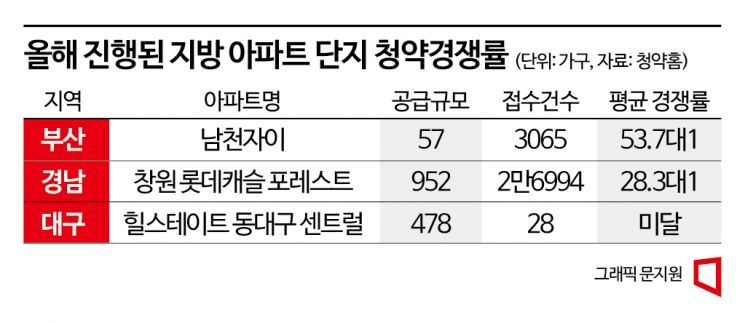
In Daegu, last week, Hillstate Dongdaegu Central received subscription applications, but only 27 people applied for 478 units, resulting in a large number of unsold units. First, the sale price was not attractive. The exclusive area of 84㎡ was priced between 599 million and 599.9 million KRW, while the actual transaction price for the same size at the nearby Dongdaegu Station Central City Xi, which is entering its second year of occupancy, dropped to 528.9 million KRW as of January this year.
This failure in popularity reflects the recent atmosphere of Daegu's sales market. In Daegu, a total of 26 complexes received subscriptions over the past year, but except for 4 complexes, all were undersubscribed. According to the Ministry of Land, Infrastructure and Transport, as of November last year, the scale of unsold units in Daegu was 11,700 households, more than four times the amount from a year earlier.
On the other hand, Lotte Castle Forest in Changwon, Gyeongnam, which launched sales in the first week of this month, attracted 26,994 applicants for a total of 952 units across blocks 1 and 2, recording an average competition rate of 28.3 to 1. The reasons for its popularity included the sale price being about 30 million KRW cheaper than the previous complex and still lower than the surrounding market price, raising expectations for capital gains.
Also, Namcheon Xi in Suyeong-gu, Busan, which was sold at the end of last year, recorded a high competition rate of 53.7 to 1 with 3,065 applicants for 57 units. Although the sale price per 3.3㎡ exceeded 30 million KRW, it was a branded apartment released in Busan after a long time, and its location in Suyeong-gu with a sea view greatly influenced its popularity.
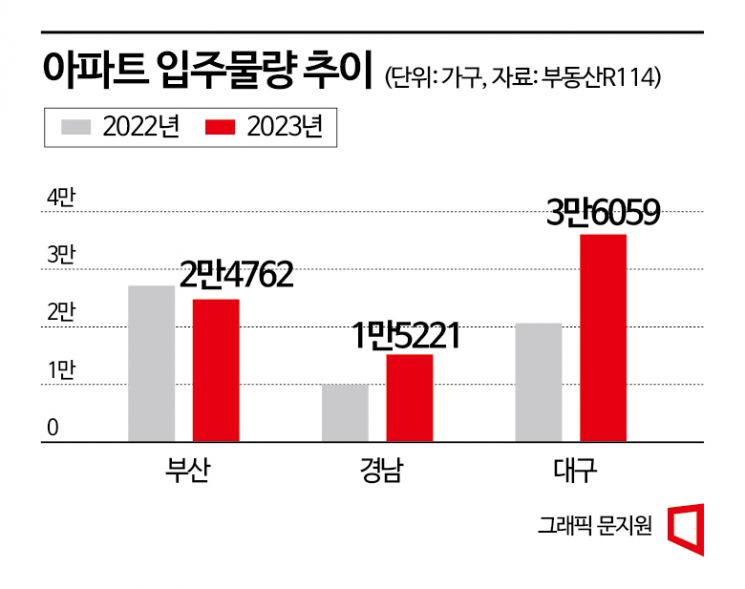
The supply volume relative to demand was also a major factor determining subscription success by region. In Daegu, 20,653 households moved in last year, and this year, an even larger 36,059 households are scheduled to move in. This means an environment where apartment supply is flooding the market. In contrast, Busan's supply is decreasing from 27,130 households last year to 24,762 households this year. The Gyeongnam region, including Changwon, is scheduled to have 15,221 households move in this year.
Ye Kyung-hee, senior researcher at Real Estate R114, said, "As regulations in the metropolitan area are lifted, the subscription market in local areas with low demand may slow down further," adding, "Rather than an overall slump, there may be selective differences in enthusiasm by region. Areas with oversupply relative to demand and high sale prices are likely to be increasingly ignored."
© The Asia Business Daily(www.asiae.co.kr). All rights reserved.
![Clutching a Stolen Dior Bag, Saying "I Hate Being Poor but Real"... The Grotesque Con of a "Human Knockoff" [Slate]](https://cwcontent.asiae.co.kr/asiaresize/183/2026021902243444107_1771435474.jpg)
















