Complex Impact of Declining School-Age Population, Work Overload, and Decline in Teacher Authority
Is the popularity of elementary school teachers, once considered a coveted profession, now a thing of the past? With the school-age population rapidly declining and factors such as the erosion of teachers' authority and reductions in the number of teachers intertwining, the competition rate for education universities (Gyodae) is decreasing. Amid this, the government has announced plans to promote education graduate schools (Gyojeonwon) as part of education reform, sparking opposition from current Gyodae students.
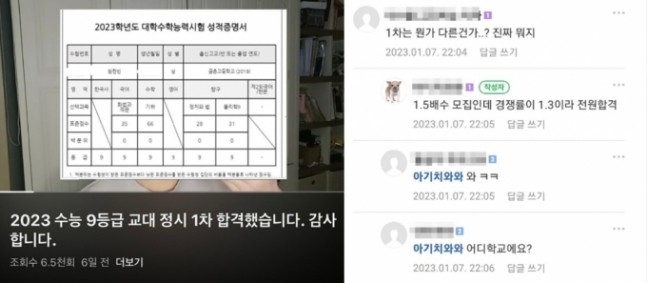
All 6 Subjects 'Grade 9'... Passed 1st Round at Gyeongin National University of Education
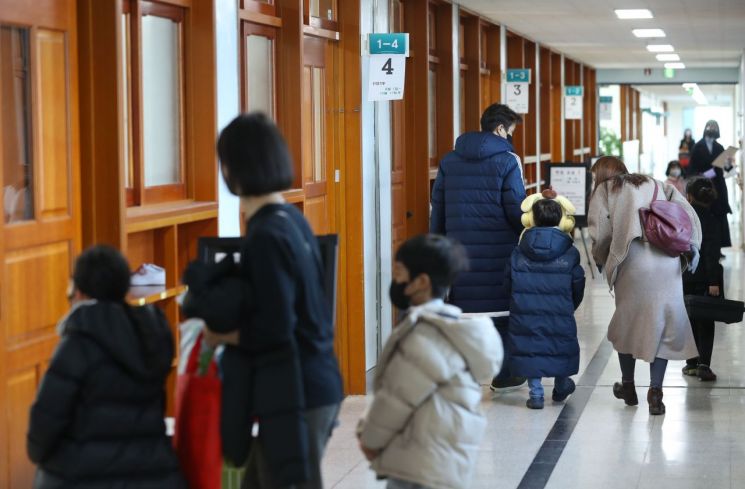 A preliminary orientation for new students of the 2023 academic year was held at an elementary school in Daegu. New students and their parents are seen heading to the classrooms.
 [Photo by Yonhap News]
This year, a test-taker who passed the first round of the regular admissions at a metropolitan area education university with grade 9 scores in the College Scholastic Ability Test (CSAT) has become a hot topic. According to Gyeongin National University of Education on the 9th, Mr. A, who graduated from high school in 2019, received the lowest grade 9 in all six CSAT subjects but passed the first round of regular admissions and is now preparing for the second round interview.
The reason Mr. A was able to pass is that the first round selects 1.5 times the number of candidates, but this year’s competition rate was only 1.37 to 1, so all applicants passed. Gyeongin National University of Education’s regular admissions have no grade ceiling and require a minimum CSAT score of 140 points. Therefore, if Mr. A performs well in the interview and other higher-scoring applicants enroll in other schools, he could actually be finally admitted.
In fact, Mr. A revealed on his YouTube channel, "Currently, education universities are on a downward trend, and since they are all grouped in the 'Na' category, I thought there might be under-enrollment, so I applied."
Gyodae Application Rates Plummet... "I Don’t Want to Be a Teacher"
The education sector diagnoses the decline in Gyodae competition rates as due to a "decrease in the school-age population," which has narrowed the employment opportunities. As the annual decrease in student numbers leads to reductions in the number of teachers, the job stability of elementary school teachers can no longer be guaranteed. According to Statistics Korea’s "Population Projections 2020?2070" released in 2021, the number of elementary school students, which was 2.72 million in 2020, is expected to plummet to 1.59 million by 2030. Additionally, the significant decline in teachers’ authority compared to the past and the increasing workload are also cited as causes.
According to the admissions industry, the average competition rate for the 10 national education universities in the 2023 academic year regular admissions was 1.87, a sharp decrease from 2.2 the previous year. Although the number of regular admission slots at education universities this year is 2,047, similar to last year, the number of applicants dropped by 15.6% (709 people) from 4,531 to 3,822. Cheongju National University of Education, which had the highest competition rate (2.46 to 1), also saw a decrease of 18.7% (94 applicants) to 410 applicants.
The same applies to four-year university elementary education departments. Ewha Womans University’s elementary education department competition rate dropped from 5.53 last year to 3.88 this year. Considering Ewha’s overall regular admission average competition rate is 3.96 and the College of Education’s is 4.12, the elementary education department is no longer a popular major. Both Jeju National University’s elementary education department (2.14) and Korea National University of Education’s elementary education department (5.02) also declined compared to the previous year, indicating an overall decrease in the popularity of elementary school teachers.
Another problem is the "oversupply" of teachers relative to the school-age population. The planned number of elementary teacher recruits this year is 3,561, a 5.2% decrease from 3,758 last year. This indicates that teacher reductions are inevitable. Moreover, the number of people who pass the teacher employment exam but do not receive appointments is increasing. Since 2017, the average waiting period for elementary teacher appointments in the Seoul area has been 1 year and 4 months. As a result, some say, "It’s better to go to a contract department that guarantees employment."
Government Implements 'Neulbom School' and 'Education Graduate Schools'
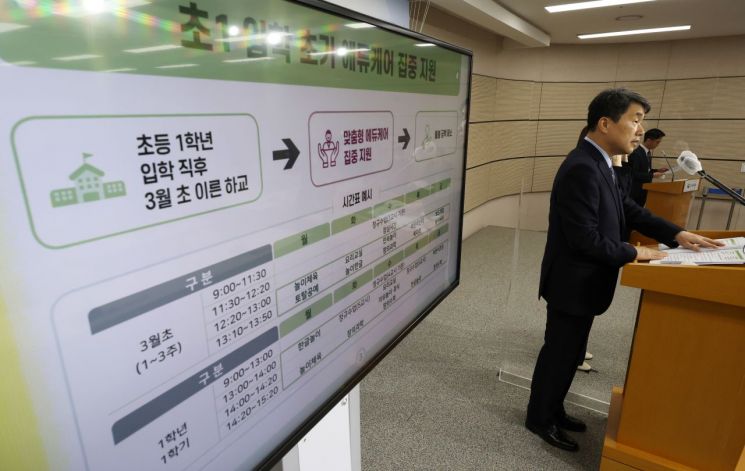 Lee Ju-ho, Deputy Prime Minister for Social Affairs and Minister of Education, announced the plan to promote Neulbom School to strengthen the national responsibility for education and care at the Government Sejong Complex in Sejong City on the 9th.
 [Photo by Yonhap News]
In the education field, there is a stance that "competent teachers are needed." The government is currently promoting 'Neulbom School,' which guarantees elementary after-school care until 8 p.m., and policies implemented as part of national responsibility education are increasing the workload of the limited number of teachers. The Korea Federation of Teachers’ Associations (KFTA) criticized, "Currently, teachers’ educational activities are being infringed upon by administrative tasks, and the supply and demand of teachers driven by economic logic is exacerbating the problem of overcrowded classes."
Some argue that the decline is temporary, noting that the competition rates for Gyodae have been on the rise: 1.9 to 1 in 2020, 2.1 to 1 in 2021, and 2.2 to 1 in 2022. Additionally, the fact that all Gyodae belong to the 'Na' category in regular admissions, forcing applicants to choose only one school, is analyzed as a factor contributing to the decline in competition rates. Despite restrictions on enrollment quotas and application methods, teaching remains a coveted profession among youth.
Currently, the education authorities have proposed 'education graduate schools (Gyojeonwon)' as part of education reform. This aims to strengthen the professionalism of elementary school teachers and change the supply system centered on Gyodae. However, students and education workers believe it is instead fueling the decline in Gyodae’s competitiveness.
In response, the Ministry of Education drew a line, stating, "Gyojeonwon is not a policy for restructuring Gyodae and colleges of education." However, Gyodae students oppose Gyojeonwon, viewing it as a foundation for reducing enrollment quotas. The National Federation of Education University Students urged, "The priority should be to reform the long-unchanged Gyodae curriculum to better fit the educational field to enhance teacher professionalism."
© The Asia Business Daily(www.asiae.co.kr). All rights reserved.
![Clutching a Stolen Dior Bag, Saying "I Hate Being Poor but Real"... The Grotesque Con of a "Human Knockoff" [Slate]](https://cwcontent.asiae.co.kr/asiaresize/183/2026021902243444107_1771435474.jpg)

















