"Over the Past 50 Years, Oil Reserves Defined Geopolitics... Now Semiconductor Factories Matter"
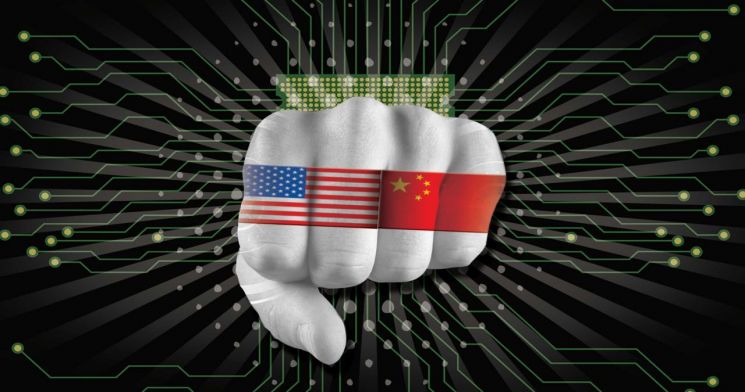
[Asia Economy Reporter Kwon Haeyoung] "The United States has embarked on investing astronomical funds to strengthen the semiconductor supply chain, the 'New Oil'."
The Wall Street Journal (WSJ) reported on the 14th (local time), citing data from the Semiconductor Industry Association (SIA), that semiconductor companies have announced 40 investment plans within the United States since 2020. WSJ analyzed, "Over the past two years, the U.S. has realized that semiconductors are as important as oil in the modern economy," adding, "Recent semiconductor shortages and China's ambition to dominate the industry have led to efforts to revitalize U.S. production." The SIA forecasts that investments worth $2 trillion (approximately 2,460 trillion KRW) will create around 40,000 jobs.
WSJ analyzed that the urgency of "If semiconductor production capacity is not secured, the U.S. will inevitably fall behind in the future supply chain race" is driving the country. While demand for semiconductors, known as the 'rice of the industry,' is steadily increasing, U.S. production capacity is not what it used to be. With the acceleration of digital transformation, the demand for semiconductors installed in automobiles reached 1,200 units (worth $600) in 2021, doubling in about a decade. However, according to Boston Consulting Group (BCG) and SIA, the U.S. share of global semiconductor production fell from 37% in 1990 to 12% in 2020. Meanwhile, China's share rose from 0% to 15% during the same period. Taiwan and South Korea each hold over 20%. Asia has established itself as a major semiconductor production base in the global market.
Concerns over the semiconductor supply chain have already led to losses for downstream companies. According to consulting firm AlixPartners, automotive companies suffered an estimated $210 billion (approximately 259 trillion KRW) in lost sales last year due to semiconductor supply chain instability.
WSJ also emphasized that semiconductors will become as important as oil was in the past. Oil was the 'linchpin' of industry in the 1900s economy, and the U.S. became one of the largest oil producers. However, securing the semiconductor supply chain is expected to be more complex than oil. While one barrel of oil is largely uniform, semiconductors vary widely in type, performance, and price, and there exists a multilayered supply chain spanning numerous countries. Accordingly, WSJ analyzed that the U.S. is reorganizing its supply chain through cooperation with neighboring countries, such as the 'Chip4 Alliance.'
Pat Gelsinger, CEO of Intel, predicted, "For the past 50 years, geopolitics was defined by regions with oil reserves," adding, "For the next 50 years, the location of semiconductor factories will become more important."
© The Asia Business Daily(www.asiae.co.kr). All rights reserved.
![Clutching a Stolen Dior Bag, Saying "I Hate Being Poor but Real"... The Grotesque Con of a "Human Knockoff" [Slate]](https://cwcontent.asiae.co.kr/asiaresize/183/2026021902243444107_1771435474.jpg)
















