Honda, Toyota, and US Ford
Continuous Love Calls Amid Exploding Battery Demand
[Asia Economy Reporter Choi Seoyoon] LG Energy Solution is quietly sweeping up global customers. There are also reports that American automaker Ford is replacing its T?rkiye joint venture partner SK On with LG Energy Solution.
There are signs of success even in the Japanese market, which the Korean automobile and battery industries considered 'impregnable.' Following Honda, which has already been secured as a customer, the world's number one automaker Toyota is also knocking on LG Energy Solution's door.
The battery industry believes that LG Energy Solution and Japan's Toyota are likely to sign a battery supply contract within the first quarter of this year. The two companies have been discussing this matter since last year.
Toyota currently receives 100% of its electric vehicle batteries from the Japanese battery company Panasonic. Ninety percent comes directly from Panasonic, and the remaining 10% is supplied through a joint venture (JV) established with Panasonic. The electric vehicle market is growing explosively. Rather than relying solely on Panasonic, Toyota needs to diversify risks in the mid to long term. A second band (secondary supplier) is necessary.
However, even if a supply contract is signed immediately, it is analyzed that it would be to secure volumes several years in advance. This is because battery supply instability is significant in the electric vehicle market. Carlos Tavares, CEO of American automaker Stellantis, also said, “Battery supply for electric vehicles will become insufficient in 2025-2026, and ultimately dependence on Asia will be inevitable.”
Yoon Hyukjin, a researcher at SK Securities, said, "Even if LG Energy Solution and Toyota sign a volume contract immediately, actual supply is expected to begin from 2026." He explained that it would take several years to develop batteries optimized for the automaker, including specifications and cathode materials.
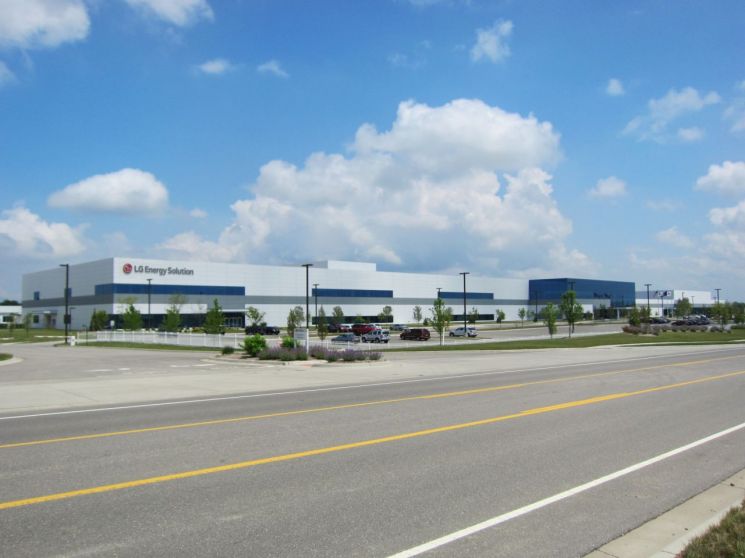
LG Energy Solution has secured customers such as Volkswagen, General Motors (GM), Ford, Stellantis, Renault-Nissan, Hyundai-Kia, BMW, and Honda. In Ford's case, LG Energy Solution stepped in to fill the gap left by the recently failed joint battery plant project with competitor SK On in T?rkiye. This has become an opportunity to strengthen the joint relationship with Ford.
An industry insider said, “SK On struggles to meet volume targets due to low yield, and Samsung SDI says, ‘We cannot supply at this price; give us more money,’ so they cannot secure many orders. LG Energy Solution, on the other hand, takes a lot of volume if it judges that it can maintain profitability even at a low price due to high yield.”
The year 2025 is expected to be a 'watershed' that determines the leadership among battery companies. The United States-Mexico-Canada Agreement (USMCA) will come into effect. Companies with supply chains in the U.S. receive many benefits such as tax reductions. LG Energy Solution has also established a 'five-corner system' supply chain in Korea, the U.S., China, Europe, and Indonesia. It has already secured a virtuous cycle between customer acquisition and supply chain strengthening.
Global automobile OEMs need stable battery supply, but there are not many companies worldwide capable of mass-producing batteries. Another industry insider said, “To receive benefits from the U.S. Inflation Reduction Act (IRA), Chinese companies must be excluded. That is why LG Energy Solution, with its abundant mass production experience, is chosen by leading overseas automakers.”
© The Asia Business Daily(www.asiae.co.kr). All rights reserved.
![Clutching a Stolen Dior Bag, Saying "I Hate Being Poor but Real"... The Grotesque Con of a "Human Knockoff" [Slate]](https://cwcontent.asiae.co.kr/asiaresize/183/2026021902243444107_1771435474.jpg)
















