FDA·EMA Primary Efficacy Endpoint Met
US Patent Expires This September
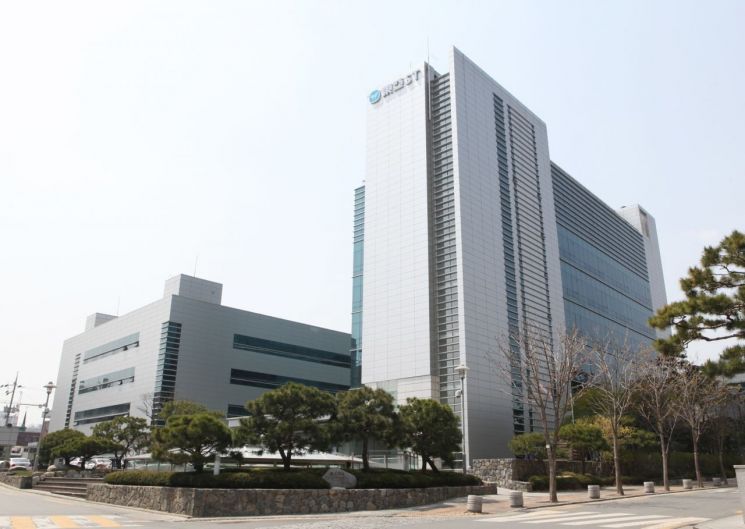
[Asia Economy Reporter Lee Chun-hee] Dong-A ST has succeeded in proving equivalence in the Phase 3 clinical trial of 'DMB-3115,' a biosimilar (biopharmaceutical generic) under development for the autoimmune disease treatment 'Stelara' (active ingredient ustekinumab).
Dong-A ST announced on the 16th that it received topline results meeting the primary efficacy endpoint for FDA (U.S. Food and Drug Administration) and EMA (European Medicines Agency) approval in the Phase 3 clinical trial to prove therapeutic equivalence between DMB-3115 and Stelara in patients with moderate to severe chronic plaque psoriasis. This clinical trial was conducted from March 2021 to November last year, involving 605 participants across nine countries including the U.S. and Poland.
Stelara is a treatment developed by Janssen (a subsidiary of Johnson & Johnson) for autoimmune diseases such as psoriasis, arthritis, Crohn's disease, and ulcerative colitis. According to Johnson & Johnson, it is a blockbuster drug that generated sales of $9.134 billion (approximately KRW 11.3444 trillion) in 2021. The substance patent expires in the U.S. this September and in Europe in July next year, opening the biosimilar market and triggering fierce competition in biosimilar development. In South Korea, besides Dong-A ST, companies such as Celltrion and Samsung Bioepis are also developing biosimilars.
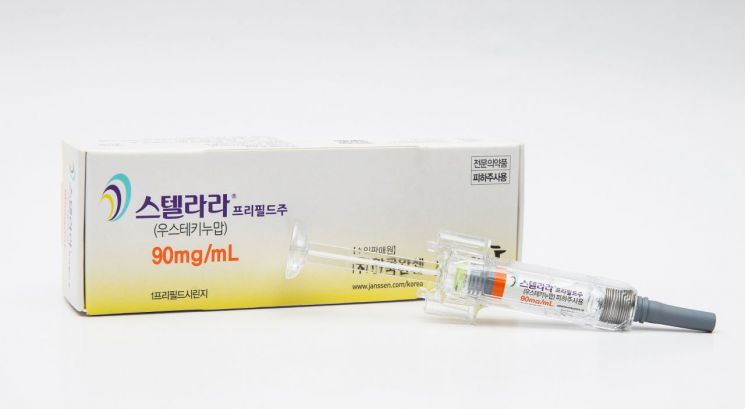 Janssen (a subsidiary of Johnson & Johnson)'s autoimmune disease treatment 'Stelara' (generic name 'Ustekinumab') [Photo provided by Korea Janssen]
Dong-A ST stated that for the primary efficacy endpoint set as the Psoriasis Area and Severity Index (PASI), the percentage change difference between DMB-3115 and Stelara at 8 weeks compared to baseline was -0.35% within the equivalence margin of ±15% at the 95% confidence interval, and at 12 weeks, the difference was -0.04% within the equivalence margin of ±10% at the 90% confidence interval. These were set as evaluation parameters for EMA and FDA approval, respectively.
In terms of safety, DMB-3115 showed a similar response level to Stelara. The incidence rate of newly occurring or worsening adverse reactions after drug administration was approximately 54% for DMB-3115 and about 57% for Stelara. In the group that switched from Stelara to DMB-3115 at 28 weeks, the rate was about 55%, with no clinically significant difference observed. The incidence rate of serious adverse reactions was also similar, about 2% for DMB-3115 and about 3% for Stelara, with no occurrences in the Stelara→DMB-3115 switch group.
A Dong-A ST official explained, "We plan to apply for marketing approval of DMB-3115 as a Stelara biosimilar in major overseas countries including the U.S. and Europe within the first half of this year."
© The Asia Business Daily(www.asiae.co.kr). All rights reserved.
![Clutching a Stolen Dior Bag, Saying "I Hate Being Poor but Real"... The Grotesque Con of a "Human Knockoff" [Slate]](https://cwcontent.asiae.co.kr/asiaresize/183/2026021902243444107_1771435474.jpg)

















