Despite Large-Scale Deregulation in Seoul, Listings Increase
Only Gangnam Regulation Area and Land Transaction Permission Zone Remain Deregulated
There are definitely buyers waiting, but no one is eager to buy a house right now. Unless the regulation areas are lifted, that is. (A representative from real estate agency A in Dogok-dong, Gangnam-gu, Seoul)
The government has launched comprehensive deregulation measures on loans, taxes, and subscription to overcome the severe real estate transaction freeze, but the effects are minimal. Buyer sentiment is stirring, but the atmosphere is such that actual transactions are not materializing. Voices are emerging that to reverse the stagnant mood, the remaining regulation areas and land transaction permission zones must be lifted, starting with key areas like Gangnam, the "barometer of housing prices."
According to the real estate big data platform Asil on the 15th, the number of apartment listings in Seoul was 51,827 as of the previous day, an increase of 647 from 51,180 on the 5th, when 21 districts outside the Gangnam 3 districts and Yongsan-gu were largely removed from regulation areas. Listings had decreased to 49,879 on the 9th but are now on the rise again.
The government expected that the massive deregulation of regulation areas would resolve the severe transaction freeze. This is because the tax burden from comprehensive real estate tax and capital gains tax has decreased, and the loan-to-value ratio (LTV) has increased, allowing for larger loan amounts. However, judging from the increase in listings, the effect on transaction activation seems minimal. In fact, in Seoul, there are still far more sellers than buyers. According to the Korea Real Estate Board, the apartment sales supply-demand index in Seoul for the second week of January rose by 0.7 from the previous week to 64.8 but is still at a low level. The sales supply-demand index is based on 100, and the lower it is, the more sellers there are compared to buyers in the market.
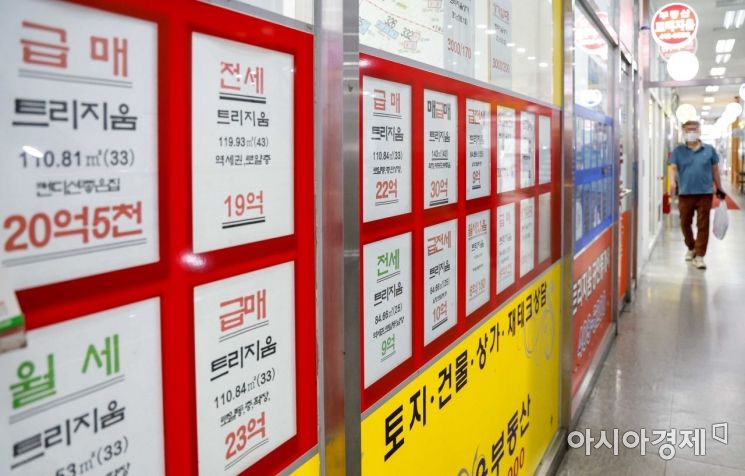 On the 14th, in a real estate-dense shopping area in Songpa-gu, Seoul, where the decline in real estate prices and the transaction freeze phenomenon continue, apartment listings with market prices are posted. Photo by Kang Jin-hyung aymsdream@
Moreover, the southeastern area including the Gangnam 3 districts dropped from 73.2 last week to 72.8. Previously, there was an expectation in the market that transactions would activate even in the remaining regulation areas of the Gangnam 3 districts and Yongsan-gu, as restrictions on resale and actual residence were eased. However, the opposite situation unfolded. This is interpreted to mean that while buyers are not moving, more sellers perceive deregulation as an opportunity to dispose of their homes.
Ultimately, there is cautious speculation that the government will lift the Gangnam 3 districts and Yongsan-gu from regulation areas, and Seoul City will also consider lifting the land transaction permission zones. Without revitalizing these key areas in Seoul, it will be difficult to resolve the overall transaction barriers.
In particular, residents within the land transaction permission zones are raising complaints, saying, "We can't buy or sell houses as we please, so transaction volumes are at rock bottom." Currently, major reconstruction complexes such as Apgujeong, Yeouido, Mok-dong, and Seongsu, as well as international exchange complex districts and nearby areas like Samsung, Cheongdam, Daechi, and Jamsil, are designated as land transaction permission zones. A representative from real estate agency B in Daechi-dong said, "To turn buyer inquiries into actual transactions, the land transaction permission zones must be lifted," adding, "If the market is left to flow naturally, transactions will normalize." A representative from real estate agency C in Mok-dong also said, "No matter how much reconstruction prospects are heard, there are no buyers," and "The complicated administrative procedures take months just to purchase, so if the government truly wants to activate transactions, lifting the land transaction permission zones is the only way."
However, the government and Seoul City maintain a cautious stance. Premature deregulation could invite speculative demand, disrupt the market, and increase harm to genuine buyers. A Seoul City official said, "The land transaction permission system is a safeguard to block speculative demand and protect actual residents," adding, "We will make decisions by comprehensively assessing market trends when the designation period expires."
© The Asia Business Daily(www.asiae.co.kr). All rights reserved.
![Clutching a Stolen Dior Bag, Saying "I Hate Being Poor but Real"... The Grotesque Con of a "Human Knockoff" [Slate]](https://cwcontent.asiae.co.kr/asiaresize/183/2026021902243444107_1771435474.jpg)















