Decrease of 199,771 People
[Asia Economy Reporter Kiho Sung] The Ministry of the Interior and Safety announced on the 15th that the population decreased last year as well, following 2020 and 2021.
As of December 31 last year, according to the resident registration population statistics of South Korea, the resident registration population was 51,439,038, a decrease of 199,771 (-0.39%) compared to 51,638,809 on December 31, 2021.
Furthermore, while the resident registration population decline continues, the proportion of single-person households is increasing, resulting in a steady rise in the number of households.
In particular, the resident registration population decreased for three consecutive years. It was 51.83 million in 2020, 51.64 million in 2021, and 51.44 million last year. By gender, the male population decline continued for four consecutive years, and the female population also showed a decreasing trend for two consecutive years following 2021.
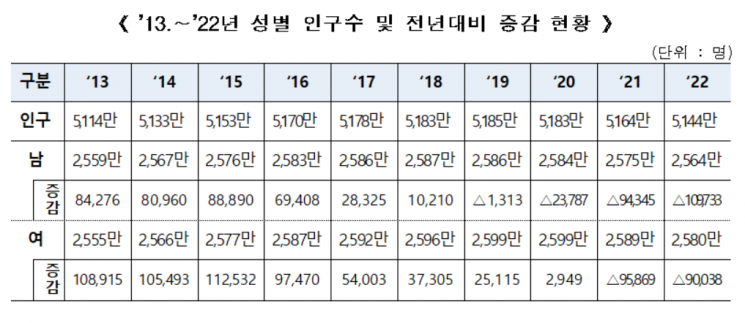
The population gap between males and females reached a record high (165,136). Since females first surpassed males in 2015, the population gap between females (25,802,087) and males (25,636,951) has widened to a record high of 165,136.
Single-person households (41.0%) continue to increase. The number of households has been steadily rising each year, increasing by 232,919 households (0.99%↑) compared to the end of 2021, reaching 23,705,814 households, while the average household size decreased to a record low of 2.17 persons.
The number of single-person households continues to grow, reaching 9,724,256 households (41.0%), approaching the milestone of 10 million households, whereas the proportion of households with three or four or more persons is steadily declining.
The proportion of elderly (65 years and older) among the total female population surpassed 20% (20.1%). Looking at the population by age group, those in their 50s still constitute the largest proportion, and the population in all age groups 60 and older increased compared to the end of 2021.
Since entering an aged society in 2017, the proportion of elderly (65 and older) has continuously increased, accounting for 18.0% of the total population at the end of 2022. Additionally, the gender proportion of the elderly population shows that females (20.1%) surpassed 20% for the first time, which is 4.2 percentage points higher than males (15.9%).
Moreover, except for Gyeonggi (increase of 23,982), Incheon (18,939), Sejong (11,696), Chungnam (3,780), and Jeju (1,400), the populations of other metropolitan autonomous regions decreased.
Han Chang-seop, Vice Minister of the Ministry of the Interior and Safety, stated, “The government is making all-out efforts across ministries to respond to the national challenge of population decline,” adding, “We will actively support local governments in cooperation with related ministries so that they can implement policies for regional revitalization, such as improving residential conditions and creating jobs tailored to their characteristics.”
© The Asia Business Daily(www.asiae.co.kr). All rights reserved.
![Clutching a Stolen Dior Bag, Saying "I Hate Being Poor but Real"... The Grotesque Con of a "Human Knockoff" [Slate]](https://cwcontent.asiae.co.kr/asiaresize/183/2026021902243444107_1771435474.jpg)















