[Asia Economy Reporter Park Sun-mi] It has been reported that global semiconductor companies such as Samsung Electronics, Intel, and Qualcomm will invest more than 400 billion KRW this year in developing or utilizing AI for semiconductor design.
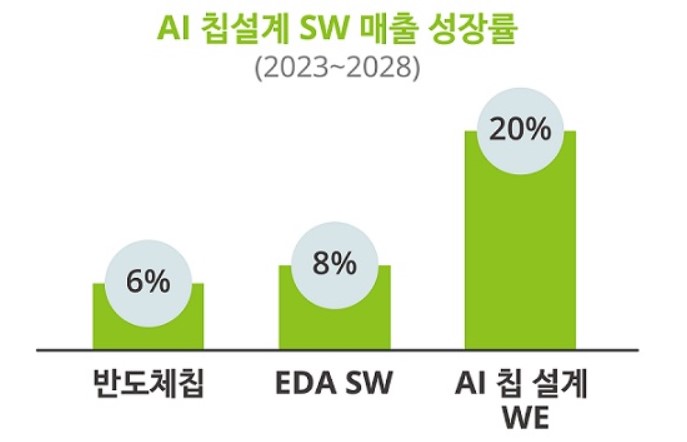
On the 13th, Deloitte Korea Group stated in its report titled "Next-Generation Semiconductors Open a New World for Humanity" that global semiconductor companies including Samsung Electronics, Intel, and Qualcomm will invest over $300 million (403.8 billion KRW, applying a 6-month average exchange rate of 1,346 KRW/USD) this year in developing in-house chip design AI and utilizing third-party tools. Furthermore, it is estimated that the investment will increase by 20% annually, reaching $500 million (approximately 673 billion KRW) by 2026.
The reason companies are sparing no investment in developing and utilizing AI for semiconductor design is that AI-based semiconductor design can reduce the time and cost required to produce chips with higher integration density. The report analyzed that with the introduction of AI in semiconductor design, AI can detect engineers' design errors and automatically suggest improvements, enabling better design proposals. Through this, the time and cost required for high-integration chip design, as well as the shortage of skilled personnel, can be resolved. Even chip designs previously considered outdated (8-inch wafers) can now be modified to suit current conditions, allowing semiconductor companies to fundamentally resolve potential future semiconductor shortages and supply stably.
In fact, an AI semiconductor design tool developed by the Massachusetts Institute of Technology (MIT) in the U.S. completed a circuit design with 2.3 times higher energy efficiency than circuits designed by engineers. Additionally, Taiwanese fabless company MediaTek used AI tools to reduce the size of key processor components by 5% and cut power consumption by 6%. Cadence, a semiconductor design automation software specialist, reported that a single engineer using AI tools improved the performance of a 5-nanometer mobile phone chip by 14% and reduced power consumption by 3% in just 10 days. This was a task that previously required 10 engineers working for several months. Collaboration with AI thus resulted in more than tenfold productivity.
Choi Ho-gye, leader of the Advanced Technology, Media, and Telecommunications division at Deloitte Korea Group, said, “The foundry fine process competition, cost issues, and supply shortage risks in the semiconductor industry are expected to be alleviated by AI-based semiconductor design,” adding, “There may come a day when AI designs both hardware and software that operate themselves together with humans.”
© The Asia Business Daily(www.asiae.co.kr). All rights reserved.
![Clutching a Stolen Dior Bag, Saying "I Hate Being Poor but Real"... The Grotesque Con of a "Human Knockoff" [Slate]](https://cwcontent.asiae.co.kr/asiaresize/183/2026021902243444107_1771435474.jpg)















