UK Research Team "Changing Sound and Behavior to Overcome Noise"
"Relying on Hunting and Mating Sounds... Impact on Group Survival"
Just as people raise their voices when talking in noisy bars, a study has found that dolphins, as social animals, also increase their vocal volume to communicate with others in noisy environments.
'Social animals' dolphins... raise their voices as noise increases
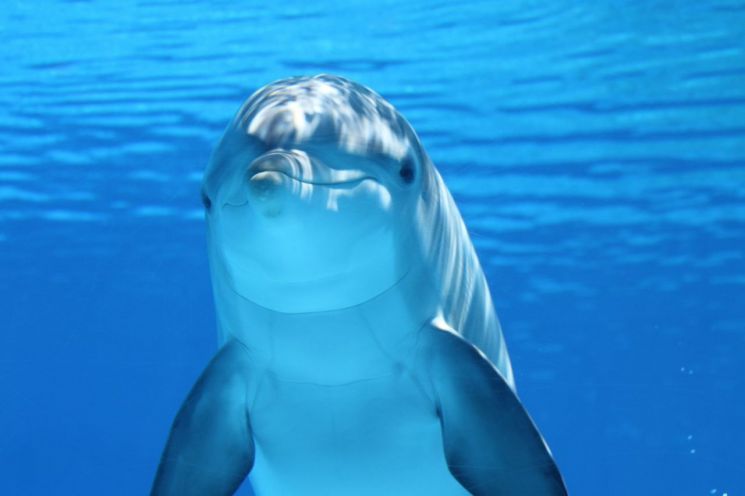
The British daily The Guardian reported on the 12th (local time) that Professor Stephanie King’s research team at the University of Bristol confirmed this fact through dolphin experiments. According to the study, noisy environments make communication and cooperation among dolphins more difficult. The Guardian emphasized that this raises concerns about the impact of human noise pollution on marine life.
Dolphins, known for their high intelligence and social nature, communicate through sounds and use echolocation?high-frequency sounds that reflect back?to locate themselves and their prey. Therefore, marine creatures like dolphins can be harmed by human-generated noises such as drilling or ship operations.
The study was published in the latest issue of the scientific journal Current Biology. Pernille Sørensen, the first author and co-corresponding author of the paper, said, "When people talk in a noisy bar, they raise their voice volume to be heard," adding, "Dolphins respond to noise in a similar way, and some miscommunication also occurs."
In the study, the research team placed two bottlenose dolphins in a 22.6m × 15.2m lake and created scenarios with and without noise. The dolphins were tasked with a cooperative mission to press buttons located at opposite corners within a set time. The team also varied the time the dolphins started moving toward the buttons to create situations where communication could only occur through sound, comparing conditions with and without noise.
The results showed that when the volume of noise from speakers at the bottom of the lake increased, the dolphins adjusted the volume and duration of their vocalizations to overcome the noise. However, as the noise level rose, communication failures among the dolphins also increased. The success rate of dolphin communication dropped from 85% at the lowest noise level to 62.5% at the highest.
Additionally, as noise increased, dolphins not only changed their calls but also altered their body language by turning their bodies toward each other more frequently to face one another and by increasing close physical proximity.
"Noise levels also affect the survival of dolphin pods"
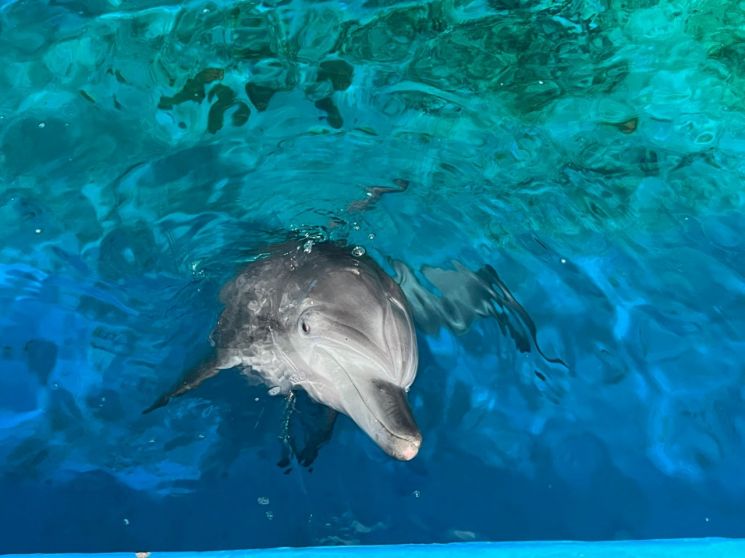
Professor King expressed concern, saying, "The study shows that simply changing vocalizations and body language is not enough for dolphins to overcome the effects of noise pollution. Since dolphins rely on sound to communicate during hunting and mating, noise levels can affect not only individual dolphin behavior but also the survival of entire pods."
Sound travels 4.5 times faster in water than in air. Moreover, marine animals often rely on sound to gather information about their surroundings, making it crucial for survival. Invertebrates and fish can hear low-frequency sounds, while dolphins and whales can hear high frequencies up to 200 kHz.
© The Asia Business Daily(www.asiae.co.kr). All rights reserved.
![Clutching a Stolen Dior Bag, Saying "I Hate Being Poor but Real"... The Grotesque Con of a "Human Knockoff" [Slate]](https://cwcontent.asiae.co.kr/asiaresize/183/2026021902243444107_1771435474.jpg)
















