Resolution on Monetary Policy Direction by the Bank of Korea Monetary Policy Committee
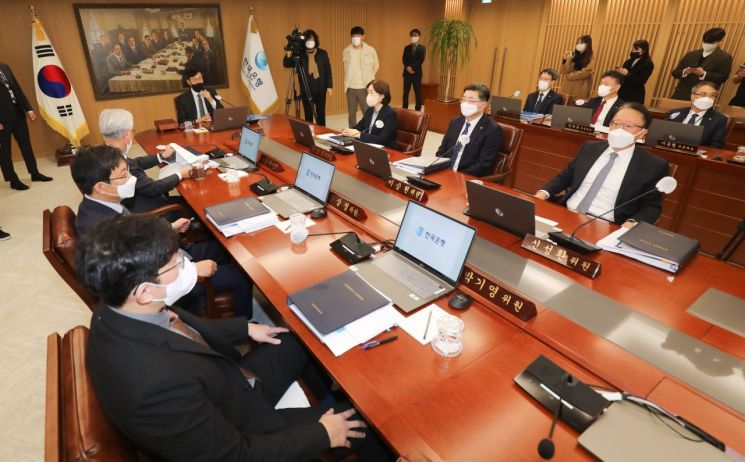 Bank of Korea Governor Lee Chang-yong is presiding over the Monetary Policy Committee plenary meeting held at the Bank of Korea in Jung-gu, Seoul, on the morning of the 13th.
 [Image source=Yonhap News]
The Monetary Policy Committee of the Bank of Korea stated that this year’s economic growth rate in South Korea is expected to fall short of the 1.7% forecast made last November. However, since inflation is likely to remain at a high level for the time being, monetary policy will be operated in a tightening manner.
On the 13th, the Monetary Policy Committee explained this in a resolution on the direction of monetary policy, saying, "We have decided to operate monetary policy by raising the base interest rate from the current 3.25% to 3.50%."
The Committee said, "Going forward, the domestic economy is expected to weaken in growth due to the global economic slowdown and rising interest rates, resulting in this year’s growth rate falling below the November forecast (1.7%). There is significant uncertainty regarding future growth prospects related to the pace of China’s economic recovery and the slowdown in major economies."
It added, "The global economy began to slow down inflation due to factors such as the decline in international oil prices, but inflation remains at a high level. As major countries continue to raise policy interest rates in response, the economic slowdown has persisted. Going forward, the global economy and international financial markets are expected to be influenced by the pace of global inflation slowdown, changes in monetary policies of major countries and movements of the US dollar, developments in China’s economy following the easing of quarantine policies, and geopolitical risks."
This year’s domestic inflation rate is expected to generally align with the 3.6% forecast made last November. The Committee stated, "Core inflation has slightly declined from the low 4% range, and short-term inflation expectations have slowed to the high 3% range, but still remain at a high level. There is significant uncertainty regarding future inflation outlook related to the degree of domestic and foreign economic slowdown, increases in public utility fees such as electricity and gas, and movements in international oil prices and exchange rates."
The Committee noted that although long-term market interest rates have recently fallen, corporate bond and commercial paper (CP) spreads have narrowed, and the won-dollar exchange rate has dropped sharply, unstable conditions still persist.
The Committee explained, "High credit caution is maintained for non-investment grade bonds and project financing asset-backed commercial papers (PF-ABCP). Household loans have continued to decline, and housing prices have sharply fallen both in the metropolitan area and provinces."
The Committee emphasized, "While monitoring growth trends, monetary policy will be operated with attention to financial stability to ensure that inflation stabilizes at the target level over the medium term. Although the domestic economic growth rate is expected to decline, inflation is anticipated to continue its high upward trend exceeding the target level, so it is necessary to maintain a tightening stance focusing on price stability."
However, it added, "We will carefully examine downside risks to growth, risks related to financial stability, the effects of past interest rate hikes, the pace of inflation slowdown, and changes in monetary policies of major countries to determine the necessity of additional rate hikes."
© The Asia Business Daily(www.asiae.co.kr). All rights reserved.
![Clutching a Stolen Dior Bag, Saying "I Hate Being Poor but Real"... The Grotesque Con of a "Human Knockoff" [Slate]](https://cwcontent.asiae.co.kr/asiaresize/183/2026021902243444107_1771435474.jpg)















