Reassessment of Nuclear Waste Saturation Point... Announcement Possible as Early as Next Month
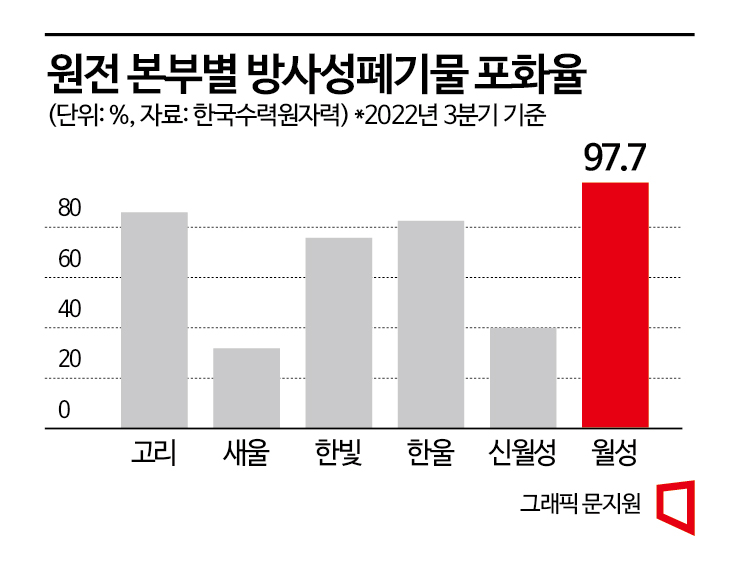
Wolseong Saturation Rate at 97.7% in Q3 Last Year
Urgent Need for Dry Storage Facility Construction
[Asia Economy Sejong=Reporter Lee Jun-hyung] The government is advancing the saturation point of radioactive waste from nuclear power plants nationwide by more than a year. This is based on the judgment that if the previous administration's 'nuclear phase-out' policy is reversed and nuclear power utilization rates are increased, the amount of radioactive waste will grow faster than expected. Since securing a high-level radioactive waste disposal facility takes time, there are calls to accelerate the construction of dry storage facilities for the temporary storage of spent nuclear fuel.
According to a compilation of reports on the 13th, the Ministry of Trade, Industry and Energy plans to announce the recalculated saturation points of radioactive waste for each domestic nuclear power plant headquarters as early as the beginning of next month. The saturation point is likely to be advanced by 1 to 2 years from the previous forecast. Earlier, in 2021, the ministry estimated that domestic nuclear power plants would sequentially reach saturation starting from 2031, beginning with the Kori and Hanbit nuclear power plants. A government official said, "Considering the continued operation of nuclear power plants, the amount of spent nuclear fuel generated will inevitably increase beyond previous expectations," adding, "(The saturation point) will be advanced by at least one year."
Nuclear Power Share at 32.4% by 2030
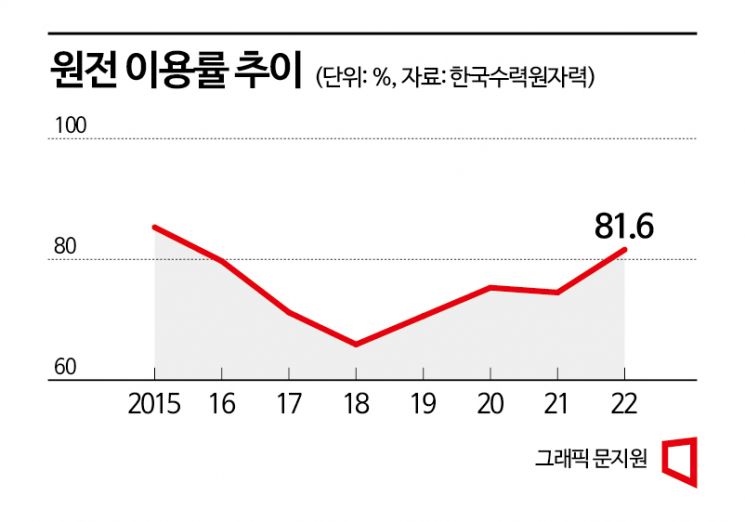
The ministry's decision to advance the saturation point reflects the Yoon Suk-yeol administration's 'nuclear power drive' policy. Increasing the utilization rate of nuclear power plants inevitably leads to a corresponding increase in the amount of spent nuclear fuel generated during operation. Last year, the utilization rate of nuclear power plants under the Yoon Suk-yeol administration was 81.6%, up 7.1 percentage points from 74.5% in 2021. The government plans to maintain the utilization rate in the 80% range, assuming safety is ensured.
Additionally, the ministry has firmly committed to raising the share of nuclear power in total electricity generation from the existing 20% range to 32.4% by 2030. This was confirmed in the '10th Basic Plan for Electricity Supply and Demand (2022-2036)' announced on the 12th. This target is 8.5 percentage points higher than the 23.9% nuclear power share goal for 2030 set by the Moon Jae-in administration in the 2021 Nationally Determined Contribution (NDC) for greenhouse gas reduction. This implies an increase in the amount of spent nuclear fuel generated.
The problem is that there are no storage facilities to move the saturated radioactive waste from nuclear power plants. Currently, domestic nuclear power plants store spent nuclear fuel in wet storage facilities in the form of pools inside the power plants. If the wet storage facilities become saturated, nuclear power plant operations must be halted. This is why the Wolseong nuclear power plant, which was the first among domestic plants to have saturated wet storage facilities, has been steadily expanding its dry storage facilities since 1991. However, Wolseong is the only domestic nuclear power plant equipped with dry storage facilities.
Concerns Over 'Radioactive Waste Crisis'
The most urgent issue is the Kori nuclear power plant located in Gijang-gun, Busan. According to Korea Hydro & Nuclear Power (KHNP), as of the third quarter of last year, the saturation rate of radioactive waste at Kori was 85.9%. Excluding Wolseong, which has dry storage facilities, this is the highest saturation rate among domestic nuclear power plants. Accordingly, KHNP attempted to propose to its board of directors in the second half of last year a plan to build dry storage facilities for spent nuclear fuel at Kori, but it was rejected. At the time, there was opposition not only from the local community but also within the board.
If the construction of dry storage facilities does not begin this year, a 'radioactive waste crisis' could occur. Typically, it takes seven years to build dry storage facilities. Considering the possibility that the saturation point for radioactive waste at Kori could be advanced from 2031 to at least 2030, this year is the 'deadline' to start construction of dry storage facilities.
The ministry's position is that the construction of dry storage facilities can only be fully initiated after approval by the KHNP board of directors. Previously, the ministry announced at the end of last year during a presidential briefing that it would place orders for the design related to Kori's dry storage facilities. A ministry official said, "The design order is conditional on passing the KHNP board," adding, "We plan to place the order immediately upon board approval."
There is also growing pressure for the government to expedite the construction of a permanent disposal facility for high-level radioactive waste. Since both wet and dry storage facilities are only 'temporary' facilities, there is a need for a facility that can permanently store radioactive waste. The ministry estimates that it will take 37 years from site selection to completion of the disposal facility. Even if site selection begins this year, a permanent disposal facility can only be secured by 2060.
© The Asia Business Daily(www.asiae.co.kr). All rights reserved.
![Clutching a Stolen Dior Bag, Saying "I Hate Being Poor but Real"... The Grotesque Con of a "Human Knockoff" [Slate]](https://cwcontent.asiae.co.kr/asiaresize/183/2026021902243444107_1771435474.jpg)

















