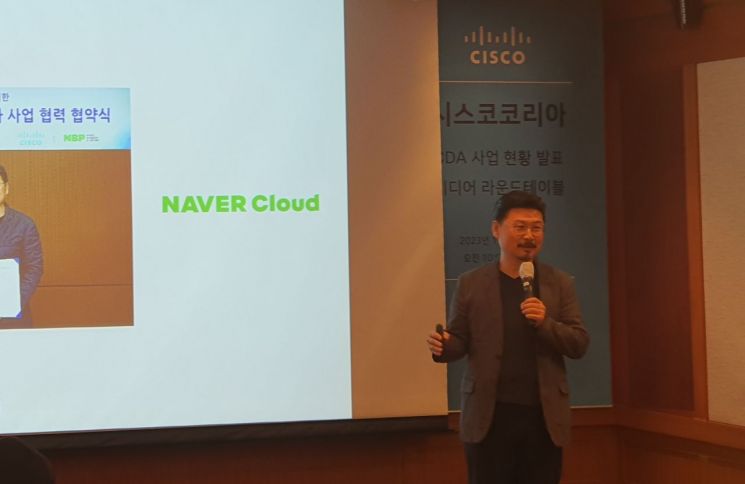
 On the 12th, Park Won-gi, Head of APAC (Asia-Pacific) Business Development at Naver Cloud, is giving a presentation at the Cisco Korea Media Roundtable held at the Grand InterContinental Seoul Parnas in Gangnam-gu, Seoul.
[Asia Economy Reporter Seungjin Lee] Park Won-ki, Head of Business Development for APAC (Asia-Pacific) at Naver Cloud, made candid remarks regarding the government's revision of the Cloud Security Assurance Program (CSAP).
On the 12th, at the Cisco Korea Media Roundtable held at the Grand InterContinental Seoul Parnas in Gangnam-gu, Seoul, Park expressed that the CSAP's restructuring into tiered levels such as high, medium, and low "seems to diverge from global trends and directions."
He explained, "Countries interested in global clouds, such as those in Europe and Asia, are showing interest in sovereign clouds that emphasize operational independence and technological autonomy, so I wonder why South Korea does not follow this trend."
He continued, "Within the industry, there are opinions to open all three levels?high, medium, and low?simultaneously if this is the approach. Europe is moving toward sovereign cloud directions, but it seems that only South Korea is uninterested in adopting such movements."
Sovereign cloud refers to cloud services based on local data centers that comply with each country's government regulations. Interest in sovereign clouds is increasing as countries, led by the European Union (EU), emphasize data sovereignty and strengthen related regulations.
When asked by reporters whether he intends to gather industry concerns and convey them to the government, Park replied, "We are already doing so." Currently, the Korea Cloud Industry Association is collecting feedback from member companies regarding the revised CSAP security certification notice, and after detailed technical and policy reviews by companies, it is known that opinions will be submitted to the relevant ministries.
The core of the government's ongoing CSAP revision is to divide the existing single certification system into three levels?high, medium, and low?and to relax security regulations for the 'low' level.
The low level removes the 'physical network separation' requirement and allows 'logical network separation,' which has become a point of controversy. Physical network separation requires public institution servers to be established to enter the public market, and foreign operators have faced restrictions entering the public market due to this standard.
Domestic cloud providers are concerned that the introduction of the CSAP tier system will signal the opening of the public cloud market to global companies.
Meanwhile, Park reiterated that Naver Cloud has no intention of participating as a new operator utilizing the 5G 28 GHz frequency band.
When asked if they plan to participate as an operator using the 5G 28 GHz frequency band, he said, "We are not a telecommunications company like SK Telecom, KT, or LG Uplus," adding, "We have no intention whatsoever to compete with telecom companies."
The Ministry of Science and ICT (hereafter MSIT) judged in December 2022 that the number of 5G 28 GHz base stations built by KT and LG Uplus did not meet the allocation conditions and ultimately canceled the frequency allocation. This drew attention to companies such as Naver Cloud, LG CNS, SK Networks Service, and CJ OliveNetworks, which operate 'Eum 5G' (5G specialized networks) using the 5G 28 GHz or 4.7 GHz bands.
© The Asia Business Daily(www.asiae.co.kr). All rights reserved.
![Clutching a Stolen Dior Bag, Saying "I Hate Being Poor but Real"... The Grotesque Con of a "Human Knockoff" [Slate]](https://cwcontent.asiae.co.kr/asiaresize/183/2026021902243444107_1771435474.jpg)















