Budget phone market share 0.76%→16.4%
Changes due to cost-effectiveness and satisfaction decline
#. Office worker Park (28) has been using a budget phone for six months to reduce living expenses. Park said, "I switched to try to cut down on monthly communication costs, and there have been no particular inconveniences. It's cheap, so I plan to keep using it," adding, "The previous plan I used was expensive, so I'm saving about 20,000 to 30,000 won."
As the economic downturn continues, the consumption tendencies of people in their 20s and 30s have shifted toward 'frugal tech' and 'no-spending challenges.' Amid this trend, more people are moving to budget phones to reduce living costs rather than bearing high communication fees. The government decided to lower wholesale prices (network usage fees) by about 20% this year to revitalize the budget phone market, and the number of budget phone users is expected to continue increasing.
Record High Number of Budget Phone Subscribers
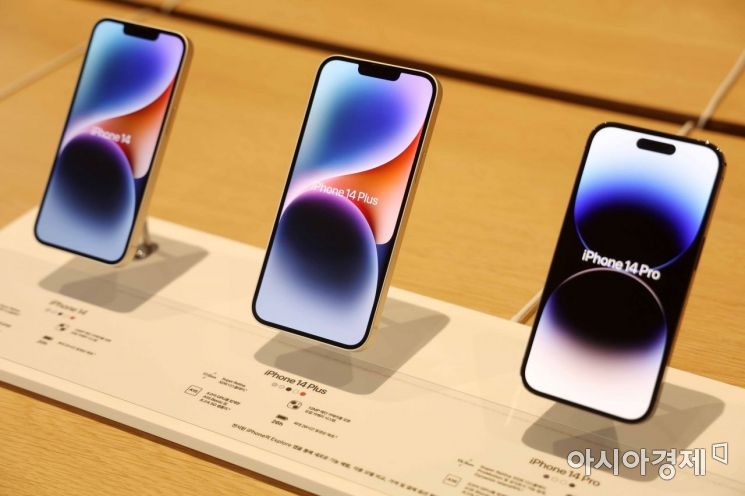
According to the Ministry of Science and ICT on the 13th, the number of budget phone subscribers reached a record high of 12.64 million as of November last year. During the same period, SK Telecom had 30.69 million subscribers with a market share of 39.9%, KT had 17.57 million (22.9%), and LG Uplus had 15.96 million (20.8%). This is the first time SK Telecom's market share has fallen below 40%.
Meanwhile, budget phone users have steadily increased. The number of budget phone subscribers was 7.75 million in December 2019, rising to 9.11 million in 2020 and 10.36 million in 2021, increasing by about 1 million each year. Then, from early last year, the number surged, reaching 12.64 million in November, an increase of about 2 million. The budget phone market share, which was 0.76% when the related system was implemented in 2011, rose to 16.4% as of last November.
Decline in Cost-effectiveness and Satisfaction Cited as Reasons
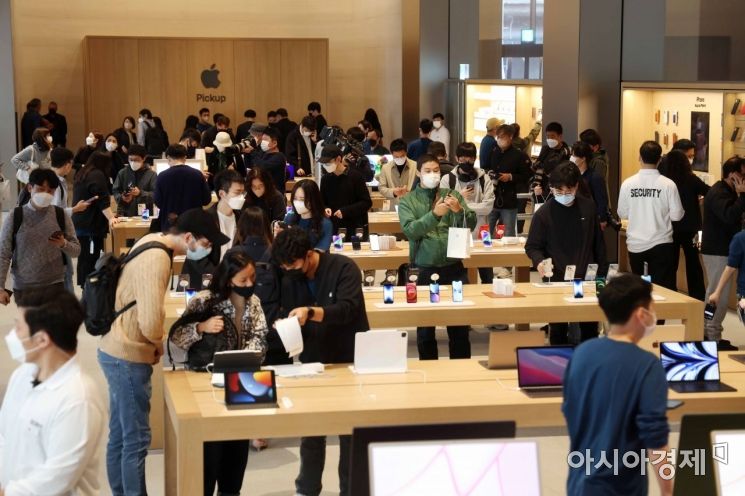 On the 7th, when Apple's new iPhone 14 series was officially released in Korea, citizens were examining the products at the Apple Store in Myeongdong, Jung-gu, Seoul. Photo by Mun Honam munonam@
Industry insiders evaluate that the emphasis on practicality and 'cost-effectiveness' as a consumption tendency of the MZ generation (Millennials + Generation Z) has also increased demand for budget phones. According to data from the budget phone plan comparison platform Modu's Plan, 35% of subscribers are in their 20s and 34% in their 30s, meaning about 70% of users belong to the MZ generation. Budget phones provide services by leasing networks from the three major mobile carriers, so they do not require separate facility investment costs, allowing them to offer services at relatively low prices.
The government has also shown its intention to revitalize the budget phone market, which is expected to expand further. The Ministry of Science and ICT announced at the end of last year that it would reduce the budget phone wholesale price from 1.61 won to 1.29 won, a 19.8% cut, and unveiled strategies to strengthen the market and protect users. The purpose is to enhance competitiveness in pricing and services through wholesale price reductions, thereby guaranteeing more benefits for users.
MZ Generation Particularly Prefers 'Expensive' iPhones
Meanwhile, alongside the MZ generation's trend toward cost-effective plans, there is also a simultaneous rise in popularity for high-priced devices.
According to a survey titled '2012?2022 Smartphone Usage & Brand, Smartwatch, and Wireless Earphone Survey' released by Korea Gallup in July last year, the MZ generation shows a distinct preference for iPhones.
Among those aged 18 to 29, 52% answered that their current smartphone is an iPhone, while 44% use a Galaxy. Considering that the overall market share in Korea is about 70% Galaxy to 20% iPhone, this is a very unusual figure. iPhones are considered high-priced devices in the handset market, with the latest high-capacity models approaching 2 million won in price.
© The Asia Business Daily(www.asiae.co.kr). All rights reserved.
![Clutching a Stolen Dior Bag, Saying "I Hate Being Poor but Real"... The Grotesque Con of a "Human Knockoff" [Slate]](https://cwcontent.asiae.co.kr/asiaresize/183/2026021902243444107_1771435474.jpg)
















