From 5100 in 2022 to 1061 This Month
Impact of Economic Recession... "Could Fall Further This Year"
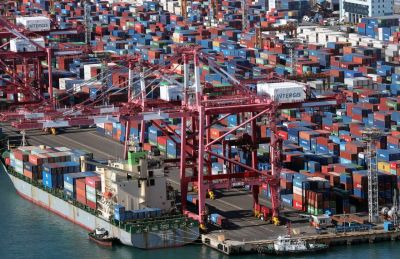
[Asia Economy Reporter Yoo Hyun-seok] The Shanghai Containerized Freight Index (SCFI), which rose to the 5100 level last year, has fallen to the 1000 level this year. This is the same level as three years ago in 2020. The global economic recession has pulled the index down. This year, the downward trend is expected to continue due to a decrease in cargo volume caused by the economic downturn.
The SCFI recorded 1061.14 on the 6th. This is a drop of 46.41 points compared to 1107.55 on December 30 last year. After falling continuously for 28 weeks, it seemed to rebound with a 0.46 point rise, but then it slipped again. The SCFI falling below 1100 is the first time since July 24, 2020.
Until the first half of last year, the SCFI maintained a high level. The SCFI, which peaked at 5109.6 on January 7 last year, dropped to 4434.07 on March 25 and 4216.13 on June 24. It fell about 900 points from the peak. Although the index declined at that time, it was seen as a return to normal after the SCFI had risen sharply due to factors such as the easing of port congestion, which was one of the causes of the surge.
However, as the United States began to raise its benchmark interest rate in earnest, concerns about an economic recession started to grow. On top of this, China’s zero-COVID policy was added. As a result, cargo volume decreased, and the SCFI index also fell rapidly. The SCFI, which was 4203.27 on July 1, dropped to 2847.62 on September 2, 1814 on October 14, and fell to the 1100 level in December of the same year. It plunged more than 3000 points.
At one point last year, the SCFI even exceeded the 5000 level. The SCFI began to rise significantly in the second half of 2020. After surpassing 2000 in November 2020, it exceeded 3000 in April 2021. Then in July, it rose above 4000 and surpassed the 5100 level in January 2022.
COVID-19 drove the SCFI up. In the early stages of COVID-19, major countries implemented lockdown measures. Economic activities also contracted, leading to a decrease in cargo volume. However, the lockdowns were lifted faster than expected. Especially, people who had been restrained due to COVID-19 engaged in pent-up consumption, causing cargo volume to increase explosively. Port congestion also appeared.
In fact, in 2020, when COVID-19 was in full swing, global cargo volume was 194.9 million TEU (1 TEU equals one 20-foot container), a 1.4% decrease compared to the previous year. However, in 2021, it was 207.9 million TEU, a 6.6% increase from the previous year.
This year, the SCFI is expected to continue its slump following last year. Concerns about an economic recession remain, and container capacity (cargo loading capacity) is expected to increase further.
This year’s container supply is 2.21 million TEU, a 6.9% increase compared to the previous year (Korea Maritime Promotion Corporation '2022 Annual Shipping Market Report'). This is the largest scale since 2000. However, demand is expected to increase by only 0.5%. This means a supply-demand imbalance where supply greatly exceeds demand.
Professor Koo Gyo-hoon of the Department of International Trade and Logistics at Baewha Women’s University said, "In the case of container ships, due to excess capacity, freight rates can only fall further," adding, "The SCFI will return to pre-pandemic levels and may fall further due to the global economic recession."
© The Asia Business Daily(www.asiae.co.kr). All rights reserved.
![Clutching a Stolen Dior Bag, Saying "I Hate Being Poor but Real"... The Grotesque Con of a "Human Knockoff" [Slate]](https://cwcontent.asiae.co.kr/asiaresize/183/2026021902243444107_1771435474.jpg)















