Spread of Unification Church Issues Following Former PM Abe's Shooting
Evidence Emerges of Donations Used for Land Purchases
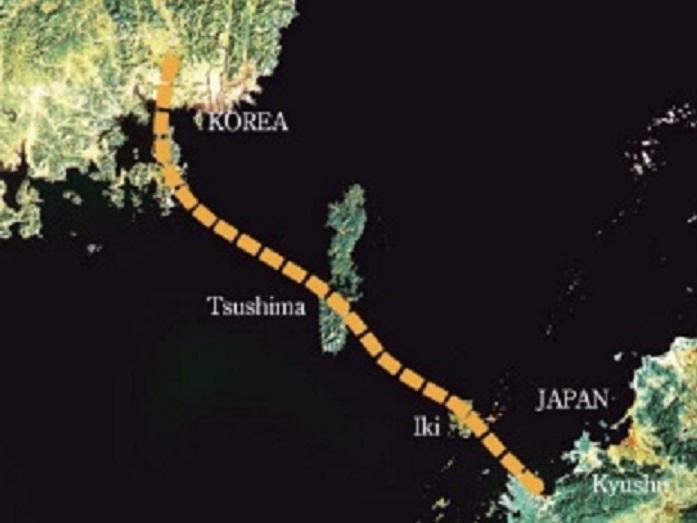 Conceptual diagram of the Korea-Japan Undersea Tunnel introduced by the International Highway Foundation. (Photo by International Highway Foundation)
[Asia Economy Reporter Jeon Jin-young] Amid the spread of the Unification Church issue in Japan following the shooting of former Prime Minister Shinzo Abe, allegations have emerged that the Unification Church invested funds in the construction of the Korea-Japan Undersea Tunnel. Japanese media reported that 95% of the land for the Korea-Japan Undersea Tunnel came from organizations related to the Unification Church, and there is evidence that donations from former Unification Church members were used.
On the 12th, the Mainichi Shimbun reported that the "International Highway Foundation," responsible for the Korea-Japan Undersea Tunnel project, purchased 460,000㎡ (approximately 140,000 pyeong) of land through donations from Unification Church-related organizations. According to Mainichi, 430,000㎡ (about 130,000 pyeong) of the total purchased land was donated by Unification Church-related groups, and in the Kyushu region, the land area equivalent to ten Tokyo Domes is known to be connected to the Unification Church.
Mainichi revealed that this was discovered after investigating land registries and other documents based on the foundation's materials from November to December last year. They also claimed that donations from former Unification Church members were used in the land acquisition process. The foundation's predecessor, the International Highway Construction Project Group, reportedly received about 10 billion yen (approximately 94.7 billion KRW) in donations from the Unification Church, according to Mainichi. Mainichi stated, "This acknowledges that donations from Unification Church members were effectively used as funds for land acquisition."
Mainichi also reported that their reporters confirmed in the "Collected Sayings of Reverend Sun Myung Moon," which contains sermons by former Unification Church leader Sun Myung Moon, statements such as, "It has already been nearly 20 years since the plan started. We spent 100 million yen (900 million KRW) monthly for ten years digging," and "More than 10 billion yen of Unification Church resources were invested."
Furthermore, related content appeared in newsletters published by the Unification Church foundation. In the 2016 newsletter, there was a photo of President Han Hak-ja inspecting the site and planting a commemorative tree, and in 2017, it was mentioned that the number of Korean inspectors reached 2,000, according to Mainichi. They added that land purchases were proceeding in a similar manner not only in Kyushu but also in Nagasaki.
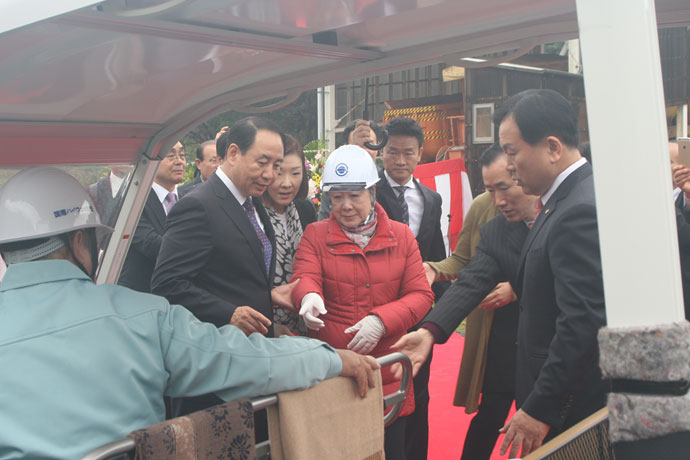 In November 2016, President Han Hak-ja inspects the site of the Korea-Japan Undersea Tunnel. (Photo by International Highway Foundation)
The Korea-Japan Undersea Tunnel Concept Began in the 1910s
The idea of the Korea-Japan Undersea Tunnel was first discussed in Japan after the 1910 Japan-Korea Annexation. Japan, aiming to occupy China, planned to build a transcontinental railway and attempted to advance the project by excavating survey tunnels, but it was abandoned due to the outbreak of World War II.
The issue resurfaced in Korea in 1981 when former leader Moon publicly announced it. Subsequently, research groups related to the Unification Church began studies, and the Korea-Japan Tunnel Research Association was established.
The Korea-Japan Undersea Tunnel has occasionally appeared in the political arena of both countries. Before the Unification Church issue arose, it was used as a card to improve Korea-Japan relations. In Japan, former Prime Minister Mori Yoshiro proposed the construction of the Korea-Japan Undersea Tunnel, and it was set as a major agenda item by the Liberal Democratic Party. In Korea, former Presidents Kim Dae-jung and Roh Moo-hyun, as well as former People Power Party Emergency Committee Chairman Kim Jong-in, mentioned the need to promote the project, and in Busan, where the tunnel would connect, the issue resurfaced during mayoral elections.
Effectively Halted... Future Promotion Seems Difficult
The Korea-Japan Undersea Tunnel project has already been effectively abandoned after repeatedly failing safety and feasibility assessments. Minister of Land, Infrastructure and Transport Saito Tetsuo also drew a line in a press conference last August, stating, "There has been no review of the Korea-Japan Undersea Tunnel in national land formation plans. Honestly, I think it is an absurd idea."
Moreover, with the Unification Church issue heating up in Japan following the shooting of former Prime Minister Abe and evidence emerging of the Unification Church's deep involvement in the Korea-Japan Undersea Tunnel project, future promotion is expected to become even more difficult.
In Japan, controversy is spreading as testimonies from professors and engineers involved in the project continue. Masaki Nakama, a professor at Kanazawa University who identified himself as a former Unification Church member, stated, "The Korea-Japan Undersea Tunnel has been promoted as an essential element of the Unification Church's vision of an East Asian community centered on the Messiah to realize a heavenly kingdom on earth."
Masaki Kito, a lawyer who has dealt with Unification Church issues in Japan, criticized, "Those involved in the Korea-Japan Undersea Tunnel concept are indirectly supporting the church, so I hope they exercise caution and be aware of the source of the funds."
© The Asia Business Daily(www.asiae.co.kr). All rights reserved.
![Clutching a Stolen Dior Bag, Saying "I Hate Being Poor but Real"... The Grotesque Con of a "Human Knockoff" [Slate]](https://cwcontent.asiae.co.kr/asiaresize/183/2026021902243444107_1771435474.jpg)
















