[Asia Economy Yang Nak-gyu, Military Specialist Reporter] It has been confirmed that the government has begun developing small stealth unmanned aerial vehicles (UAVs).
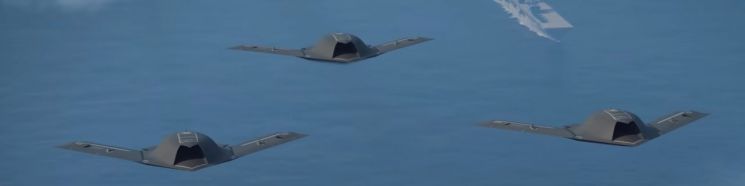
According to the defense industry on the 12th, the Agency for Defense Development (ADD) is currently holding consultations among domestic defense companies to develop small reconnaissance UAVs, following the ‘unmanned swarm aircraft’ and ‘stealth unmanned reconnaissance aircraft’ projects.
Earlier, Dr. Jeong Sang-jun of ADD reportedly stated during the Ministry of National Defense’s briefing to President Yoon Suk-yeol the previous day that, in response to public concerns about UAV technology, "Our UAV technology has advanced to the point where we will soon be able to produce and mass-produce stealth UAVs."
‘Stealth technology’ reduces the Radar Cross Section (RCS), making it difficult for conventional radar to detect and identify early. The stealth UAV mentioned at the briefing is known to be part of the ‘Gaori-X series.’ Korean Air is developing various stealth UAVs under the Gaori-X versions: Gaori-X 1 is an ‘unmanned swarm aircraft,’ and Gaori-X 2 is a ‘stealth unmanned bomber.’ Following these UAVs, the possibility of developing the Gaori-X 3, a small stealth reconnaissance UAV, is being explored.
Possibility of ‘Gaori-X 3’ Version Enhancing Reconnaissance Capabilities Among Korean Air’s UAV Series
Gaori-X 1 was developed in 2014. It is a scaled-down version of a large unmanned combat aircraft, reduced to 46% of the original size, measuring 10.4 meters in length, 14.8 meters in wingspan, and weighing 10 tons. Gaori-X 1 flew 50 km in 1 hour and 30 minutes, opening the possibility for unmanned combat aircraft development.
Since last year, development of the attack-type unmanned combat aircraft Gaori-X 2 has been underway. It can be equipped with Korean-style medium-range guided bombs and is referred to as a ‘mini B-2 bomber.’ To mount weapons, it is expected to be equipped with a 5,500-pound class turbofan engine currently under development for stealth UAVs. Stealth UAV engines being developed by the U.S. and others are equipped with 10,000-pound class engines.
Gaori-X 3, focusing on reconnaissance, is expected to be about 3 meters in size and will be coated with radar-absorbent material (RAM paint). The paint applied to the aircraft’s surface, along with an infrared suppression engine, is a core technology of stealth aircraft. Developing this paint domestically was necessary because importing it from overseas was difficult due to concerns about technology leakage. The RAM paint was completed in 2020 through a commissioned research project with a private company. This paint is also applied to the first domestically produced fighter jet, the ‘KF-21 Boramae.’ The plan is to apply it to Gaori-X 3 after performance verification by applying the paint to prototypes during the KF-21 development process.
Some Opinions Suggest Developing Stealth and Hypersonic Missile Materials Will Take a Long Time
Applying domestically developed paint to Gaori-X 3 is expected to significantly reduce its ‘detectability rate,’ lowering the chance of detection by enemy radar. The latest stealth fighter, the F-35A, has a Radar Cross Section (RCS) of 0.001㎡, and the F-22 ‘Raptor’ has an RCS as low as 0.0001㎡. To enemy radar, these fighters appear about the size of a ‘golf ball.’
However, the military and related circles view that, as the government stated, development will not be easy in the near future. To build stealth UAVs, high-heat-resistant and radar-absorbent materials for airframes must also be developed, but these have not yet been achieved. These materials are not only essential for stealth fighters but also core technologies for hypersonic vehicles that the government is promoting.
Hypersonic vehicles fly at speeds exceeding Mach 9 (approximately 11,000 km/h). At such speeds, temperatures exceeding 2,000 degrees Celsius occur at the front of the vehicle. If the vehicle cannot withstand this heat, it will melt before reaching its destination. This is why high-heat-resistant and radar-absorbent materials are necessary for hypersonic vehicles.
A government official said, “Developing materials for small stealth UAVs and hypersonic vehicles and moving into actual design will likely only be possible after 2028,” adding, “Although the Ministry of National Defense announces measures every year, these achievements cannot be realized in a short period.”
© The Asia Business Daily(www.asiae.co.kr). All rights reserved.
![Clutching a Stolen Dior Bag, Saying "I Hate Being Poor but Real"... The Grotesque Con of a "Human Knockoff" [Slate]](https://cwcontent.asiae.co.kr/asiaresize/183/2026021902243444107_1771435474.jpg)















