 On the morning of the 11th, attendees are taking a commemorative photo at the 'DTx Policy and Institutionalization Promotion Forum' held at the National Assembly Members' Office Building in Yeongdeungpo, Seoul, co-hosted by Baek Jong-heon, a member of the People Power Party, Lee Byung-hoon, a member of the Democratic Party of Korea, and the Korea Internet Corporations Association.
 [Photo by Lee Chun-hee]
[Asia Economy Reporter Chunhee Lee] As the country's first 'digital therapeutic device (digital therapeutics, DTx)' is expected to be released soon, a forum was held to discuss what kind of policy and institutional support should be prepared for actual industry growth. Participants unanimously agreed on the need for industrial movements and regulatory reforms that consider the characteristics of DTx.
On the morning of the 11th, at the National Assembly Members' Office Building in Yeongdeungpo, Seoul, a forum titled 'Discussion for Promoting DTx Policy and Institutionalization' was co-hosted by Baek Jongheon, a member of the People Power Party, Lee Byunghun of the Democratic Party, and the Korea Internet Corporations Association. Presenters emphasized that understanding the characteristics of DTx is essential for proper policy formulation and institutionalization.
The first presenter, Professor Myungcheol Park of the Department of Avionics Engineering at Kyungwoon University, repeatedly stressed in his presentation on 'Measures to Revitalize the DTx Ecosystem' that it is necessary to properly understand and approach the features of DTx. Professor Park pointed out that, in terms of approval, "DTx has fewer elements that could be fatal to subjects compared to other therapeutics, and many treatments are conducted as management during drug holidays for chronic disease patients," emphasizing the need for regulatory relaxation differentiated from other therapeutics. He also cited 'user participation' as a distinguishing feature of DTx compared to other treatments. Starting with 'NeuroRacer' in 2013 and followed by Akili Interactive's 'EndeavorRx' receiving FDA approval in June 2020, game-based DTx has been gaining attention.
Given the significant preventive effects of DTx through such methods, Professor Park highlighted the role of the insurance sector. He said, "The less the loss, the greater the insurer's profit," and added, "If DTx that can manage chronic diseases preventively over the long term emerges, there could be proposals to utilize virtual loss amounts based on this." Regarding fee application, he pointed out that the current reimbursement system is largely divided into three categories: procedures, pharmaceuticals, and materials, stating, "In fact, DTx encompasses all three," and criticized that "since it does not fit procedural content, new regulatory procedures are necessary."
Han Deokhyun: "DTx Should Not Merely Be Digitalized"
Next, Professor Deokhyun Han of the Department of Psychiatry at Chung-Ang University Hospital, in his presentation on 'The Evolution and Concept of DTx,' stressed the need to distinguish digital therapeutics, digital medicine, and digital health. Professor Han emphasized that digital health, which merely refers to effects like 'improved concentration,' is insufficient; clinical evidence must be secured to advance to digital medicine, and furthermore, understanding why actual clinical improvements occur is necessary to progress to digital therapeutics.
He lamented that the DTx industry has forgotten its essence and chosen an easy detour. To be recognized as DTx, the mechanism that brings clinical improvement must be proven, but the reliability of this is often controversial. He said, "To overcome this, many DTx developers have shifted to digitalizing cognitive behavioral therapy (CBT)," adding, "Although this is unavoidable to secure scientific evidence, even Pear Therapeutics, which received FDA approval as the 'first DTx,' is currently not widely used because it lacks user engagement," strongly criticizing the situation.
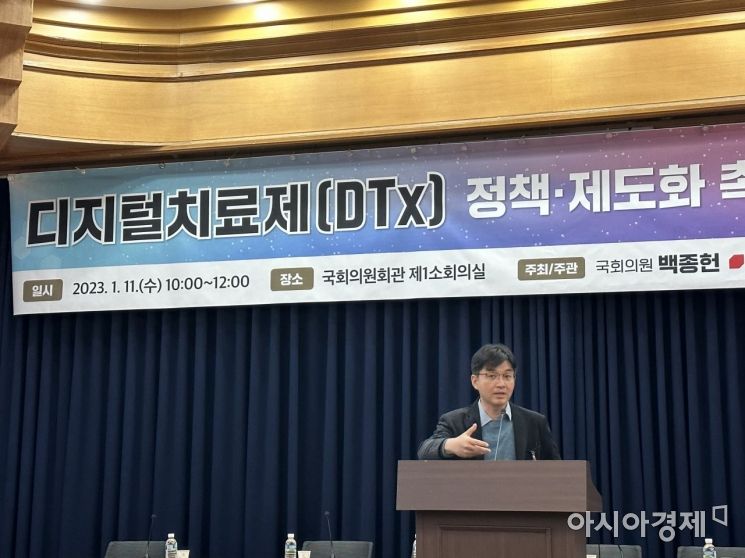 On the morning of the 11th, at the National Assembly Members' Office Building in Yeongdeungpo, Seoul, Han Deok-hyun, a professor in the Department of Psychiatry at Chung-Ang University Hospital, is giving a presentation at the 'DTx Policy and Institutionalization Promotion Forum.'
 [Photo by Lee Chun-hee]
To overcome this, he advised DTx developers to "remember that DTx is absolutely not just a digitalized CBT" and "must secure its unique identity." Professor Han said, "Clinical experts must be practically involved in the design, production, and clinical aspects of DTx," and "beyond CBT, characteristic mechanisms of digital therapeutic effects are needed."
He also called for active consideration of business models. Professor Han analyzed, "In the U.S., when making prescription DTx, the response is often 'why bother?'" and "since it is difficult to enter the medical system, there is a tendency to vaguely shift to non-medical models." In contrast, he stressed the need for active prescription entry in Korea. He said, "Korea's strong health insurance system is an advantage that is hard to follow overseas in terms of DTx development," and added, "Even if non-reimbursed, if it is first recognized and used within health insurance, it can serve as a kind of license."
Kang Sungji: "A System to Build Trust in DTx Must Be Established"
The final presenter, Kang Sungji, CEO of Welt, who is currently developing the insomnia DTx 'PillowRx,' offered suggestions for the future created by DTx institutionalization. Kang emphasized that 'trust' is crucial for DTx institutionalization. He classified general digital healthcare as 'experience goods' and DTx as 'credence goods,' explaining that unlike digital healthcare, where it is difficult for anyone to guarantee reliability and side effects, DTx "receives product approval from the Ministry of Food and Drug Safety, doctors trust the ministry and prescribe, and the Health Insurance Review & Assessment Service recognizes fees trusting the prescribing doctors, so the public benefits," emphasizing that "continuous trust" is important and securing trust through this process is an urgent task.
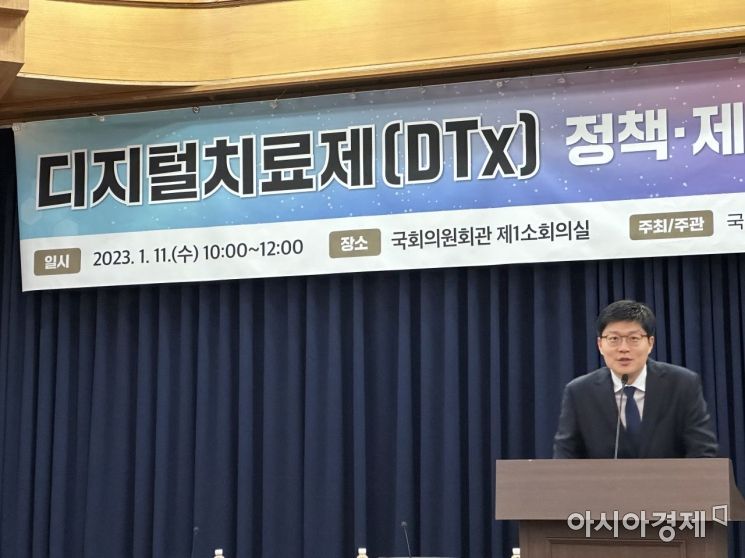 On the morning of the 11th, Kang Sung-ji, CEO of Welt, is giving a presentation at the 'DTx Policy and Institutionalization Promotion Forum' held at the National Assembly Members' Office Building in Yeongdeungpo, Seoul.
 [Photo by Lee Chun-hee]
He also pointed out the need to actively establish scientific evidence and to go beyond mere 'digitalization of CBT.' Kang said, "Existing insomnia DTx is not even 'digitalized' but merely 'computerized,'" and shared that they are attempting to develop DTx that goes beyond this. He gave the example of online lectures: what was once face-to-face lectures has been transformed into high-quality content produced in studios following protocols, making it available without limitation. Similarly, DTx aims to be structured using appropriate and verified protocols.
Based on these efforts, Welt envisions expanding into 'precision medicine.' Kang emphasized, "We are sparing no effort to include devices to understand sensors and users," and added, "Just as games analyze users to improve gameplay, DTx will continue to evolve to better treat patients."
"To Grow DTx, Institutional Discussions for Rapid Use Are Needed"
The subsequent discussion focused on what kind of systems should be established to actively support the emerging DTx industry. Legislative Research Officer Junhwa Jeong of the National Assembly Legislative Research Office explained, "We are considering whether existing regulations are appropriate for the new approach of DTx," adding, "If appropriate, regulatory relaxation is suitable, but if not, it is necessary to find appropriate regulations that fit."
 On the morning of the 11th, participants are engaged in a discussion at the 'DTx Policy and Institutionalization Promotion Forum' held at the National Assembly Members' Office Building in Yeongdeungpo, Seoul.
 [Photo by Lee Chunhee]
Professor Donggyu Lee of Dong-A University's Department of Business Disaster Management pointed out the need for institutional incentives to bring DTx to market. He said, "Overseas, various institutional efforts are being made for rapid market entry," and "we should benchmark these." Citing Germany's 'Digital Health Application Program (DiGA),' he explained, "Since it inevitably takes time to secure therapeutic effect data for DTx, providing reimbursement during the 12 months of data collection is important," emphasizing the need to discuss systems that allow rapid use and the will to do so.
Member of the National Assembly Baek Jongheon, who stayed until the end of the forum, shared his thoughts, saying, "The statement that user participation is the most important resonated with me," and "Since many regulations in the health and welfare sector need to be eased, I will work hard in my office."
© The Asia Business Daily(www.asiae.co.kr). All rights reserved.
![Clutching a Stolen Dior Bag, Saying "I Hate Being Poor but Real"... The Grotesque Con of a "Human Knockoff" [Slate]](https://cwcontent.asiae.co.kr/asiaresize/183/2026021902243444107_1771435474.jpg)

















