On the 27th, LG Energy Solution's Employee Stock Ownership Plan Shares Released
Potential Large Sell-off Causes Haink Korea Stock Price Fluctuation
CJ CGV and Lotte Tour Development Hampered by CB Volume
[Asia Economy Reporter Son Seon-hee] Since the beginning of the new year, many listed companies have been holding their breath in the stock market due to the 'overhang (potential large-scale sell-off volume)' issue. Companies that had stocks locked under resale restrictions or raised large-scale funds through convertible bonds (CBs) seem to be facing setbacks.
According to the Korea Securities Depository (KSD) on the 12th, among the listed companies scheduled to have their mandatory holding registration lifted this month, the company with the largest proportion relative to total issued shares is 'Haink Korea.' On the 20th, stocks equivalent to about 74.64% of the total issued shares will be released into the market.
Haink Korea is a company that produces wireless chargers, smartphone cases, and more. It mainly supplies self-manufactured products to Samsung and has been expanding its business by operating an online store since last year. It was listed on KOSDAQ on February 26, 2021, and recently absorbed and merged its subsidiary BNT International, which manufactures and sells accessories for Apple products. Lee Geon-jae, a researcher at IBK Investment & Securities, said, "Haink Korea is preparing the simple payment service 'Baroda' based on the funds secured through listing and increased recognition," adding, "The B2C sales business, which directly distributes its products through the online store, is also expected to grow smoothly."
Despite positive market evaluations, the company's stock price has shown increased volatility, falling and then sharply rebounding. After recording 9,370 won on November 28 last year, it dropped to the low 5,000 won range within just a month, then surged 15.08% in one day on the 11th to close at 5,800 won. This is interpreted as a combined effect of growth potential and the upcoming mandatory holding registration release of about 75% of issued shares on the 20th. According to KSD, a total of 2.7331 billion shares from 57 companies, including Haink Korea, will have their mandatory holding registration lifted this month.
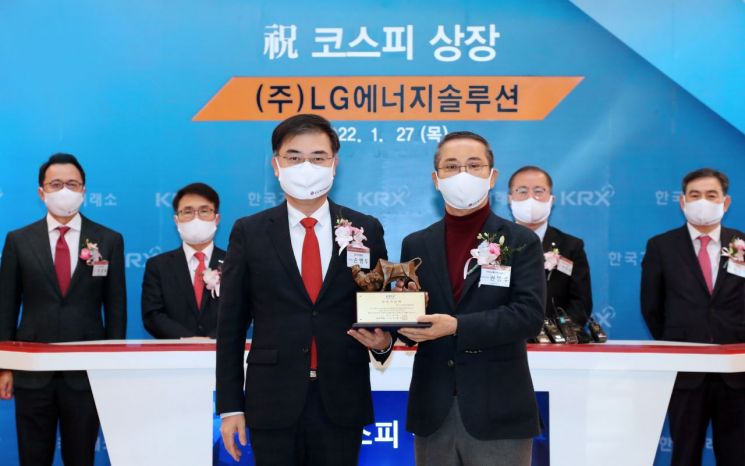 On January 27 last year, at the Korea Exchange, Son Byung-doo, Chairman of the Exchange (left), and Kwon Young-soo, CEO of LG Energy Solution, are taking a commemorative photo at the LG Energy Solution's new listing ceremony on the KOSPI market. Photo by Yonhap News Agency
On the KOSPI, the stock price trend of LG Energy Solution is undoubtedly a focus. LG Energy Solution will mark its "1-year anniversary of listing" on the 27th. On the same day, about 7.92 million shares of employee stock ownership will have their lock-up period lifted. This volume accounts for about 3.4% of the total issued shares. LG Energy Solution's stock price hit an intraday high of 629,000 won on November 11 last year but has since continuously declined, closing at 474,500 won on the 11th.
Analyses differ on how LG Energy Solution's stock price will move following the lifting of the employee stock ownership lock-up. Despite the recent downward trend, the stock price remains higher than the initial public offering price (300,000 won) at the time of listing early last year, leading to a dominant view that employees will realize profits as the lock-up period ends. On the other hand, some argue that the impact will not be significant as the growth potential of the battery industry remains valid. Yoon Hyuk-jin, a researcher at SK Securities, said, "Although there is a supply-demand burden due to the lifting of the employee stock ownership lock-up, we believe concerns about performance and demand have bottomed out."
Some companies are experiencing overhang risk due to excessive CB volumes. CJ CGV issued a total of 700 billion won worth of CBs in two rounds in June 2021 (conversion price 22,000 won) and July 2021 (26,600 won). After recording 21,650 won in December last year, CJ CGV's stock price turned sharply downward and has been hovering around 17,000 won recently, showing sluggish performance.
Similarly, Lotte Tour Development raised funds by issuing CBs in January last year (13,250 won) and March (15,550 won). Recently, as it has been spotlighted as a beneficiary of China's reopening (resumption of economic activities), its stock price has been rising, and the CB volume is gradually being released. When the stock price rises above the conversion price, CB investors are more likely to realize profits. This implies dilution of stock value, so the outstanding CB balance already issued acts as a burden factor on the stock price.
© The Asia Business Daily(www.asiae.co.kr). All rights reserved.
![Clutching a Stolen Dior Bag, Saying "I Hate Being Poor but Real"... The Grotesque Con of a "Human Knockoff" [Slate]](https://cwcontent.asiae.co.kr/asiaresize/183/2026021902243444107_1771435474.jpg)















