Woisikyeon 'Rice Usage Status and Food Security in Food Service Industry' Report
2020 Rice Consumption 3.64 Million Tons... Decreasing 2.1% Annually
"Core of Food Security is 'Rice'... Importance of Securing Production and Promoting Consumption"
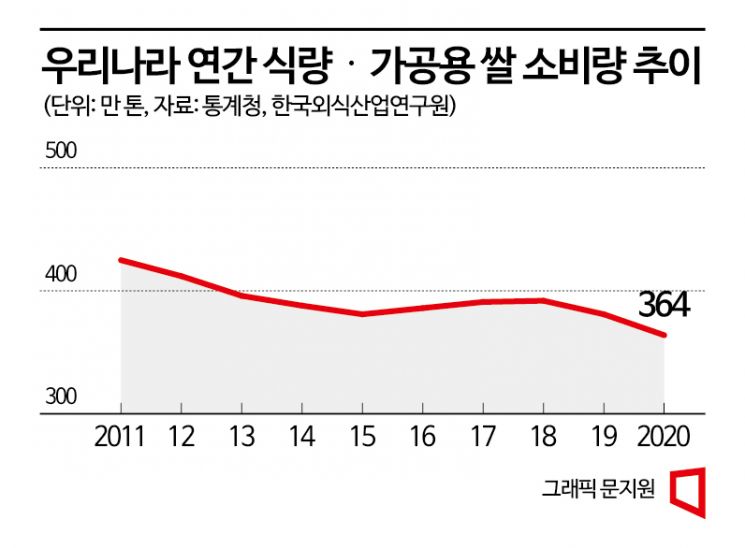
The nation's staple grain, rice, is being overshadowed by bread and meat, threatening its presence on the dining table. Domestic annual rice consumption has recorded the lowest levels in the past decade.
According to the report "Rice Usage in Food Service Industry and Food Security" published by the Korea Foodservice Industry Research Institute on the 11th, the consumption of rice for food and processing in South Korea was 3.64 million tons in 2020, a 14.4% decrease compared to ten years ago.
Looking at the yearly figures, domestic rice consumption, which reached 4.25 million tons in 2011, dropped to 4.12 million tons in 2012 and further declined to 3.96 million tons in 2013, falling below 4 million tons. Subsequently, it recorded 3.88 million tons in 2014, 3.81 million tons in 2015, 3.86 million tons in 2016, 3.91 million tons in 2017, 3.92 million tons in 2018, and 3.81 million tons in 2019.
Among these, the consumption of rice for food purposes has been decreasing by 2.1% annually, attributed to factors such as Western dietary habits including bread, increased meat consumption, and the rise of alternative foods.
As of 2021, the annual per capita rice consumption was 56.9 kg, which is a 49.6 kg (46.6%) decrease from 106.5 kg in 1995, nearly half. Rice consumption is now at a level similar to meat consumption. According to the Korea Hanwoo Association, last year’s per capita meat consumption was 56.5 kg, and the association forecasts that this year will mark the first time in South Korea that per capita meat consumption surpasses per capita rice consumption.
On the other hand, consumption of rice for processing purposes is showing a gradual increase (0.5%) due to the spread of home meal replacements (HMR).
Examining rice consumption by demand sectors, as of 2019, 61.8% of total rice consumption occurred at home, while outside the home, restaurants accounted for 18.5%, and group meals at schools and workplaces accounted for 16.8%. Although rice consumption at homes, schools, and workplaces is decreasing, rice consumption at restaurants is on the rise.
South Korea’s rice supply has been decreasing by about 1.9% annually since 2011, but food consumption has decreased even more, by about 2.3%, maintaining an oversupply trend of rice.
Lee Kyung-mi, senior researcher at the Korea Foodservice Industry Research Institute, stated, "Rice is the core of our country's food security, and securing stable production and promoting consumption are of utmost importance." She added, "It is time for multifaceted government policies to secure food sovereignty and strengthen farm management stability." She continued, "Although the government, producers, and consumer groups are making efforts to promote rice consumption, the effects have not been evident." She further noted, "Due to the resulting rice price collapse, farmers' incomes are decreasing, so practical support measures for rice-producing farmers are also necessary."
© The Asia Business Daily(www.asiae.co.kr). All rights reserved.
![Clutching a Stolen Dior Bag, Saying "I Hate Being Poor but Real"... The Grotesque Con of a "Human Knockoff" [Slate]](https://cwcontent.asiae.co.kr/asiaresize/183/2026021902243444107_1771435474.jpg)
















