Half of Apartment Brokerage Transactions This Year Are Below Previous Prices
'Cheondoron' House Prices Soared, Resulting in Large Declines
Experts: "High Interest Rates and Stagnant Population Inflow... Weakness Expected"
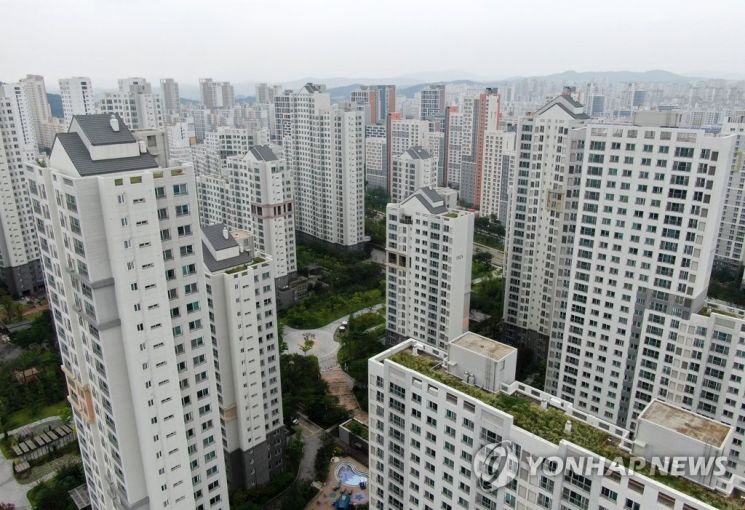
[Asia Economy Reporter Lim On-yu] The real estate cold wave that hit Sejong City continues into the new year. As houses change hands repeatedly, prices keep falling, intensifying the fear among market participants. Given that Sejong City’s housing prices soared in 2020 thanks to the so-called 'relocation theory' tied to the administrative capital move, the boomerang effect of the ultra-high interest rate era is even more painful. Experts weigh more heavily on the decline theory, although there is a variable of reduced new housing supply this year.
According to the Ministry of Land, Infrastructure and Transport’s real transaction price disclosure system on the 12th, a total of 12 apartment sales contracts were signed in Sejong City this year. Among 8 brokerage transactions excluding direct deals, 4 were bought and sold at prices lower than the previous ones. A 99.07㎡ (exclusive area) unit in Haedeulmaeul 6 Complex, Daepyeong-dong, Sejong City, was sold for 720 million KRW on the 5th. This is 280 million KRW less than the previous transaction price of 1 billion KRW in November last year. It plunged to nearly half the highest price of 1.385 billion KRW recorded in July 2021.
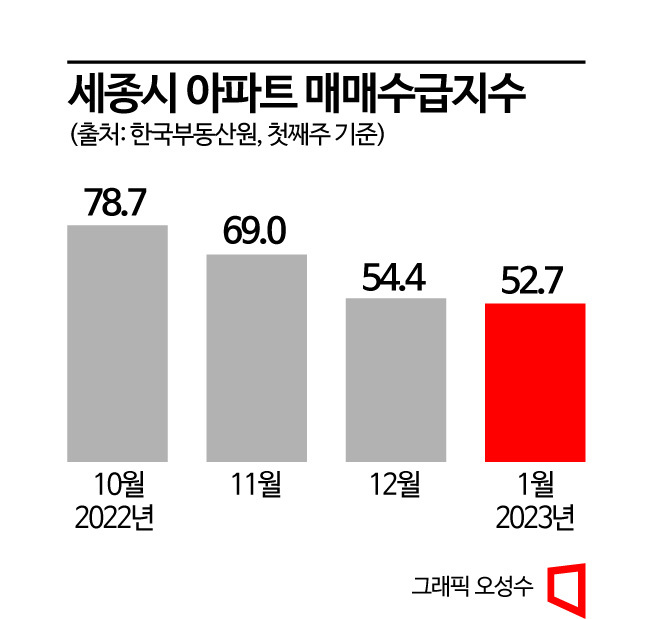
On the 7th, a 59.99㎡ unit in Garakmaeul 15 Complex, Goun-dong, changed hands for 300 million KRW. This is 105 million KRW lower than the previous transaction price of 405 million KRW in May last year. A representative from Goun-dong A Real Estate Agency said, "The price drops by tens of millions of won with each contract, and there are so few buyers that it’s fortunate the units are selling at all." In fact, the sales supply-demand index, which indicates the ratio of buyers to sellers in Sejong, was only 52.7 as of the first week of January, the lowest among the 17 metropolitan cities and provinces nationwide.
Sejong City’s housing prices surged in 2020 riding the ruling party’s relocation theory. According to the Korea Real Estate Board, apartment prices in Sejong City rose by 42.3% compared to the previous year. However, the rapid rise during the real estate downturn returned as a boomerang in the form of a sharp decline. Last year, apartment prices in Sejong City fell by 16.74%. The housing prices, which had been declining since 2021 due to a supply glut, saw the decline deepen in conjunction with the base interest rate hikes.
Most experts expect the weak housing prices in Sejong City to continue this year. Ham Young-jin, head of the Zigbang Big Data Lab, explained, "With the macroeconomic situation of high interest rates continuing and population inflow stagnating, it will be difficult for prices to rebound this year unless there is a positive factor to drive growth." However, since there is no short-term oversupply expected as in Daegu or Incheon, if interest rate hikes stop, there is a possibility that real demand will revive. Ye Kyung-hee, senior researcher at Real Estate R114, said, "Sejong’s housing prices fell too much last year, so this year will be a breather period," adding, "If government regulations continue to ease and interest rate hikes conclude, real demand buyers looking to switch homes may become active in the second half of the year."
© The Asia Business Daily(www.asiae.co.kr). All rights reserved.
![Clutching a Stolen Dior Bag, Saying "I Hate Being Poor but Real"... The Grotesque Con of a "Human Knockoff" [Slate]](https://cwcontent.asiae.co.kr/asiaresize/183/2026021902243444107_1771435474.jpg)
















