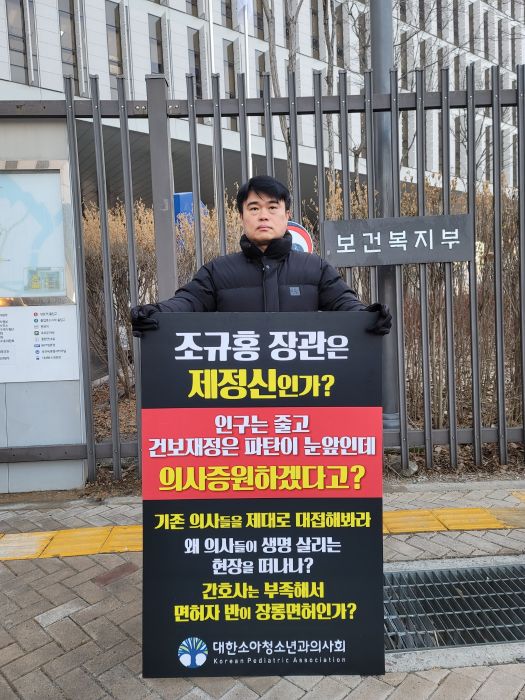
 Im Hyuntaek, president of the Korean Pediatric Society, is staging a one-person protest in front of the Ministry of Health and Welfare building in opposition to the increase in medical school quotas.
 [Photo by Korean Pediatric Society]
[Asia Economy Reporter Lee Gwan-ju] Since the beginning of the new year, the government has been bringing sensitive issues such as pension and health insurance reform, expansion of medical school quotas, legalization of telemedicine, and strengthening of non-reimbursable service management to the forefront. Given that the medical community has clearly opposed these policies, conflicts between the government and the medical sector are expected from the start of the year.
According to the Ministry of Health and Welfare on the 12th, the government is considering increasing the medical school quota as one of the measures to strengthen essential medical services. Minister of Health and Welfare Cho Kyu-hong said the day before, “We will promptly begin consultations with the medical community to expand medical school quotas and legalize telemedicine.” The ministry stated that no specific discussions have yet taken place with the Korean Medical Association regarding the timing or scale of the quota increase.
However, dialogue itself is expected to be difficult. The medical community has consistently opposed discussions related to increasing medical school quotas, arguing that it cannot be a fundamental solution to expanding essential medical services. Lim Hyun-taek, president of the Korean Pediatric Society, recently held a solo protest in front of the Ministry of Health and Welfare building opposing the increase in medical school quotas. Lim criticized, “Even though the medical society proposed policy alternatives tailored to field conditions at a ‘cram school’ level, they were not accepted, which damaged pediatric medical infrastructure, and the damage was directly borne by parents raising children. Now, to make matters worse, presenting an increase in medical school quotas as a solution to the collapse of essential medical services is simply pathetic.” He also questioned, “Do new ministry officials stay on the job only if they are well treated, or do they come to work even if the treatment is poor as long as the number of officials increases?”
Conflicts are also inevitable over the government’s plan to strengthen management of non-reimbursable services to enhance health insurance coverage. The Ministry of Health and Welfare plans to establish a ‘Second Comprehensive Plan for Strengthening Non-Reimbursable Service Management’ soon after consultations with related ministries. Kwon Byung-gi, the ministry’s essential medical support officer, explained, “In addition to the previously presented measures regarding non-reimbursable services, we plan to identify and propose additional ways to promote rational use of non-reimbursable services.” However, the medical community strongly opposes this, viewing it as an attempt to control non-reimbursable services as an ‘axis of evil.’ The Association of Presidents of Metropolitan and Provincial Medical Associations pointed out, “This undermines market autonomy, induces price competition among medical institutions and patient attraction, seriously damages the trust relationship between patients and medical institutions, leads to a decline in the quality of medical services, and ultimately the damage will be borne entirely by patients.”
The conflict between the government and the medical community is likely to negatively affect discussions on the legalization of telemedicine, which is being pursued as a national agenda. The government plans to complete legalization by June. There are many details to be negotiated, such as the target patients and diseases, but if conflicts intensify, the discussion timeline will inevitably be delayed. The ‘Medical-Government Consultative Body,’ a consultation mechanism between the government and the medical community that was suspended during the previous administration, has not yet resumed.
© The Asia Business Daily(www.asiae.co.kr). All rights reserved.
![Clutching a Stolen Dior Bag, Saying "I Hate Being Poor but Real"... The Grotesque Con of a "Human Knockoff" [Slate]](https://cwcontent.asiae.co.kr/asiaresize/183/2026021902243444107_1771435474.jpg)















