Rural Development Administration Announces '2023 Work Plan'
[Asia Economy Sejong=Reporter Lee Jun-hyung] The Rural Development Administration (RDA) is set to expand the distribution of powdered rice by developing new varieties. It will also expand the dissemination of double-cropping cultivation technology to increase food self-sufficiency.
On the 11th, the RDA announced its "2023 Work Plan" containing these details. This year's work plan includes four major strategic tasks and ten practical tasks: ▲Promoting the future growth industrialization of agriculture ▲Supporting food sovereignty ▲Supporting the stable production and supply of agricultural and livestock products ▲Revitalizing rural areas and expanding field support. At a briefing held at the Government Sejong Complex, Yoon Jong-cheol, Deputy Administrator of the RDA, said, "As we enter the second year of the Yoon Suk-yeol administration, we will focus the organization's capabilities on the flawless implementation of national tasks and creating future growth engines for agriculture through science and technology."
The RDA plans to first develop new varieties that can replace existing powdered rice varieties. This involves early development and distribution of high-quality new varieties that improve issues such as pre-germination in the existing powdered rice variety ‘Baromi 2’. They will establish cultivation techniques to increase powdered rice productivity and develop a double-cropping cultivation system.
Development of New Powdered Rice Varieties
The industrialization of powdered rice will also be accelerated. The RDA plans to develop standard management methods to maintain quality during the storage and distribution of powdered rice. In collaboration with the Ministry of Agriculture, Food and Rural Affairs, they will develop processing characteristic analysis and large-scale milling technology for powdered rice. Additionally, eight self-sufficient specialized complexes linked to powdered rice production sites will be established to support facilities needed for milling and processing, as well as provide technical education.
The distribution of new wheat and soybean varieties suitable for paddy field cultivation will also be expanded. Accordingly, the RDA will increase the field demonstration area of the paddy field soybean variety ‘Jangpum’ sixfold from the existing 1 hectare (ha) to 6 ha. They will also test the field adaptability of ‘Miryang 403’, a line suitable for paddy field cultivation and mechanization with high yield potential.
The distribution area of the bread wheat new variety ‘Hwanggeumal’ will be raised from 50 ha last year to 200 ha this year. Early distribution of the double-cropping suitable soybean new variety ‘Seonyu 2’ will also be promoted. They plan to distribute 7 tons of Seonyu 2 seeds to secure a cultivation area of 200 hectares.
Measures to expand ‘smart agriculture’ to open fields have also been announced. First, to spread open-field smart agriculture, prediction, diagnosis, and decision-support models will be developed for eight items including soybeans and onions. The RDA is currently conducting a preliminary feasibility study for the ‘Open-field Agriculture Digital Transformation Technology Development Project’ worth 130 billion KRW. To digitally transform fruit farms, the establishment of the ‘Fruit Digital Agriculture Demonstration Research Institute’ will also be accelerated. The RDA plans to invest a total of 42 billion KRW over four years from this year to 2026 to promote related projects.
Development of Agricultural Machinery for Field Farming
Agricultural machinery optimized for field farming will also be developed. The RDA plans to simultaneously develop varieties and cultivation techniques suitable for mechanized field crop operations. They will establish a high-performance computing center specializing in life and health fields and start providing customized genome and transcriptome data services to researchers, seed companies, and other users from October. Previously, in August last year, the Ministry of Science and ICT designated the RDA as a high-performance computing center specializing in life and health fields.
In addition, the work plan includes measures to support the government's agricultural product export policy. The RDA plans to focus on cultivating export strategic items such as strawberries and grapes, as well as promising export items like oriental melons and citrus this year. They will develop logistics cost reduction technologies such as CA container utilization technology, as well as package technology export models linked to domestic resources and technologies in downstream industries such as agricultural machinery and seed industries.
Jo Jae-ho, Administrator of the RDA, said, “The importance of food security is increasing, and as 4th Industrial Revolution technologies are applied to agriculture, agriculture is emerging as a future growth industry. To achieve the four strategic goals, we will actively implement the ‘Innovation Strategy for Agricultural R&D and Technology Dissemination’ established at the end of last year.”
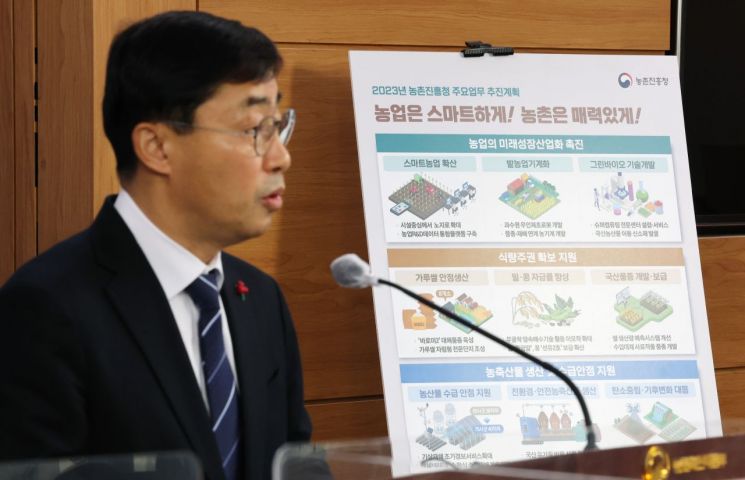 RDA 'Stable Production of Rice Flour, Development of New Wheat and Soybean Varieties to Improve Food Self-Sufficiency Rate'
(Sejong=Yonhap News) Reporter Kim Juhyung = Yoon Jongcheol, Vice Administrator of the Rural Development Administration, is announcing the major work plans of the RDA for 2023 at the Government Sejong Complex in Sejong City on the morning of the 11th. 2023.1.11
kjhpress@yna.co.kr
(End)
<Copyright(c) Yonhap News Agency, Unauthorized reproduction and redistribution prohibited>
© The Asia Business Daily(www.asiae.co.kr). All rights reserved.
![Clutching a Stolen Dior Bag, Saying "I Hate Being Poor but Real"... The Grotesque Con of a "Human Knockoff" [Slate]](https://cwcontent.asiae.co.kr/asiaresize/183/2026021902243444107_1771435474.jpg)
















