IKEA Drawer Overseas Causes Death of 8 Children
Chronic Issue of Injuries to Children and Elderly
Safety Test Procedures Detached from Reality
Over 30 Recalls Including Famous Brands in 3 Years
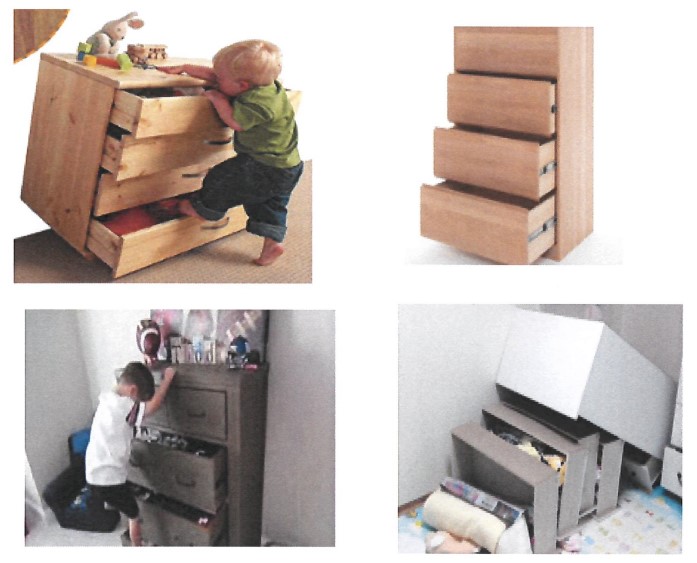
Incidents of dressers tipping over continue to occur. In the United States, an IKEA dresser tipped over, causing the death of a child, and recently in South Korea, a two-drawer dresser tipped over, prompting calls to strengthen safety standards. Furniture companies have an obligation to conduct safety inspections on their products, but problems persist, with even well-known companies receiving mass recall orders.
◆Ongoing Tipping Accidents = Accidents involving dressers tipping over and injuring children and the elderly are a chronic problem in households. A representative case is the global furniture company IKEA. The Malm dresser, released in 1989, has caused the deaths of eight children in the U.S. alone due to tipping accidents, leading to significant backlash. A global recall was conducted for the product, and in 2020, IKEA agreed to pay $46 million (approximately 53.6 billion KRW) to the bereaved families. The Organisation for Economic Co-operation and Development (OECD) reported that 33,000 people are injured annually in the U.S. due to furniture or TVs tipping over. For children, one visits the emergency room every 30 minutes, and one dies every two weeks. Children often stand on open drawers as if they were steps, causing the dresser to tip forward and result in accidents.
Recently, in Goyang City, Gyeonggi Province, a two-drawer dresser manufactured by a well-known furniture company collapsed after failing to bear the load. A whistleblower, Mr. A, said, "When the drawers were filled and all opened, the dresser tipped over, and even if the drawers were empty, pressing with a single finger caused it to tip." Mr. A’s mother, who was using the dresser, narrowly avoided the falling dresser. This dresser had no safety standards because its height was only 52 cm.
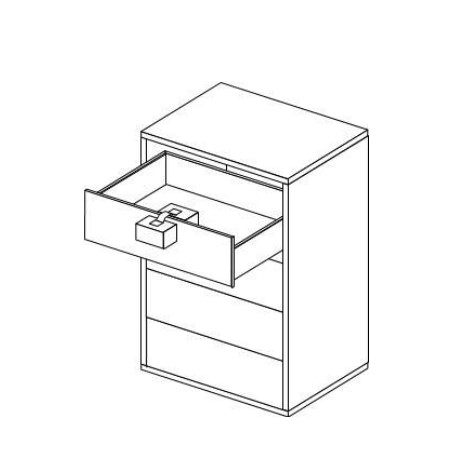 Stability test for drawers set by the National Institute of Technology and Standards. A 25 kg weight is hung on a single drawer, and it is tested to ensure it does not tip over for 1 minute.
◆Safety Inspection ‘Loopholes’ = Safety regulations for household dressers are managed by the Korea Agency for Technology and Standards under the Ministry of Trade, Industry and Energy. For wooden dressers 76.2 cm or taller, safety standards have been established due to the risk of accidents. Companies must pass safety tests conducted by third-party organizations to sell their products. The stability test to prevent tipping includes: ▲ opening all drawers to two-thirds of their operational length while loaded and ensuring the dresser does not tip for one minute, and ▲ hanging a 25 kg weight on one drawer, opening it two-thirds, and confirming it does not tip for one minute. Additionally, the furniture must have or provide parts to attach devices that fix it to walls or other structures to prevent tipping.
Although these safety regulations were strengthened after the IKEA incident, there are several blind spots. First, safety regulations apply only to wooden dressers 76.2 cm or taller. Second, the test only opens drawers to two-thirds of their full range, failing to reflect situations where consumers open drawers fully. A furniture industry insider said, "The test is a formal procedure disconnected from consumers’ daily lives," adding, "Even dressers that pass the test will tip over if all drawers are opened and the top drawer is pressed with a single finger, shifting the center of gravity." The Korea Agency for Technology and Standards increased the weight used in the safety test from 23 kg to 25 kg in 2020, considering the weight of a 5-year-old boy in Korea. However, since the test opens only one drawer, it is insufficient to prevent situations where children open multiple drawers and stand on them.
◆Ongoing Dresser Recall Incidents = The method of preventing dressers from tipping by fixing them to walls is left to the discretion of companies or consumers. Hanssem and Hyundai Livart handle returns if consumers refuse wall fixation for dressers 76.2 cm or taller. IKEA, whose products require self-assembly, provides wall-fixing devices and informational notices. An IKEA representative stated, "We have developed fixed dressers that require wall fixation to function, and interlock dressers where opening one drawer automatically locks the others for safety," adding, "We plan to continue efforts and investments." However, IKEA’s fixed and interlock dressers have been introduced in the U.S., Germany, and the U.K., with no plans for release in South Korea yet. The domestic small furniture company 'Office Angeonsa' has supplied over 2,000 dressers with automatic locking of other drawers when one is opened to U.S. military bases in South Korea.
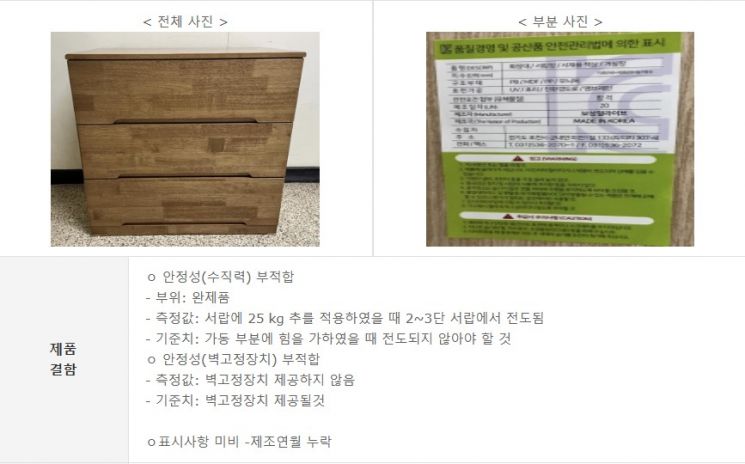 Furniture recalled last October due to safety non-compliance and other reasons [Image=Product Safety Information Center]
Due to superficial safety inspections and effectively shifting responsibility for safety onto companies, dresser recall incidents continue unabated. In 2020, eight products; in 2021, 17 products; and last year, 11 products were judged unsafe or failed to provide wall-fixing parts, resulting in recall orders for collection and exchange. The recall list includes products from well-known domestic brands such as Dongseo Furniture, Emons, Casamia, and Illoom. Considering that products sold on the market are randomly sampled to determine recalls, the risk of tipping accidents still exists.
Yoon Myung, Secretary-General of the Korea Consumer Organization, said, "While product safety at the level of passing tests should be continuously maintained, it is not properly upheld due to changes in raw and subsidiary materials," adding, "Since these accidents can lead to infant deaths, it is necessary to strengthen safety regulations by considering the actual circumstances of accidents from the user’s perspective."
© The Asia Business Daily(www.asiae.co.kr). All rights reserved.
![Clutching a Stolen Dior Bag, Saying "I Hate Being Poor but Real"... The Grotesque Con of a "Human Knockoff" [Slate]](https://cwcontent.asiae.co.kr/asiaresize/183/2026021902243444107_1771435474.jpg)

















