'Sexuality Reproduced in Golf Videos' Study
Close-ups of Body Parts Like Hips and Chest
"Viewer Satisfaction... Consumed as Sexual Objects"
When the media broadcasts women's golf players' matches, an analysis revealed that players are selectively shown based on physical characteristics rather than the progress of the game. The analysis of filmed frames and units showed that the players' external appearances were emphasized more than their game performance, indicating that the media still consumes female athletes as sexual objects.
Discriminatory Emphasis on 'Upper Body' in Highlight Broadcasts

According to the paper titled "Exploring the Subtlety of Sexuality Represented in Women's Golf Match Highlight Videos" published in the academic journal
The research data analyzed consisted of three highlight videos from the KLPGA 2020 Phantom Classic held over three days from September 25 to 27, 2020. The paper compared Player A, who attracted more attention due to physical attractiveness, with Player B. The reason for selecting highlights was to show the most important scenes and to examine what differences appear from there.
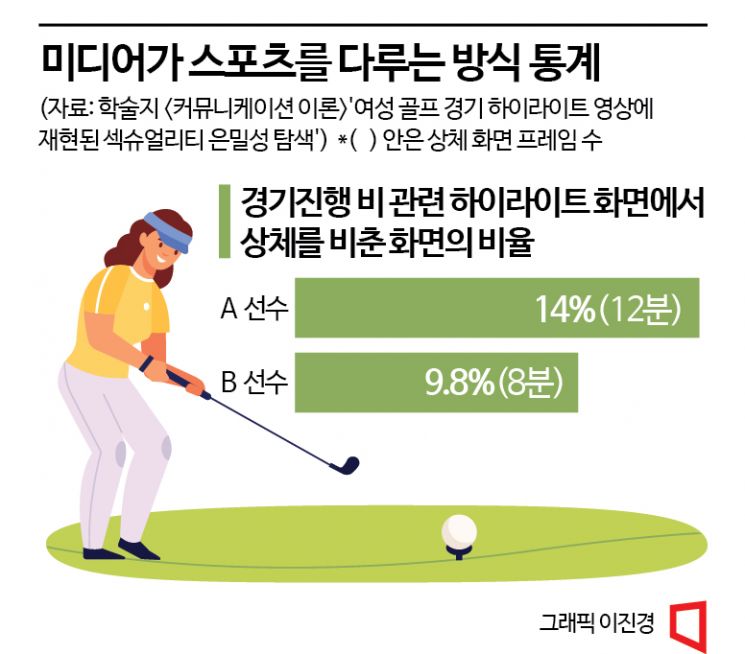
The study found that Player A's highlight video began with a prominent display of physical features such as the chest compared to Player B. When comparing the frequency and playback time of physical emphasis, Player A's upper body appeared in 13.8% of the screen time in the 5-minute 5-second highlights of rounds 2 and 3, whereas Player B's upper body appeared in only 9.8% of the screen time despite the video being longer at 7 minutes 51 seconds.
In terms of frame count, Player A's upper body frames numbered 1,208 in the 5-minute video, which was more than Player B's 829 frames. The paper explained that by analyzing golf highlight videos in detail by minutes and frames, it verified whether discriminatory emphasis on female golfers' sexuality exists in the media.
Majority Male Viewers... Media Increasing Satisfaction through Visual Stimuli

Sports that rank players using physical strength have traditionally been considered a male domain. Since organizers, participants, and audiences were all male, women were thoroughly excluded from sports. In fact, in the 1967 Boston Marathon, a woman was stopped by officials when she tried to run, and regulations allowing women to participate in the Olympics were only established in 1991.
Looking at how the media handles female athletes, it tends to do so within the visual scope of the overwhelmingly male audience. Traditional female sports such as figure skating and rhythmic gymnastics showcase physical beauty at a glance, and the media focuses more on female athletes' appearance, age, family, and household matters rather than their athletic performance and abilities.
ESPN's coverage of the 2015 Australian Open tennis mentioned female players' appearance, clothing, and personal stories more than male players, showed female players crying more often, while male players were shown regaining composure. Female boxing champions were described as having "small and pretty fists," and volleyball commentary included remarks like "7 blocks, which is a lot for a woman."
The paper cited Fink, stating, "Unlike male athletes, the media deliberately marks female athletes by gender or treats them as young and immature," and argued that "victories won by luck and roles as wives or family members outside the game are mentioned, engaging in femininity marketing."
The paper described this phenomenon as the "sports media commercial complex" and added that sexuality influences viewer satisfaction. Even when the screen only shows female athletes, the media still emphasizes hips and legs to increase viewers' satisfaction through visual stimuli. It emphasized that the media gains attention by focusing on these representations.
© The Asia Business Daily(www.asiae.co.kr). All rights reserved.
![Clutching a Stolen Dior Bag, Saying "I Hate Being Poor but Real"... The Grotesque Con of a "Human Knockoff" [Slate]](https://cwcontent.asiae.co.kr/asiaresize/183/2026021902243444107_1771435474.jpg)

















