End-of-Life Satellite Falls into Sea Near Alaska
Once Feared to Fall on Korean Peninsula
Increasing Satellites Cause 'Space Debris' Problem
[Asia Economy Reporter Yoon Seul-gi] Debris from a decommissioned U.S. Earth observation satellite passed over the Korean Peninsula and fell into the sea near Alaska. Although it is very rare for space debris to fall to Earth and cause damage, the increasing number of launched satellites has led to more threatening incidents.
According to the Ministry of Science and ICT and the Korea Astronomy and Space Science Institute (KASI) on the 10th, the satellite debris finally crashed around 1:04 p.m. on the 9th near the Bering Sea southwest of Alaska (latitude 56.9 degrees, longitude 193.8 degrees).
The object that fell that day was the U.S. Earth observation satellite 'ERBS.' It weighed 2.45 tons. It was launched from the Challenger space shuttle in October 1984 and carried out missions to observe and analyze Earth's thermal radiation distribution until 2005. After orbiting Earth for 18 years, it recently succumbed to gravity and fell.
Earlier, KASI analyzed that ERBS was highly likely to fall between 12:20 p.m. and 1:20 p.m. on the 9th. The problem was that the predicted fall range included the Korean Peninsula. The Ministry of Science and ICT issued a warning around 7 a.m. that day, preparing for any emergency, as there was a possibility that ERBS could fall near the Korean Peninsula.
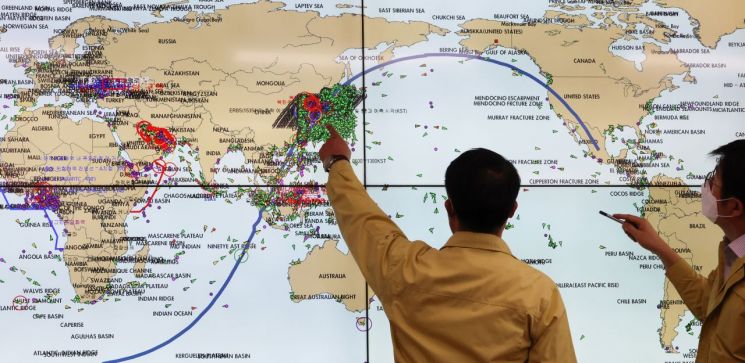 On the morning of the 9th, officials at the Ministry of Oceans and Fisheries Situation Room in the Government Complex Sejong, Sejong City, closely monitored the predicted crash trajectory of the US Earth Radiation Budget Satellite 'ERBS,' which is known to have a possibility of falling near the Korean Peninsula, while ensuring the safety of South Korean vessels. Photo by Yonhap News
The Ministry of Land, Infrastructure and Transport banned aircraft takeoffs and landings during the estimated fall time. According to the Korea Airports Corporation, aircraft departures were prohibited for 44 minutes from 12:10 p.m. to 12:54 p.m. at airports nationwide that day.
Fortunately, the satellite debris fell into the sea near Alaska, another location predicted by KASI. It is known that there was no damage caused by the crash.
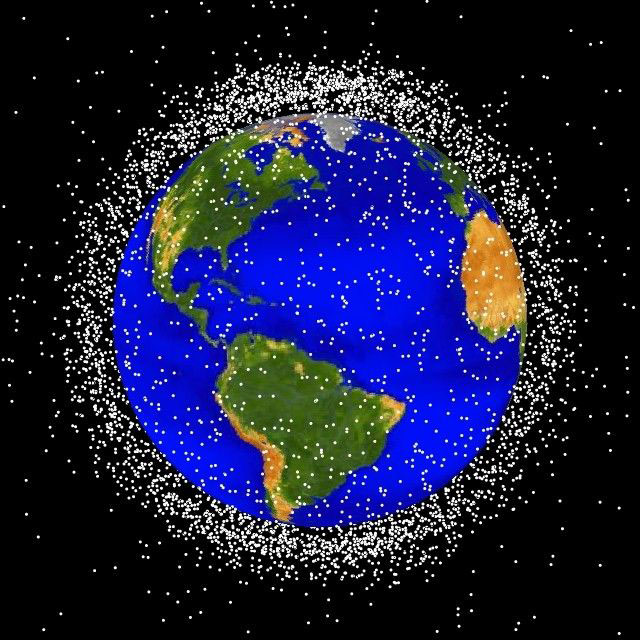
However, since such alarming situations could recur in the future, there are calls for measures to address space debris falling. According to the World Economic Forum (WEF), there are currently about 6,000 satellites orbiting in low Earth orbit, of which approximately 60% are defunct space debris. It is estimated that there are about 900,000 pieces of space debris larger than 1 cm in diameter. Converted to weight, this amounts to about 8,000 tons.
Concerns are also growing due to the recent surge in the number of satellites launched by private aerospace companies such as the U.S. SpaceX. SpaceX has launched 3,500 satellites to date and is reportedly planning to launch an additional 7,500 satellites.
There have also been actual cases of being hit by space debris fragments. On January 22, 1997, Lottie Williams, who lived in Tulsa, Oklahoma, was hit on the shoulder by a piece of a Delta II rocket. However, it was a light fragment, so there was no injury.
As space debris falling to Earth increases, cases of causing inconvenience are also rising. In March 2020, rocket debris about 2 meters in diameter from China's Chang Zheng 3B fell in a Chinese village, and in May of the same year, some rocket debris from Chang Zheng 5B fell in a village in C?te d'Ivoire, Africa, damaging buildings. In the case of SpaceX, debris from a launch vehicle was found on a farm in southern Australia in August last year.
However, according to NASA, the probability of humans being harmed by space debris is about 1 in 9,400, which is very low. Most small debris burns up due to frictional heat with the air as it re-enters Earth's atmosphere. Even if debris falls, since 70% of the Earth is covered by oceans, the likelihood of debris fragments falling on land, especially on the Korean Peninsula, is low.
© The Asia Business Daily(www.asiae.co.kr). All rights reserved.
![Clutching a Stolen Dior Bag, Saying "I Hate Being Poor but Real"... The Grotesque Con of a "Human Knockoff" [Slate]](https://cwcontent.asiae.co.kr/asiaresize/183/2026021902243444107_1771435474.jpg)
















