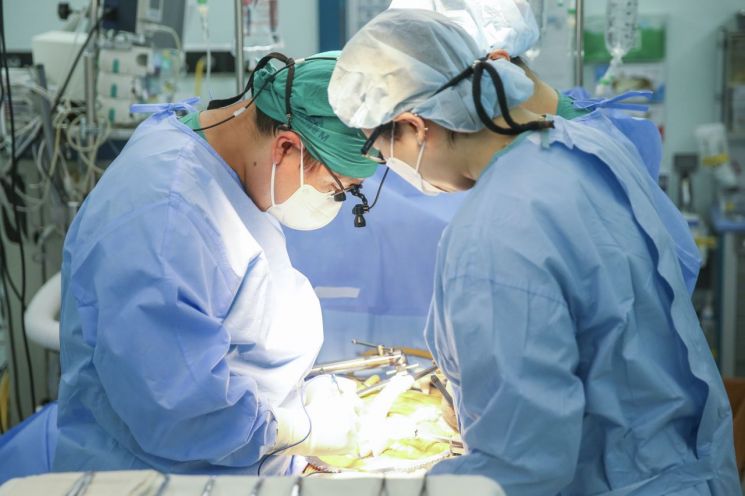
 The Kidney Transplant Team at the Organ Transplant Center of Seoul Asan Medical Center is performing a kidney transplant.
 [Photo by Seoul Asan Medical Center]
[Asia Economy Reporter Lee Gwan-joo] Seoul Asan Medical Center announced on the 10th that it has achieved the first 7,000 kidney transplants in Korea.
The Kidney Transplant Team at Seoul Asan Medical Center's Organ Transplant Center (Professors Kim Young-hoon, Shin Sung, Kwon Hyun-wook, and Ko Young-min of the Kidney and Pancreas Transplant Surgery Department) recently successfully transplanted a kidney from a husband to his wife in her 40s, Kim, who was battling stage 5 chronic kidney disease. Ms. Kim recovered smoothly and was discharged.
Since starting deceased donor kidney transplants in 1990, Seoul Asan Medical Center has performed 5,460 living donor kidney transplants and 1,540 deceased donor kidney transplants. Since 2019, the annual number of kidney transplants has exceeded 400 cases, accounting for one out of every five kidney transplants in Korea.
In particular, kidney transplants are safely performed even for high-risk patients with a high possibility of rejection. Since the first successful ABO-incompatible kidney transplant in 2009, the center has conducted 986 cases, the highest number in Korea, and has performed 353 crossmatch-positive kidney transplants since 2009.
Despite including these high-risk patients, the graft survival rates are 98.5% (1 year), 90% (5 years), and 77.1% (10 years), comparable to the United Network for Organ Sharing (UNOS) graft survival rates of 99.9% (1 year) and 85.4% (5 years) in the United States. Graft survival rate refers to the percentage of patients whose transplanted kidney functions normally without the need for dialysis or re-transplantation after transplantation.
Professor Kim Young-hoon of the Kidney and Pancreas Transplant Surgery Department at Seoul Asan Medical Center said, "The reason we have performed the most kidney transplants in Korea and achieved a high surgical success rate is due to Seoul Asan Medical Center's systematic multidisciplinary system." He added, "All medical staff, including the Kidney and Pancreas Transplant Surgery Department, Nephrology, Infectious Diseases, Laboratory Medicine, Operating Room, Intensive Care Unit, Wards, and Organ Transplant Center, collaborate to treat patients to reduce expected rejection before and after surgery."
He continued, "Recently, the number of patients receiving kidney transplants due to causes such as diabetes and hypertension has steadily increased. Early management of chronic diseases is most important, and if the condition has already progressed to end-stage renal failure requiring dialysis, it is best to receive a kidney transplant as soon as possible."
© The Asia Business Daily(www.asiae.co.kr). All rights reserved.
![Clutching a Stolen Dior Bag, Saying "I Hate Being Poor but Real"... The Grotesque Con of a "Human Knockoff" [Slate]](https://cwcontent.asiae.co.kr/asiaresize/183/2026021902243444107_1771435474.jpg)















