Uganda Invites Korea... Discussing Nuclear Power Cooperation
Project Cost $9 Billion... Site Secured Last Year
"Willing to Cooperate in Uganda... Negotiations Just Started"
[Asia Economy Sejong=Reporter Lee Jun-hyung] Korea Hydro & Nuclear Power (KHNP) is confirmed to be discussing a nuclear power plant project cooperation worth 11 trillion won with the Ugandan government. If KHNP wins the project, Korea will build the first nuclear power plant in East Africa. Analysts say that the Yoon Seok-yeol administration, which is strongly promoting the goal of becoming a 'nuclear powerhouse,' is gaining momentum.
According to related ministries on the 9th, the Ugandan government recently sent an invitation letter to KHNP expressing its intention to visit locally. This is to confirm whether KHNP is willing to participate in the new nuclear power plant project promoted by the Ugandan government. Accordingly, two officials from KHNP's Export Business Headquarters will visit Kampala, the capital of Uganda, from the 10th to the 15th. KHNP plans to meet with local nuclear power authorities such as Uganda's Ministry of Energy and Mineral Development (MEMD) to discuss cooperation plans for the nuclear power project. A KHNP official said, "We are just starting negotiations (with Uganda)," adding, "Uganda said they want to cooperate with Korea to promote the nuclear power project."
Project Cost of 9 Billion USD
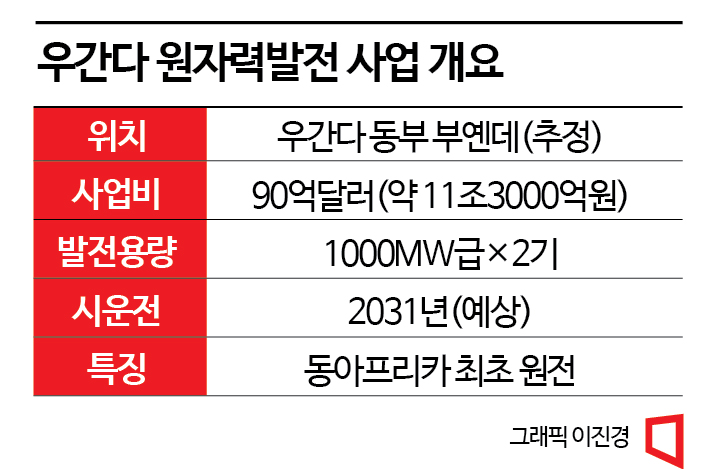
Uganda is promoting a nuclear power project worth 9 billion USD (approximately 11.3 trillion won). It is a project to build two large nuclear power plants, each with a capacity of 1000MW, totaling 2000MW of power generation capacity. In terms of project cost alone, it is about 3 billion euros larger than the Czech nuclear power project (6 billion euros) that KHNP is focusing on.
The Ugandan nuclear power project began gaining momentum after the International Atomic Energy Agency (IAEA) approved the construction of the nuclear power plant in May last year. Following this, the Ugandan government announced in the same month that it had secured a site for the nuclear power plant. They also set a plan to start trial operations around 2031. Considering that nuclear power plant construction usually takes 5 to 8 years, it means that the project operator could be decided as early as next year.
Uganda sent a 'love call' to KHNP because it highly evaluated the competitiveness of the Korean-designed nuclear power plant (APR-1400). In fact, the global competitiveness of the APR-1400 is considered proven through Korea's 2009 contract for the Barakah nuclear power project in the United Arab Emirates (UAE). Units 1 and 2 of the Barakah nuclear power plant have already started commercial operations, and units 3 and 4 are scheduled to begin full operation sequentially this year and next year. Korea's consecutive new nuclear power project contracts in Egypt and Poland last year were also thanks to the strong competitiveness built by successfully constructing and operating the Barakah nuclear power plant.
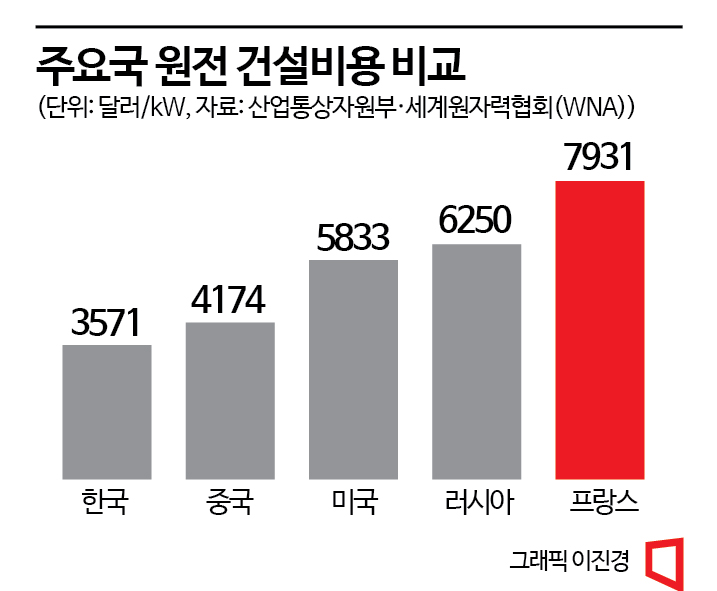
Price competitiveness is also said to have attracted Uganda's attention. According to the Ministry of Trade, Industry and Energy, Korea's nuclear power plant construction cost is 3,571 USD per kW, which is more than 2,000 USD cheaper than major countries such as the United States (5,833 USD), Russia (6,250 USD), and France (7,931 USD). Compared to China (4,174 USD), which boasts one of the world's lowest nuclear power plant construction costs as a competitive advantage, it is about 14.5% lower. The 'On Time On Budget' adherence to the budget and construction period proposed to clients is also a strength of the APR-1400.
Targeting the African Nuclear Power Market
If KHNP wins the Ugandan nuclear power project, it can gain an advantage in the local nuclear power market. Uganda has announced through its mid- to long-term national development plan, 'Uganda Vision 2040,' that it aims to increase nuclear power generation capacity up to 2.4GW. This is to break away from the power supply system centered on hydropower, which accounts for more than 80% of the national development facility capacity, by utilizing domestically deposited uranium. Uganda also expressed its willingness to invest in infrastructure and human resource development for the advancement of the nuclear power industry in Vision 2040. In effect, Uganda has designated nuclear power as its future baseload power source.
Since the current government has set a goal to export 10 nuclear power plants, it is expected to accelerate its efforts to target the rapidly expanding African nuclear power market. Major African countries such as Kenya and Ghana are promoting large-scale nuclear power projects. Due to population growth and economic development, electricity demand is increasing, making stable power supply more important. Currently, the only nuclear power plant on the African continent is the Koeberg nuclear power plant in South Africa.
However, compared to China and Russia, insufficient financial resources are considered a variable. China and Russia, which are actively targeting the African nuclear power market, are enhancing their competitiveness by providing large-scale loans to countries constructing new nuclear power plants. Professor Jeong Dong-wook of the Department of Energy Systems Engineering at Chung-Ang University said, "Not only technology but also financial capacity to provide loans is a factor that determines the success or failure of nuclear power plant exports," adding, "Developing countries in Africa are likely to rely heavily on loans for a significant portion of the nuclear power plant construction costs due to financial issues."
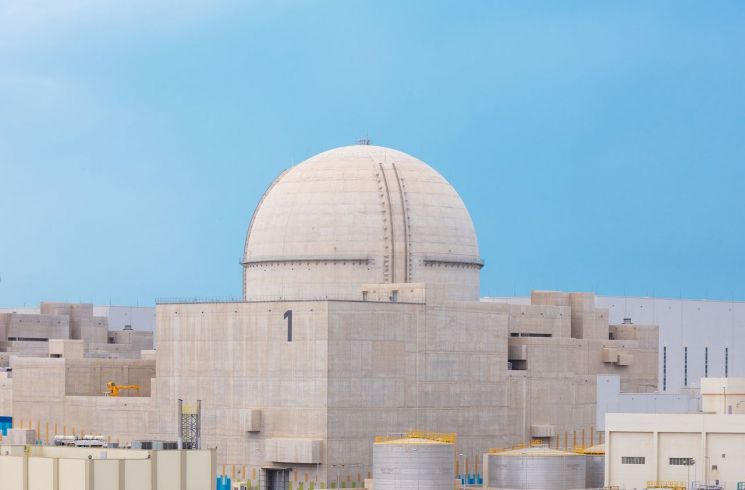 Korea's first exported nuclear power plant, the Barakah Nuclear Power Plant in the United Arab Emirates (UAE).
 [Image source=Yonhap News]
© The Asia Business Daily(www.asiae.co.kr). All rights reserved.
![Clutching a Stolen Dior Bag, Saying "I Hate Being Poor but Real"... The Grotesque Con of a "Human Knockoff" [Slate]](https://cwcontent.asiae.co.kr/asiaresize/183/2026021902243444107_1771435474.jpg)


















