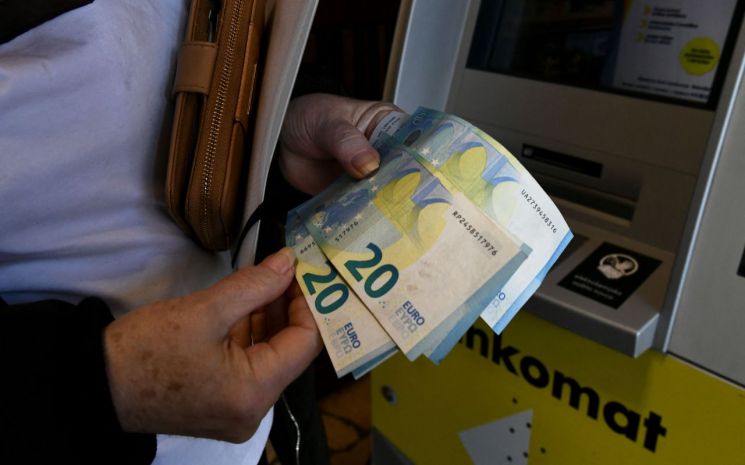
 On the 2nd (local time), a woman is withdrawing euro banknotes from an ATM in Zagreb, the capital of Croatia. From January 1st, the first day of the new year, Croatia officially switched its currency to the euro. Croatia had promised to join the Eurozone when it became a member of the European Union (EU) in 2013, but it was unable to use the euro due to not meeting strict economic conditions such as stable exchange rates. With this change, Croatia became the 20th EU country to use the euro.
 [Image source=Yonhap News]
[Asia Economy Reporter Kim Daehyun] The consumer price inflation rate in the Eurozone (20 countries using the euro) has been found to have slowed for two consecutive months.
On the 6th (local time), Eurostat, the statistical office of the European Union (EU), announced that the consumer price index in the Eurozone for December last year rose by 9.2% (flash estimate) compared to the previous year. The Associated Press explained that the easing of the inflation rate for two consecutive months is the first since June 2021.
The Eurozone consumer price inflation rate set record highs for 12 consecutive months from November 2021 through October last year. However, the increase narrowed slightly to 10.1% in November, and in December, the inflation rate returned to single digits.
By sector, energy prices led the inflation with a 25.7% increase compared to a year earlier. Even this figure has been continuously decreasing from 41.5% in October last year to 34.9% in November and 25.7% in December. This is attributed to the recent mild weather in Europe, which significantly reduced heating demand and continued the downward trend in natural gas prices.
The inflation rate for food, alcohol, and tobacco rose slightly to 13.8% from 13.6% the previous month. Industrial goods increased by 6.4%, and service prices rose by 4.4% compared to a year earlier.
According to the Harmonized Index of Consumer Prices (HICP) used by the European Central Bank (ECB), the estimated inflation rates of major countries show that Germany, the largest economy, saw its inflation rate decrease from 11.3% in November to 9.6% in December. During this period, France's inflation rate eased slightly from 7.1% to 6.7%, Spain's from 6.7% to 5.6%, and Italy's from 12.6% to 12.3%.
The Baltic states of Estonia (17.5%), Lithuania (20%), and Latvia (20.7%) also experienced a reduction in inflation growth compared to the previous month. However, they still remain the most severely affected by inflation within the Eurozone.
Despite assessments that the inflation rate has peaked, the European Central Bank (ECB) is expected to continue its interest rate hike policy for the time being.
ECB President Christine Lagarde stated in an interview with Croatian media on the 1st that the ECB has no choice but to implement additional interest rate hikes to curb inflation and bring it down to the target range of around 2%.
Since July last year, the ECB has raised its key interest rate by 2.5 percentage points. However, at the most recent monetary policy meeting held last month, the ECB slowed the pace by reducing the rate hike from the previous 0.75 percentage points to 0.5 percentage points.
© The Asia Business Daily(www.asiae.co.kr). All rights reserved.
![Clutching a Stolen Dior Bag, Saying "I Hate Being Poor but Real"... The Grotesque Con of a "Human Knockoff" [Slate]](https://cwcontent.asiae.co.kr/asiaresize/183/2026021902243444107_1771435474.jpg)
















