Food and Beverage Industry Index Falls 6% in January
Q4 Earnings Estimates Downgraded, Outlook for This Year Uncertain
[Asia Economy Reporter Hyungsoo Park] While the entire domestic stock market showed a weak trend last month, the food and beverage sector stood out as a representative defensive stock by rising alone. However, this month, the sector has collectively entered a downward trend. Although there were high expectations for fourth-quarter earnings due to price increases last year, it is interpreted that cautionary selling is emerging as the price hikes in raw materials were not properly reflected.
According to the financial investment industry on the 5th, the food and beverage sector index fell 5.97% this month. Considering that the KOSPI rose about 1.26%, this underperformance is more than 7 percentage points compared to the market.
This trend is the exact opposite of last month. From December 1 to 29 last year, while the KOSPI dropped 9.6%, the food and beverage sector index rose 2.99%.
The food and beverage sector has a strong defensive stock characteristic. Even during economic recessions, it is difficult to reduce consumption of essential daily goods like food and beverages, so this sector tends to attract attention when the stock market is sluggish. Looking back at past recession periods, shipments of semi-durable goods such as clothing and furniture decreased, but shipments of food products did not decline. Moreover, following last year’s grain price increases, most food and beverage companies raised product prices, raising expectations for profit margins.
As the fourth-quarter earnings disclosure period approaches, downward revisions of estimates continue. This month, CJ CheilJedang’s stock price fell 11.2%. Hanwha Investment & Securities estimated that CJ CheilJedang recorded consolidated sales of 7.8623 trillion KRW and operating profit of 314.7 billion KRW in the fourth quarter of last year. This represents increases of 13.2% and 33.0%, respectively, compared to the same period last year. Although it performed well compared to the previous year, it fell short of the market expectation of 350.4 billion KRW.
Han Yujeong, a researcher at Hanwha Investment & Securities, explained, "Even reflecting the effect of domestic processed food price increases, sales volume slightly decreased compared to the same period last year," adding, "Entering a sharp consumption recession, there is also a burden of slowing food sales growth due to changes in consumer behavior."
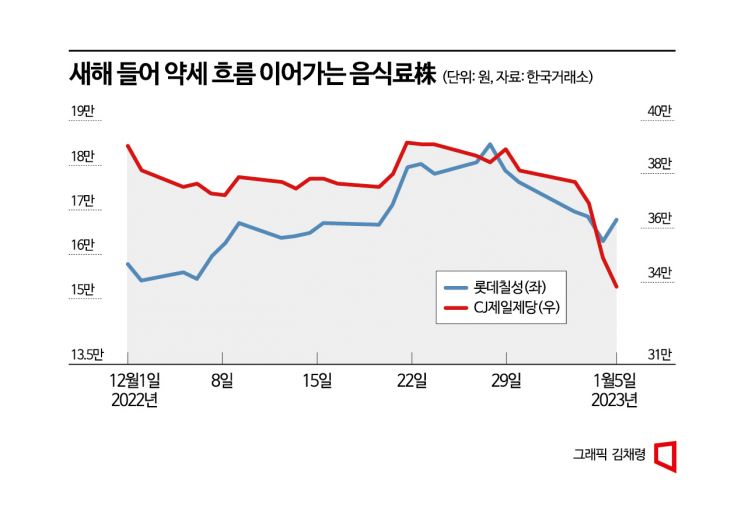
Hanwha Investment & Securities lowered its profit estimates for Lotte Chilsung. It estimated that in the fourth quarter, sales would reach 658.2 billion KRW and operating profit 25.5 billion KRW, increases of 9.8% and 34.4%, respectively, compared to the same period last year. This is about 10% lower than the previous estimate of 27.9 billion KRW.
Besides the downward revision of estimates, the approaching economic recession, which forces even food consumption to decrease, was also cited as a cause of the stock price decline. Amid rapidly rising prices, most consumers are experiencing a decrease in real income due to increased interest expenses from interest rate hikes. It is feared that the capacity for food expenditure will also decrease due to the decline in real income. A researcher analyzed, "Due to inflation, when the cost increases are reflected in food and beverage prices, consumer price resistance is inevitable," adding, "This year, the profitability of food and beverage companies depends on cost control."
© The Asia Business Daily(www.asiae.co.kr). All rights reserved.
![Clutching a Stolen Dior Bag, Saying "I Hate Being Poor but Real"... The Grotesque Con of a "Human Knockoff" [Slate]](https://cwcontent.asiae.co.kr/asiaresize/183/2026021902243444107_1771435474.jpg)















