"Result of Indiscriminate Quantitative Salary Expansion"
 Statistics show that the amount of social insurance premiums borne by our citizens has increased by 47 trillion won over the past five years. Photo by Korea Employers Federation
[Asia Economy Reporter Oh Gyumin] Statistics have revealed that the scale of social insurance contributions borne by our citizens has increased by 47 trillion won over the past five years.
The Korea Employers Federation stated in its report titled "Current Status of National Burden of Social Insurance and Policy Improvement Tasks" that "Considering the demographic crisis caused by low birth rates and aging, indiscriminate quantitative expansion of benefits directly leads to an increase in national insurance premiums and rapid fiscal deterioration," adding, "This undermines the sustainability of social insurance and acts as an obstacle to the virtuous cycle of the national economy."
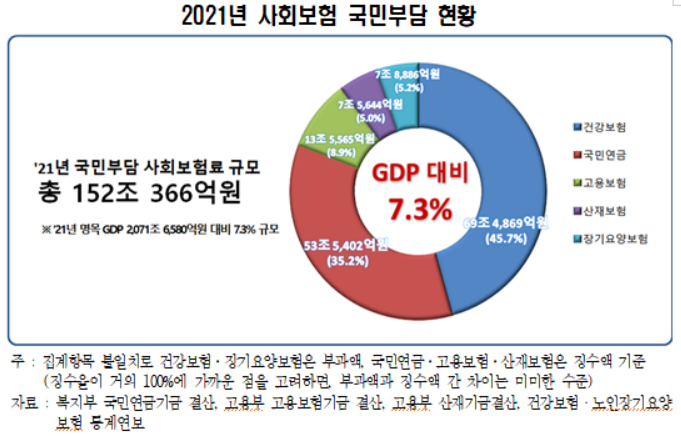
According to the report, the total amount of the five major social insurance contributions borne by our citizens last year was 152.0366 trillion won. This figure represents an 8% increase from 140.7174 trillion won the previous year. Compared to 105.0488 trillion won in 2016, the Korea Employers Federation explained that the national burden increased by 46.9878 trillion won (44.7%) during the five years of the Moon Jae-in administration.
By system, health insurance premiums accounted for 69.4869 trillion won, representing 45.7% of the total social insurance contributions. National pension contributions were 53.5402 trillion won (35.2%), employment insurance 13.5565 trillion won, long-term care insurance 7.8886 trillion won (5.2%), and industrial accident insurance 7.5644 trillion won (5%) in order.
Last year, the social insurance contributions borne by companies (employers) and workers amounted to 124.6376 trillion won, accounting for 82% of the total national burden. Among these, the social insurance contributions purely borne by employers were 67.6541 trillion won, representing 54.3% of the combined labor and management burden and 44.5% of the total national burden.
The Korea Employers Federation analyzed that this increase in burden significantly exceeds the annual inflation rate and GDP growth rate, thus failing to reflect the national economic situation at all. From 2011 to last year, the average annual growth rate of social insurance contributions was 7.7%, about six times higher than the inflation rate (1.3% per year) and about 1.9 times higher than the nominal GDP growth rate (4.1% per year).
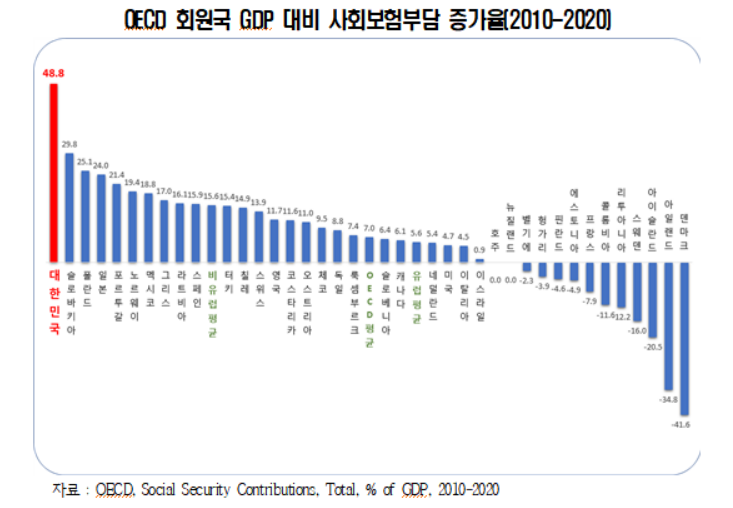
According to 2020 OECD statistics, Korea's social insurance burden relative to GDP was 7.8%, ranking in the middle among all member countries (24th) and in the top tier among non-European members (3rd). Although it falls short of the OECD average of 9.2%, the Korea Employers Federation stated, "It has grown remarkably to a level comparable to the middle tier even when compared to the G7 industrialized countries."
Accordingly, the Korea Employers Federation expressed concern that although direct comparisons are difficult due to differing systems in each country, the pace of increase in Korea's social insurance burden is rapid.
Son Seokho, head of the social policy team at the Korea Employers Federation, said, "Since the insurance premium burden has increased sharply, from now on, the expansion of social insurance benefits must be pursued strictly within the scope of economic growth," adding, "When establishing national plans related to social security, such as the upcoming National Health Insurance Comprehensive Plan and the Long-term Care Basic Plan, the scale of resources required to achieve policy goals and the methods of procurement should be presented together to gain public acceptance."
© The Asia Business Daily(www.asiae.co.kr). All rights reserved.
![Clutching a Stolen Dior Bag, Saying "I Hate Being Poor but Real"... The Grotesque Con of a "Human Knockoff" [Slate]](https://cwcontent.asiae.co.kr/asiaresize/183/2026021902243444107_1771435474.jpg)

















