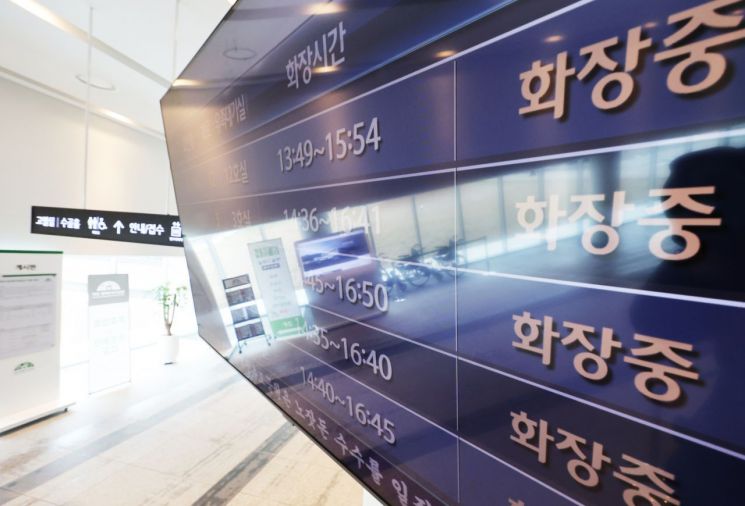
[Asia Economy Reporter Byeon Seon-jin] As "well dying" emerges as a new value, welfare policies "from cradle to grave" are expanding to include "after the grave." The state takes responsibility so that all citizens can prepare for a good death in advance. The Ministry of Health and Welfare announced on the 5th that it will implement the "3rd Comprehensive Plan for the Supply and Demand of Funeral Facilities (2023?2027)" starting from the 6th, which includes these contents.
The Ministry of Health and Welfare has established various funeral cultures such as cremation and natural burial sites, moving away from the traditional burial method after death through the 1st Comprehensive Plan for the Supply and Demand of Funeral Facilities (2013?2017) and the 2nd Comprehensive Plan (2018?2022). The cremation rate, which was 76.9% in 2013, rose to 91.6% last year, and the use of natural burial sites expanded to 24.5% as of 2020.
However, due to low birth rates, aging population, and an increase in single-person households, the funeral environment is rapidly changing, and there have been calls for balanced supply and demand management of funeral facilities by region and period. There is a need to support public funerals for an increasing number of unclaimed deceased, and the surge in cremations due to COVID-19 has revealed regional imbalances in cremation facility supply and demand that require resolution.
"Four Tasks to Prepare for a 'Good Death'"
Accordingly, the government has presented four tasks in line with the changing funeral culture paradigm: strengthening supply and demand management of funeral facilities, improving the quality of funeral services, enhancing national responsibility, and leading funeral culture.
First, the number of cremators, which was 378 last year, will be increased to 430 by 2027 to expand cremation capacity. The Ministry of Health and Welfare sees the urgent need to expand cremators in densely populated metropolitan areas such as Seoul, Gyeonggi, Busan, and Daegu. It will create and manage eco-friendly and demand-centered funeral facilities and solidify management standards. The introduction of "cabinet-type cremators," which address the shortcomings of existing "carriage-type cremators," will also be considered. Plans will be made for differentiated pricing and prioritized national funding to improve cremators. The goal is to expand cremation capacity and add 146,000 natural burial sites and 57,000 enshrinement facilities by 2027.
Second, the quality of funeral services will be improved so that all citizens can prepare for a "good death" in advance. The funeral law will be revised as needed to introduce the concept of funeral welfare, assigning responsibilities to the state and local governments. A permanent advisory body will be established to discover broad funeral policies and discuss current issues, and the funeral policy cooperation network will be strengthened to promote consultation and communication.
Mountain and sea scattering (산분장), which involves scattering ashes in mountains or seas after cremation, will also be institutionalized. The qualification system for funeral directors will be upgraded from the current "time-based non-exam qualification system" to a "national qualification exam system," strengthening the qualification management framework and status. The expertise of funeral support centers and regional entrusted training institutions will be secured, and the quality of education will be ensured by improving education methods and completion cycles.
The third task is to strengthen national responsibility by improving the national disaster response system in the funeral sector. To this end, the Ministry of Health and Welfare will establish a funeral support system and develop manuals to proactively respond to a surge in deaths caused by natural and social disasters and infectious diseases. It will also prepare a metropolitan or regional response system for expanding and operating emergency cremation facilities and secure emergency storage spaces such as indoor cold storage rooms.
Funeral welfare for socially vulnerable groups will be expanded. A standard model for public funerals for unclaimed deceased will be established, and community participation will be activated through cooperation with private organizations, religious groups, and volunteer organizations. The scope of "persons who can conduct funerals (funeral organizers)" will be expanded to respect the self-determination rights of unclaimed deceased, moving away from the current blood-relative-centered funeral culture. The role and function of funeral support centers will be strengthened by designating the Korea Funeral Culture Promotion Institute as a public institution in the future.
The final goal is to lead the establishment of a new funeral culture. In line with environmental changes, the funeral information system will be advanced, and "virtual space and online memorials" using metaverse and artificial intelligence technologies will be activated, moving beyond "place-centered grave visits and memorials" such as cemeteries. Additionally, a system (tentatively called the Advance Funeral Intention Statement) will be introduced to enable people to decide their funeral intentions in advance, laying the foundation for spreading "preparing funerals in advance."
In response to the increase in single-person households and solitary deaths, the government is also considering introducing a "posthumous welfare" pilot project that allows individuals to prepare their own funerals and ensures a dignified death in the community where they lived.
"Comprehensive Plan to be Shared with Local Governments This Month"
The Ministry of Health and Welfare plans to guide local governments on the comprehensive plan and the "Guidelines for Establishing Regional Supply and Demand Plans for Funeral Facilities" within this month, enabling provincial governors and mayors to prepare regional supply and demand plans for funeral facilities under the Funeral Services Act by July. This comprehensive plan was prepared through expert meetings, local government briefings, and public hearings based on the operation of the funeral policy council, policy promotion consulting research, funeral policy idea contests, and public awareness surveys on funeral culture.
Choi Jong-gyun, Director of Population Policy at the Ministry of Health and Welfare, said, "Through the establishment and implementation of the 3rd Comprehensive Plan for the Supply and Demand of Funeral Facilities, we will solidify supply and demand management of funeral facilities and faithfully carry out funeral policies that respond to social changes such as low birth rates, aging population, and the increase in single-person households."
© The Asia Business Daily(www.asiae.co.kr). All rights reserved.
![Clutching a Stolen Dior Bag, Saying "I Hate Being Poor but Real"... The Grotesque Con of a "Human Knockoff" [Slate]](https://cwcontent.asiae.co.kr/asiaresize/183/2026021902243444107_1771435474.jpg)















