Ministry of Agriculture, Food and Rural Affairs Work Report... Presentation of Four Major Policy Goals
Full-Scale Production of Powdered Rice... Expansion of Stockpile to 10,000 Tons
Formation of K-Food Export Headquarters... Minister to Serve as Head
[Asia Economy Sejong=Reporter Lee Jun-hyung] The government will introduce the Strategic Crop Direct Payment System starting this year to strengthen food security. This system provides subsidies when cultivating wheat, soybeans, etc., instead of rice in paddy fields. The agricultural direct payment system, which compensates farmers' income with national funds, will be expanded to a scale of 5 trillion won.
Jung Hwang-geun, Minister of Agriculture, Food and Rural Affairs, reported this major work plan for this year to President Yoon Seok-yeol on the afternoon of the 4th. The Ministry of Agriculture, Food and Rural Affairs' work report included four major policy goals: ▲food security ▲future industrialization of agriculture ▲farm management safety net ▲creation of new rural spaces and strengthening of rural welfare.
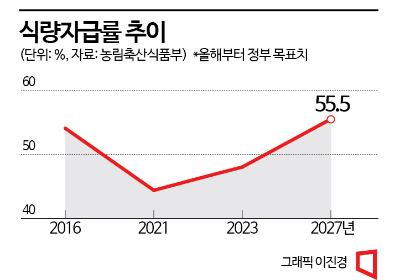
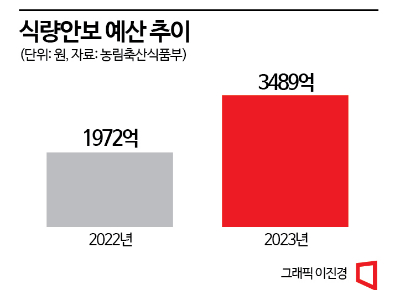
In the work report on the same day, the Ministry of Agriculture, Food and Rural Affairs presented a plan to raise the food self-sufficiency rate to 55.5% by 2027. This is 11.1 percentage points higher than the 2021 food self-sufficiency rate (44.4%). The budget related to food security this year is 348.9 billion won, about 78% more than last year (197.2 billion won). Minister Jung explained in a pre-briefing on the 3rd, "Since the establishment of the Republic of Korea government, the food self-sufficiency rate has continuously declined," adding, "This government aims to reverse (the self-sufficiency rate) for the first time."
Introduction of Strategic Crop Direct Payment System
To improve the food self-sufficiency rate, the Ministry of Agriculture, Food and Rural Affairs decided to newly introduce the Strategic Crop Direct Payment System this year. This system provides subsidies ranging from 500,000 to 4.3 million won per hectare (ha) when cultivating three crops?powdered rice, wheat, and soybeans?in paddy fields instead of table rice. The budget for the Strategic Crop Direct Payment System this year is about 112.1 billion won. Specifically, when double cropping is done by dividing winter crops (wheat, forage crops) and summer crops (paddy soybeans, powdered rice) in paddy fields, 2.5 million won per ha is supported. Summer forage and winter crops receive 4.3 million won and 500,000 won per ha, respectively. Cultivating paddy soybeans and powdered rice receives 1 million won per ha.
Production of powdered rice, a wheat substitute, will also be intensified. The Ministry plans to newly designate 39 specialized powdered rice production complexes this year and expand the cultivation area to 2,000 ha. It will also support the entire process of new product development of powdered rice by private companies. Through these policies, the Ministry aims to replace 10% of domestic wheat flour demand with powdered rice by 2027.
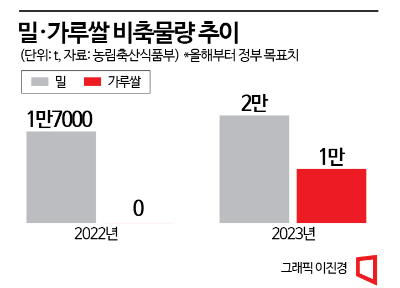
Both wheat production and stockpiling will be expanded. Although demand is steadily increasing, the high dependence on imports is judged to make the supply chain vulnerable to crises. Accordingly, the number of specialized wheat production complexes will increase from 51 last year to 73 this year. The target stockpile of wheat this year is 20,000 tons, 3,000 tons more than last year's 17,000 tons. Powdered rice, which had no stockpile before, will have a new stockpile of 10,000 tons this year.
Overseas grain supply chains will also be expanded. The Ministry plans to increase grain imports through domestic companies from 610,000 tons in 2021 to 3 million tons by 2027. According to the Ministry's plan, grain imports through domestic companies will account for 18% of total grain imports in 2027, a significant increase from 3.5% in 2021.
Promotion of Agricultural Export Industrialization
To foster new agricultural technologies, the distribution rate of smart farms centered on young farmers will also be increased. Accordingly, the Ministry plans to newly establish three regional specialized rental-type smart farms this year and build two youth farmer startup complexes that provide both smart farms and residential spaces. Additionally, a 50 ha open-field smart farm pilot complex will be operated in Naju, Jeollanam-do, within the year, and three new pilot complexes will be designated. To systematically foster and support smart agriculture, the Ministry plans to enact the 'Smart Agriculture Promotion Act' and prepare subordinate laws within the year.
Policies to industrialize agriculture for export will also be promoted. A representative example is the 'K-Food Export Expansion Headquarters' to be established this year by the Ministry. Minister Jung will serve as the head of this headquarters, which will consist of major export companies, local governments, and related organizations. The headquarters will handle tasks such as resolving difficulties in agricultural product exports and discovering public-private cooperative projects. Centered on this headquarters, the Ministry plans to increase agricultural product export revenue from 8.8 billion dollars last year to 15 billion dollars by 2027. Minister Jung said, "If agricultural products are not industrialized for export, prices can fluctuate anytime, and market expansion will also be problematic," adding, "The export target for this year is 10 billion dollars."
"Direct Payment System Roadmap to be Announced within February-March"
Measures for farm management safety nets have also been prepared. The Ministry plans to gradually expand the agricultural direct payment system to a scale of 5 trillion won. The land eligibility condition for the basic direct payment system, which limited payments to farms with direct payment records from 2017 to 2019, will be removed. As a result, about 560,000 farmers are expected to receive an additional 300 billion won in direct payments starting this year. Minister Jung said, "Korea will inevitably move toward the direct payment system (like Europe) in the end," adding, "We will announce the direct payment system roadmap within February to March."
In addition, policy funds amounting to 980 billion won, whose repayment periods are due starting January this year, will have repayment deferred. The Ministry also plans to invest 270 billion won this year to support 80% of the price increase in mineral fertilizers. Loans for feed will be provided at a low interest rate of 1.8%. To resolve labor shortages on farms, the Ministry will collaborate with the Ministry of Employment and Labor to promote a labor matching project for about 50,000 people this year. A Ministry official stated, "The system to expand foreign labor supply will also be expanded," and "We plan to enact the 'Agricultural Labor Support Special Act' to establish systematic agricultural labor support policies."
Minister Jung said, "The Ministry of Agriculture, Food and Rural Affairs has completed preparations to move toward the future through a major organizational restructuring last year," adding, "This year, we will do our best to produce visible results so that agriculture can become an industry contributing to economic growth."
© The Asia Business Daily(www.asiae.co.kr). All rights reserved.
![Clutching a Stolen Dior Bag, Saying "I Hate Being Poor but Real"... The Grotesque Con of a "Human Knockoff" [Slate]](https://cwcontent.asiae.co.kr/asiaresize/183/2026021902243444107_1771435474.jpg)

















