Interview with Russian Deputy Foreign Minister
"No Peace Treaty Negotiations with Japan Participating in Sanctions Against Russia"
[Asia Economy Reporter Yoon Seul-gi] Amid Japan's formulation of a new security strategy through the revision of the three major security documents, including the basic diplomatic and security guideline 'National Security Strategy,' Russia has defined this as a serious challenge to security in the Asia-Pacific region (Asia-Pacific region). Russia warned that it would take countermeasures if Japan's militarization policy continues.
On the 3rd (local time), Andrey Rudenko, Deputy Foreign Minister of Russia, pointed out in an interview with Russia's TASS news agency, "We note that Prime Minister Fumio Kishida's Japanese government is abandoning the peace and development path advocated for decades and accelerating the transition to a militarism-strengthening path."
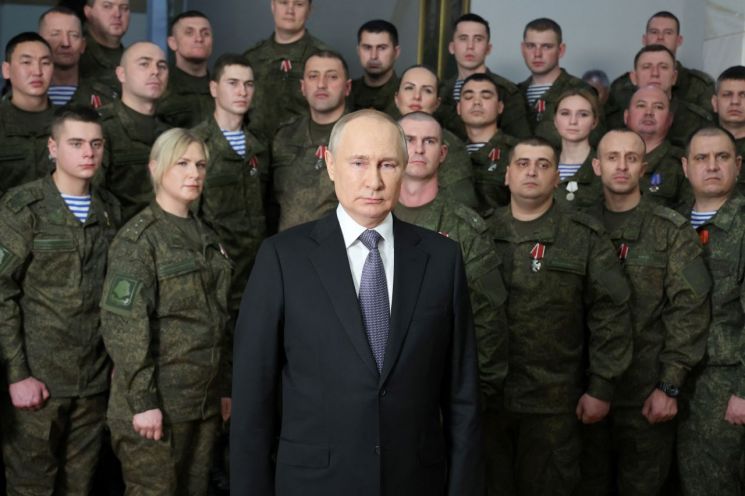 On the 31st of last year (local time), Vladimir Putin, President of Russia, delivered a New Year's speech at the military district headquarters in the southern city of Rostov-on-Don. In his nine-minute New Year's address, President Putin emphasized that the moral and historical justification for the war in Ukraine lies with Russia. Photo by Reuters·Yonhap News
Earlier, on the 16th of last month, the Japanese government decided at an extraordinary cabinet meeting to revise the three major security documents?National Security Strategy, National Defense Strategy, and Defense Capability Development Plan?in a direction that explicitly includes possessing counterattack capabilities capable of striking enemy missile launch bases and significantly strengthening defense capabilities. Subsequently, on the 23rd of last month, it set next year's defense budget at 6.8 trillion yen (approximately 65.7 trillion won). This is the largest defense budget ever and represents a 26% increase from the 5.4 trillion yen defense budget reflected in the 2022 fiscal year budget.
Deputy Minister Rudenko pointed out Japan's militarism-strengthening policies, including large-scale military exercises near the Russian border inviting external partners (such as the United States), revisions of military security doctrines to enhance offensive capabilities, and unprecedented increases in defense spending. He said, "We regard these Japanese activities as a serious threat to the security of Russia and the entire Asia-Pacific region," and warned, "If such policies continue, we will take appropriate countermeasures to block military threats against Russia."
Deputy Minister Rudenko also reiterated Russia's position of refusing to negotiate a peace treaty with Japan regarding the Southern Kuril Islands. This is due to Japan's active participation in Western sanctions against Russia following the Ukraine war. He stated, "It is impossible to discuss peace treaty negotiations with a country that openly shows an unfriendly attitude toward Russia and carries out direct threats." He added, "Since the start of the 'special military operation' in Ukraine, the Kishida government has actively participated in the Western-led anti-Russian campaign, dismantling long-accumulated mutually beneficial cooperative achievements."
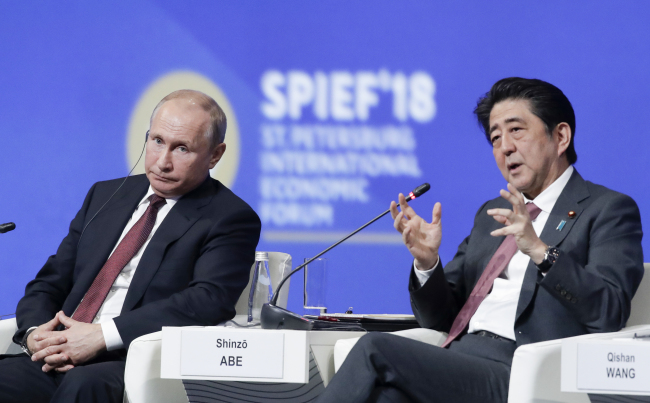 Former Japanese Prime Minister Shinzo Abe and Russian President Vladimir Putin. Photo by AP·Yonhap News
Currently, Russia and Japan have not concluded a peace treaty regarding the Southern Kuril Islands. The Southern Kuril Islands are a territory disputed between Russia and Japan, who fought as enemies in World War II. The two countries attempted negotiations to resolve the territorial dispute and conclude a peace treaty during former Prime Minister Shinzo Abe's administration, but no results were achieved. In March, Russia declared the suspension of peace treaty negotiations, citing Japan's participation in Western sanctions against Russia.
Deputy Minister Rudenko also commented on South Korea's policy toward Russia after the Ukraine war. He said, "Under strong pressure from the United States to separate South Korea from Russia, the South Korean leadership had no choice but to participate in Western sanctions following the Ukraine situation."
He continued, "At the same time, we have witnessed South Korea pursuing a balanced and pragmatic approach toward Russia, seeking to prevent a rapid reduction in relations with Russia and find ways to minimize damage caused by Western sanctions in bilateral cooperation." He emphasized, "We share a similar view and, amid the complex and rapidly changing international situation, Russia remains interested in developing stable and mutually beneficial relations with both countries on the Korean Peninsula."
© The Asia Business Daily(www.asiae.co.kr). All rights reserved.


















