Foreign Exchange Reserves Increase by 7.06 Billion USD in One Month
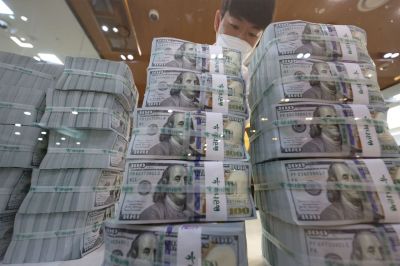
Last month, South Korea's foreign exchange reserves increased by more than $7 billion, continuing an upward trend for the second consecutive month. This was due to a weaker dollar amid the U.S. Federal Reserve's (Fed) slowdown in tightening, which reduced market intervention by foreign exchange authorities, and an increase in the U.S. dollar valuation of South Korea's foreign currency assets.
According to foreign exchange reserve statistics released by the Bank of Korea on the 4th, as of the end of December last year, the foreign exchange reserves stood at $423.16 billion, up $7.06 billion from the end of the previous month. After three consecutive months of decline from August last year, the reserves rebounded in November and have increased for two consecutive months since then.
The foreign exchange reserves had increased to about $469.2 billion in October 2021 but then continuously declined due to the sharp rise in U.S. interest rates. As the dollar value surged and the won-dollar exchange rate surpassed 1,400 won, the foreign exchange authorities actively intervened in the market by selling dollars to defend the exchange rate.
As a result, the foreign exchange reserves decreased by $19.66 billion in September last year alone, marking the largest decline since the financial crisis in October 2008, when reserves fell by $27.4 billion.
However, as the recent dollar strength has eased, the foreign exchange reserves have started to increase again. The Bank of Korea explained, "Despite temporary decreases due to factors such as foreign exchange swaps with the National Pension Service, the foreign currency deposits of financial institutions and the U.S. dollar valuation of other currency foreign assets increased, leading to a rise in foreign exchange reserves."
In December last year, the U.S. dollar depreciated by about 2.8% (based on the U.S. dollar index), meaning that the foreign currency assets converted into U.S. dollars increased accordingly. The won-dollar exchange rate fell to 1,271 won at the previous day's closing price, reducing the need for exchange rate defense, which also contributed to the increase in foreign exchange reserves.
Breaking down the foreign exchange reserves by asset type, securities such as government and corporate bonds ($369.69 billion) increased by $4.07 billion compared to the previous month.
Deposits ($29.35 billion) rose by $2.67 billion, and special drawing rights (SDR, $14.84 billion) and the International Monetary Fund (IMF) reserve position, which is the right to draw convertible currency from the IMF ($4.49 billion), also increased by $190 million and $130 million, respectively.
Gold was recorded at $4.79 billion, the same as the previous month, because it is valued at the purchase price rather than the market price. The Bank of Korea has not purchased gold for about 10 years since February 2013.
As of the end of November last year, South Korea's foreign exchange reserves ranked 9th in the world. Although South Korea's reserves increased, most other countries also saw increases, maintaining the same ranking as the previous month.
China had the largest reserves at $3.1175 trillion, followed by Japan ($1.2263 trillion), Switzerland ($905.9 billion), Russia ($567.3 billion), India ($553.2 billion), Taiwan ($552.2 billion), Saudi Arabia ($471 billion), and Hong Kong ($423.2 billion).
© The Asia Business Daily(www.asiae.co.kr). All rights reserved.
![Clutching a Stolen Dior Bag, Saying "I Hate Being Poor but Real"... The Grotesque Con of a "Human Knockoff" [Slate]](https://cwcontent.asiae.co.kr/asiaresize/183/2026021902243444107_1771435474.jpg)















