Nonggyeongyeon '2Q Processed Food Expenditure Status' Report
Impact of Increased Fresh Food Spending and Dining Out
Highest Spending Age Group is in Their 40s
Kim Sung-gyu (29, male), an office worker who has been living alone in Seoul for five years, recently found himself worried after seeing a sharp increase in his credit card bills. Although he had been living an ordinary life with a similar daily routine, he was surprised to find that his food and dining expenses had significantly increased compared to before. While he works and earns a salary to make a living, the rising prices almost every day have made it even harder to get by. As a result, Kim canceled a planned tour of famous restaurants in downtown Seoul with friends this weekend to celebrate the New Year.
During the COVID-19 pandemic, the average monthly food expenditure of households headed by people in their 20s increased significantly. This is interpreted as being influenced by rising prices and increased dining-out expenses.
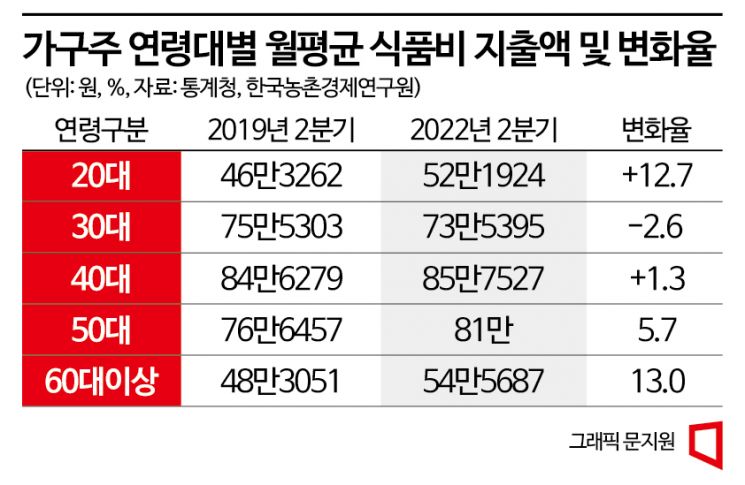
According to an analysis of the "2022 Q2 Household Processed Food Expenditure Status and Characteristics" report released by the Korea Rural Economic Institute on the 2nd, the food expenditure of households in their 20s in Q2 last year was 521,924 KRW, a 12.7% increase from 463,262 KRW in Q2 2019, when COVID-19 began.
The sharp increase in expenditure among people in their 20s was influenced by a rise in fresh food spending (20.8%) and dining out (15.4%).
Breaking down food expenses, in Q2 last year, the real expenditure on fresh food was 156,243 KRW, processed food was 190,116 KRW, and dining out was 351,750 KRW. While fresh and processed food expenditures slightly decreased compared to Q1, dining-out expenses increased by 19.8% (55,234 KRW) from Q1.
Looking at changes in processed food expenditure by category in Q2 compared to Q2 2019 before COVID-19, most processed food expenditures increased. In particular, expenditures on oils and fats (72.0%), alcoholic beverages (27.8%), other foods (26.6%), and grain processed products (24.3%) increased significantly, reflecting household eating habits and the rising trend of drinking alone (hon-sul).
The age group with the highest average monthly food expenditure was people in their 40s. Households in their 40s spent 857,527 KRW, a 1.3% increase compared to 846,279 KRW in Q2 2019 before COVID-19.
Following were the 50s (810,020 KRW), 30s (735,395 KRW), 60 and older (545,687 KRW), and 20s (521,924 KRW).
Looking at the expenditure trends of the top 30 items by average monthly household spending in the first half of last year, expenditures on bread and other bakery products, Korean traditional sweets (hangwa) and other snacks, other processed meat products, and instant/frozen foods increased. Meanwhile, milk, alcoholic beverages, and other seasonings decreased.
With the increase in home meals due to COVID-19, consumption of most items such as other processed meat products, instant/frozen foods, side dishes, tofu, and kimchi increased significantly compared to 2019, but as the pandemic prolonged, the impact gradually diminished.
Among the top 30 items, the top five by average monthly expenditure were "bread and other bakery products (18,243 KRW)", "hangwa and other snacks (13,730 KRW)", "other processed meat products (10,358 KRW)", "instant/frozen foods (9,971 KRW)", and "milk (9,381 KRW)". Among these, bread and other bakery products and hangwa and other snacks increased by 8.9% and 2.8% respectively compared to the same period last year, while instant/frozen foods remained almost the same with a -0.6% change, and milk decreased by 2.4%.
Among the top expenditure items, processed fruit products (-14.2%), processed vegetable products (-11.2%), other seasonings (-13.2%), and side dishes (-1.0%) increased compared to 2019 but decreased compared to the same period last year.
With the easing of COVID-19, alcohol consumption outside the household increased, leading to a decrease in household consumption of beer (-4.2%) and soju (-2.3%) compared to the previous year.
The real expenditure share by food type showed that dining-out expenses accounted for 50.4%, an increase of 3.8 percentage points compared to the same period last year. The share of processed food expenditure was 27.2%, and fresh food was 22.4%, both decreasing by 1.9 and 1.8 percentage points respectively compared to the previous year.
Real food expenditure by income quintile showed that households in the lowest 20% income group (1st quintile) spent 364,442 KRW, 2nd quintile 514,198 KRW, 3rd quintile 677,065 KRW, 4th quintile 849,887 KRW, and 5th quintile 1,084,627 KRW.
Jung So-young, a researcher at the Korea Rural Economic Institute, said, "Since the second half of last year, the consumer price index for processed foods and dining out has risen sharply, and with the continuous increase in raw material prices and the rise in the base interest rate, the real share of dining-out expenditure in Q2 this year showed the highest level since before COVID-19 in 2019."
© The Asia Business Daily(www.asiae.co.kr). All rights reserved.
![Clutching a Stolen Dior Bag, Saying "I Hate Being Poor but Real"... The Grotesque Con of a "Human Knockoff" [Slate]](https://cwcontent.asiae.co.kr/asiaresize/183/2026021902243444107_1771435474.jpg)















