A Total of 70,000 Cases Last Year... Approximately 160,000 Cases Decrease Compared to Previous Year
'Yeongkkeul' Focused Areas No·Do·Gang Near 80% Decrease
Government Soon to Announce Deregulation of Restricted Areas... "Revitalization Difficult"
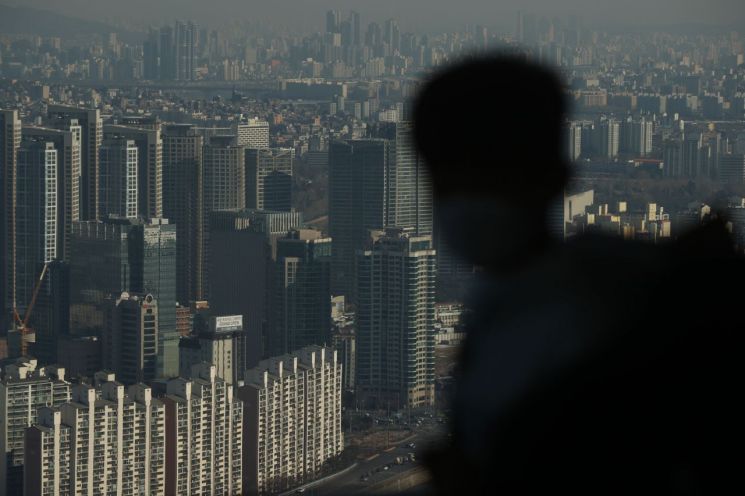
[Asia Economy Reporter Lim On-yu] As the government is set to announce measures to address the ‘real estate transaction cliff,’ it has been revealed that apartment transactions in Seoul and Gyeonggi Province last year decreased by 70% compared to the previous year. In particular, the ‘Nodogang’ (Nowon, Dobong, Gangbuk districts) area of Seoul, where the 2030 generation ‘young-chul’ buyers were concentrated, saw a decline rate approaching 80%. The imbalance, with sellers but no buyers, is intensifying, raising warning signals of a hard landing in the real estate market.
◆Beyond the transaction cliff to transaction extinction: "41 apartment transactions per day in Seoul"= On the 2nd, Asia Economy analyzed housing transaction data from the Korea Real Estate Board and Seoul and Gyeonggi real estate portals, finding that last year’s apartment sales volume in Seoul and Gyeonggi totaled 70,878 transactions, a 69% (157,666 transactions) decrease compared to 228,544 transactions the previous year. Compared to 2020, when the real estate market was booming due to rapid price increases, the decline rate reached 81.3%.
By region, Seoul’s transactions dropped from 49,751 to 14,868, a 70.1% (34,883 transactions) decrease. The average daily apartment sales, which used to be 136 transactions, sharply shrank to 41. Especially, the transaction volume in Nodogang, a mid-to-low priced apartment dense area where young buyers surged during the housing price boom, froze severely. Dobong District’s transactions fell from 2,095 to 416, Nowon District from 4,434 to 882, both showing a decline rate of 80.1%. Gangbuk District dropped from 1,094 to 243, a 77.8% decrease.
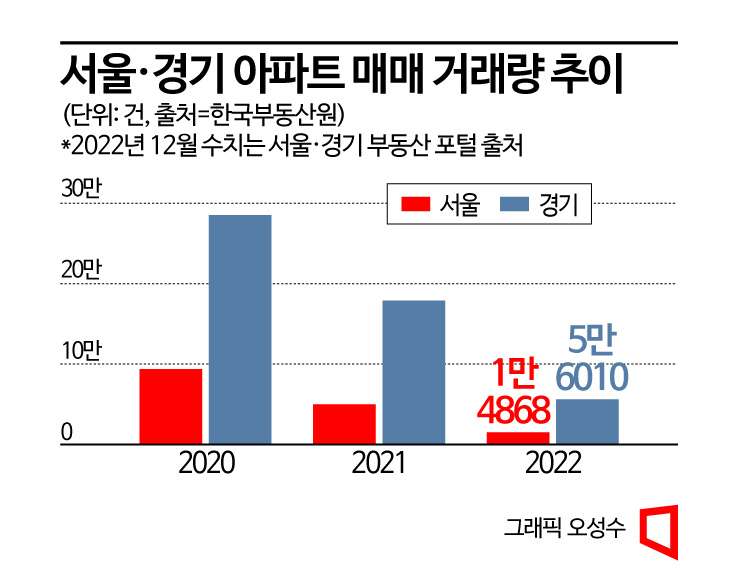
In Gyeonggi Province, apartment sales volume was 56,010 transactions, down 68.6% from 178,793 transactions the previous year. The average daily apartment purchases, which reached 490, froze to 153 transactions. Particularly notable was the transaction cliff in Gwangmyeong and Seongnam’s Bundang and Sujeong districts, which are also designated as regulated areas along with Seoul. Gwangmyeong’s transactions plunged from 2,681 to 673, a 74.9% drop, and Bundang and Sujeong districts fell from 5,754 to 1,622, a 71.8% decrease.
In the era of high interest rates, the burden of interest payments has greatly increased, pushing the real estate market beyond a serious transaction cliff to the brink of transaction extinction. The supply-demand imbalance continues with sellers but no buyers, causing housing prices to trend sharply downward. According to the Korea Real Estate Board, the cumulative decline rate in sales prices in Seoul and Gyeonggi as of the fourth week of December last year was 7.20% and 9.61%, respectively. Especially, in Nowon District and Gwangmyeong, where the transaction cliff is severe, the decline rates reached 12.02% and 15.41%, respectively.
◆"We will resolve the transaction freeze"... Will Seoul’s regulated areas be lifted in January?= The real estate transaction cliff not only restricts freedom of residence relocation but also leads to contraction in related industries such as real estate brokerage, construction, and interior design, placing a heavy burden on South Korea’s economy. In response, Minister of Land, Infrastructure and Transport Won Hee-ryong promised on the 1st, "We will soon announce measures to resolve the transaction freeze and unsold properties."
The government’s announced plan is to lift real estate regulation areas as soon as possible. Earlier, when announcing the 2023 economic policy direction, the government hinted at the possibility of lifting regulation in some parts of Seoul, Gwacheon, Seongnam’s Sujeong and Bundang districts, Hanam, and Gwangmyeong.
However, experts believe that since the high interest rate environment, a major cause of the real estate market stagnation, will persist, deregulation alone is unlikely to stimulate transaction activity. Yang Ji-young, head of Yang Ji-young R&C Research Institute, said, "In a situation where loan interest burdens may increase further, lifting regulation areas may cause homeowners to withdraw their listings but will not move buyers’ minds." Lee Eun-hyung, a research fellow at the Korea Institute of Construction Policy, said, "Loan regulations have already been eased, so the visible effects of lifting regulation areas will not be significant. Especially with the major variable of US interest rate hikes, it will be difficult for the real estate market to move according to government policies."
© The Asia Business Daily(www.asiae.co.kr). All rights reserved.
![Clutching a Stolen Dior Bag, Saying "I Hate Being Poor but Real"... The Grotesque Con of a "Human Knockoff" [Slate]](https://cwcontent.asiae.co.kr/asiaresize/183/2026021902243444107_1771435474.jpg)

















